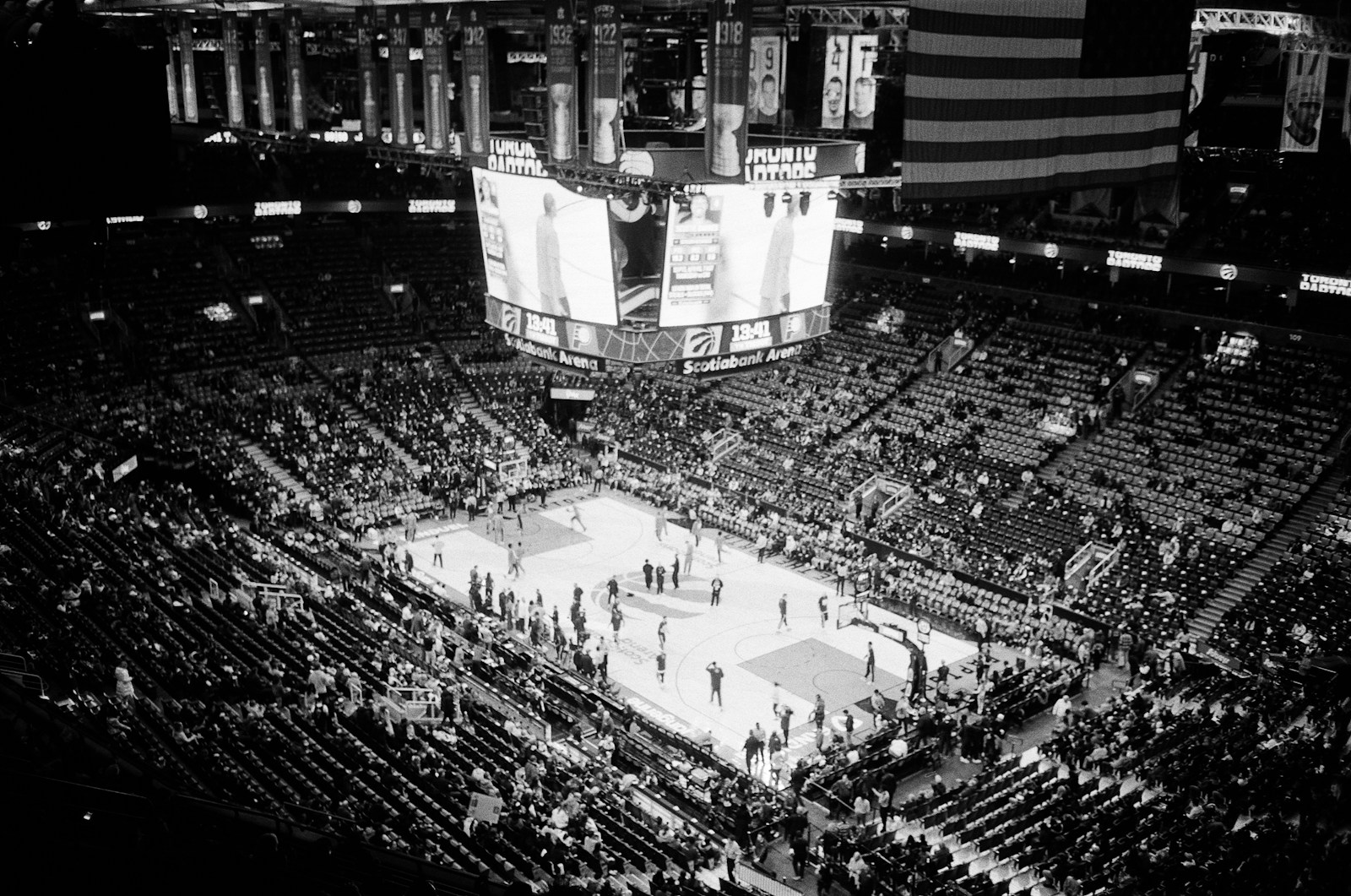

Scottie Barnes signed a five-year, $225 million extension in October 2024. It was the largest contract in Toronto Raptors history. The math on the announcement said this was a franchise-altering commitment to a 23-year-old All-Star with two-way upside. The math on the next twelve months said something more complicated. The Raptors went 46-36, lost in the first round to Cleveland 3-4, and finished the regular season in exactly the place the NBA’s middle class always finishes — too good to pick high, not good enough to scare anyone in May.
That contract, signed before Barnes’s third NBA season, was an enormous bet on a player whose ceiling is real but whose 2025-26 box-score profile improved less than the price tag implied it would. The Brandon Ingram trade in February 2025, which cost Toronto Kelly Olynyk, Bruce Brown, a 2026 first-round pick and a 2031 second, locked in the rest of the roster decision. The Raptors are now committed to a Barnes-Ingram-Quickley core that is comfortably good enough to win 46 games and structurally unable to win 56.
This is the NBA mid-tier trap, expressed in fluent Toronto. Here is how the numbers landed there, why the way out is harder than the way in, and what the public analytics community is missing about the way modern cap inflexibility punishes teams that pay early.
The math that the contract assumed
The Barnes extension was negotiated on the assumption that his player profile scales the way a typical All-Star wing scales between age 23 and 27. The comparable comp set that gets cited internally — and externally on the press-conference summer 2024 — was the band of two-way wings who jumped from “very good young starter” to “second-best player on a contender” between their third and sixth NBA seasons.
That band exists. Pascal Siakam made the jump. Jaylen Brown made the jump. The list is shorter than the narrative implies. About one in three All-Star wings under 25 with Barnes’s profile (defensive versatility, secondary playmaking, average outside shooting) actually makes the second jump. The other two-thirds plateau at the All-Star level, which is what Barnes appears to have done across 2025-26.
The 2025-26 numbers tell a clean version of the plateau story. Box score improvements were marginal across the board — true shooting percentage held roughly flat, three-point volume increased without the efficiency catching up, defensive impact metrics softened slightly as the team leaned on him for more offensive load. Our usage-rate piece on how on-ball volume can mask efficiency covers exactly the pattern that Barnes’s season produced. The contract did not anticipate the plateau. The plateau happened anyway.
The trade that locked in the floor
The Brandon Ingram acquisition in February 2025 is the move that turned the Raptors from “young team in flux” to “mid-tier team committed to a window.” Ingram is a 26-year-old All-Star scorer with a real offensive ceiling and a real defensive limitation. The fit with Barnes works for stretches and breaks down in the half-court when both need usage. Immanuel Quickley, signed to a five-year, $175 million extension before the 2024-25 season, is a high-quality starting guard who plays meaningful minutes but is not the third star a contender needs.
The salary commitments through 2028-29 now sit at roughly:
| Player | Through | Annual avg | Status |
|---|---|---|---|
| Scottie Barnes | 2029-30 | $45M | Max-tier, plateaued |
| Brandon Ingram | 2027-28 | $36M | All-Star scorer, fit limit |
| Immanuel Quickley | 2028-29 | $35M | Quality starter |
| RJ Barrett | 2026-27 | $28M | Solid wing |
| Jakob Poeltl | 2026-27 | $19M | Center, fit-dependent |
That is roughly $163 million committed to the top five, with a salary cap that will likely sit around $158 million in 2026-27. The Raptors are operating as an over-the-cap team with no realistic path to opening cap space for the next three summers. The 2026 first they hold (19th overall) is the most-leveraged single asset they have left, and a 19th pick is not historically the kind of asset that turns a 46-win team into a 56-win team.
What the NBA’s mid-tier trap actually looks like
I have written some version of the NBA mid-tier trap piece roughly once a year for the last three years, and every time the framing in the analytics community is the same: it is a draft-position problem: a team is too good to land an elite prospect and not good enough to develop one through real playoff minutes. That framing is incomplete. The deeper trap is cap inflexibility under the new collective bargaining agreement’s second-apron restrictions.
A team paying max-tier money to a plateaued young All-Star, near-max money to a second All-Star with limited two-way fit, and near-max money to a quality starting guard does not have the tools to add the third star a contender needs. The trade exception is too small. The first-round picks are mostly traded or restricted. The mid-level exception goes to a fourth or fifth starter, not a difference-maker.
The team that wins 46 games and loses in the first round is not the worst place to be in the NBA. The team that wins 46 games and loses in the first round with no flexibility to move is the second-worst, behind only the team that is bad and capped out. Toronto is currently in band two.
Where this gets weird
Three nuances complicate the clean mid-tier trap story, and the Raptors specifically have a version of each that the league at large does not.
First, Scottie Barnes can still make the jump. The plateau read is the modal outcome based on the comp set, not a verdict on the player. Defensive impact for wings often jumps non-linearly between ages 24 and 26 as basketball IQ catches up to physical tools. If Barnes adds a reliable corner three at 36% volume in 2026-27, the All-Star plateau ceiling moves materially. The contract bet was not unreasonable. It was just a 33% bet priced at 70% confidence.
Second, the Eastern Conference is unusually soft right now. Cleveland is good but injury-prone. The Knicks are an aging core. Boston is in transition. Milwaukee is a Giannis health bet. A 46-win Toronto team could plausibly win two playoff series in a conference where the second seed wins 50 games. The mid-tier trap is sharper in the West than in the East, and the Raptors are in the right conference.
Third, the new CBA punishes the highest-payroll teams more than it punishes the middle. The Raptors are projected to sit just under the first apron through 2027-28. That is uncomfortable but operationally workable — they can still execute mid-sized trades, sign-and-trades, and full mid-level exceptions. The teams that are actually trapped are the ones above the second apron with frozen first-round picks.
What the next twelve months looks like, in numbers
Four things to watch over the 2026-27 season, in order of leverage.
- Barnes’s three-point profile. The single highest-leverage number in the entire franchise. If volume and efficiency both move up — 5.5 attempts at 36% — the contract starts to look defensible. If they hold flat, the structural problem deepens.
- Ingram-Barnes lineup data. The pairing’s on-court net rating in 2025-26 was uncomfortable. The off-court data was better. That pattern is the cleanest argument for or against the core’s fit, and 800+ shared minutes in 2026-27 is the sample where the pattern stops being noise.
- Quickley as third option. A quality starting guard can be a third option on a contender if the first two options scale. The 2026-27 season is the trial period.
- The trade deadline asset board. What the Raptors can offer for a difference-maker in February 2027 is the cleanest test of the Masai Ujiri front-office plan. If the answer is “the 2027 first and a salary match,” the rebuild has crossed into the operational mid-tier trap.
The callback
The October 2024 press conference, with the $225 million number behind the podium, was sold as a franchise commitment to the next generation. Twelve months later, it looks more like the moment Toronto paid the asking price of a window that could turn out to be flat. The bet on Barnes is the bet most front offices would have made with the same information. The bet on Ingram is the bet most front offices would have made under the same trade-deadline pressure. The bet that they scale together is the bet the next twenty-four months have to settle. The lineup synergy piece covers the math. The Raptors are not the worst team in the NBA. They are the most expensive 46-win team in it. That is a different problem, and it has a much longer half-life.
Salary cap data via Spotrac; lineup data via Basketball Reference; CBA restriction context via NBA.com.