Read a week’s worth of coverage from any preseason access event and a pattern emerges that has nothing to do with the sport. The pieces sort themselves into five recognisable shapes, year after year, across leagues and across countries. Somebody is in the best condition of his career. Somebody is adapting to a new voice in the building. Somebody has noticed that outsiders are not expecting much.
The obvious explanation is laziness, and it is wrong. The pattern comes from the room. A media day is a logistics solution before it is a journalistic occasion, and its design determines what can be produced inside it far more tightly than any individual reporter’s ambition does.
Understanding that design is useful in both directions. It tells reporters where the genuinely new material is hiding, and it tells readers which of the pieces in front of them contains something that could only have been written this year. That second test turns out to filter very aggressively.
The session in six lines
- The purpose is supply. One day, one venue, and a season’s worth of quotes, photographs and video produced in a block.
- The design goal is throughput. Every format decision follows from moving many players past many outlets quickly.
- Someone else controls the clock. A communications staffer opens the session, calls the questions and ends it.
- There is no news to report. Nothing has been played, so the available material is limited by definition.
- Five story types exhaust that material. The body, the change, the expectation, the relationship and the past.
- The test for anything new is whether it contains a checkable specific that could not have been said last year.
What a preseason media day is built to produce
Before it is anything else, a preseason media day is a scheduling answer to a supply problem. Broadcasters need portrait and action footage for graphics packages that will run all season. Photographers need a library. Club channels need content. Wire services need copy. Doing all of that piecemeal across a training camp would be impossible, so it gets compressed into a single controlled day.
That compression is the whole story. Throughput is the design constraint, and every visible feature of the event serves it: short timed sessions, rotating stations, a moderator keeping the line moving, and a physical layout that treats players as a queue.
None of that is sinister. It is a room built to manufacture a specific set of outputs efficiently, and it does that well. The mistake is expecting depth from a format that was engineered for volume, and then blaming the participants when it does not arrive.
Who is actually running the session
The schedule belongs to the communications department, of the club or of the league depending on the event. They decide which players appear at which station, in what order and for how long. That is an editorial decision made before any question is asked.
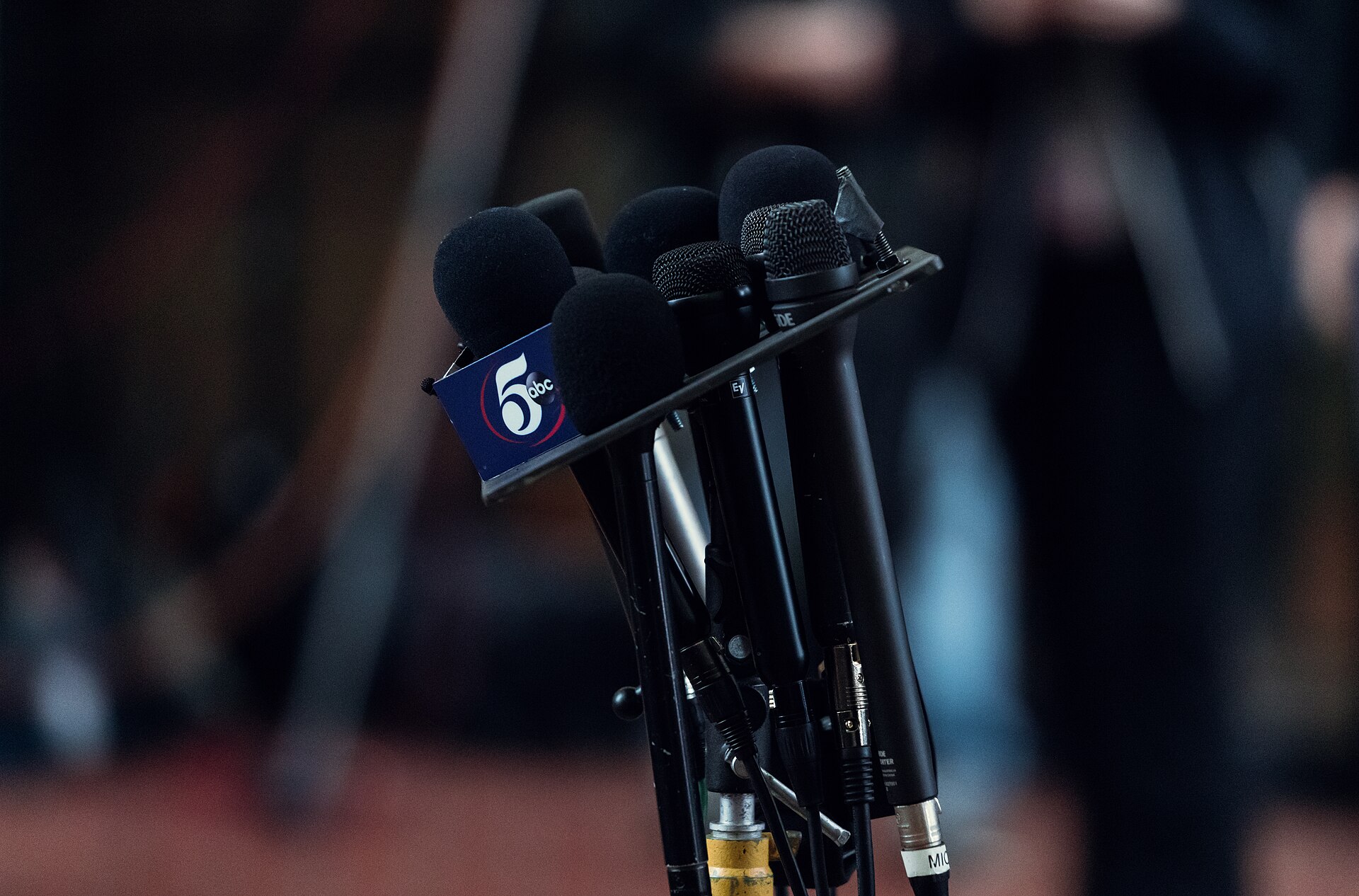
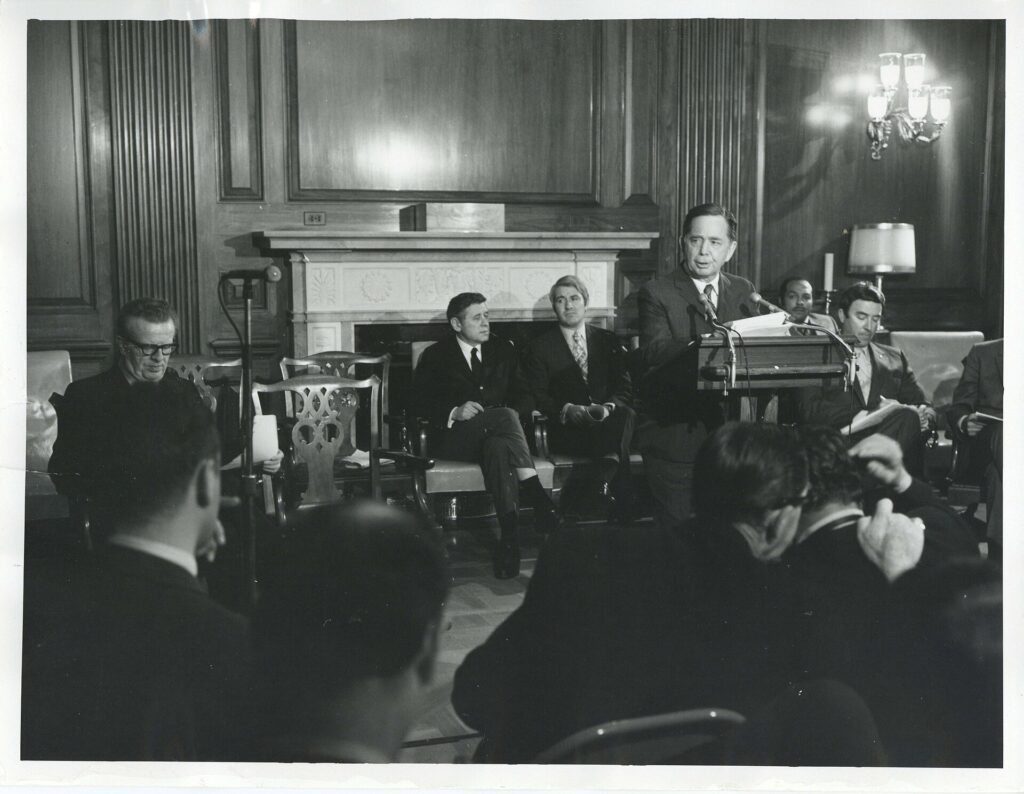
Inside a podium session, the moderator holds two levers: who gets called on, and when the session ends. Both are usually exercised politely and both are decisive. A reporter who is not called does not ask, and a session that ends after eight questions ends whether or not the eighth was interesting.
Two other parties sit in the room with different incentives. Rights-holding broadcasters typically have priority windows written into their agreements, so they get the first and cleanest access. Club-owned media operate in parallel and are not neutral participants: they are producing material for the organisation that employs them, which is legitimate and worth labelling when their footage is later used as though it were independent.
The floor plan, station by station
| Station | Format | What it reliably produces | What it cannot produce |
|---|---|---|---|
| Main podium | Moderated, elevated, all cameras rolling | The headline quote and broad answers | Depth, because follow-ups are rationed |
| Breakout table | Small standing or seated group, longer window | Detail, colour and usable specifics | Exclusivity, since everyone hears it |
| Booked one-on-one | A single outlet in a set slot | Polished video and a planned line of questioning | Spontaneity, and often candour |
| Rights-holder circuit | Rotating set positions, very short stops | Branded promotional segments | Journalism in any recognisable form |
| Portrait set | Silent, no questions asked | The season-long image library | Anything verbal at all |
| Mixed zone at events | A corridor athletes pass through | Unmoderated, immediate reaction | Time, and any control over conditions |
Match the station to the story you are reading and a lot becomes clear. A piece built entirely on podium answers will be broad by construction. A piece with a specific procedural detail almost certainly came from a breakout table or a mixed zone, where somebody had the seconds to ask a second question.
The five that come back every year
One: the offseason body
The condition story is the most reliable output of the entire event, and the format generates it mechanically. Players arrive after months out of view, the portrait set documents any visible change, and the opening question in most sessions is some version of asking what the summer looked like.
It is not a fabricated genre. Bodies do change over an offseason and preparation does vary. What makes it recycled is that the story exists whether or not anything changed, because the question is asked regardless and any answer at all fills the slot.
Two: the new voice in the building
Change is the only subject at a preseason event that is genuinely new by definition, so any change gets covered heavily: a new head coach, a new coordinator, a new system, a player in a new role. This is usually the most substantive of the five and the one worth reading first.
Three: nobody believed in us
This one is manufactured by the question rather than by the answer. A reporter hands over a premise, asking what a player makes of outside projections that place the team low, and the reply necessarily engages with that premise. The resulting quote gets reported as a statement of defiance when it was a response to a framing supplied from the floor.
Four: the veteran and the rookie
Mentorship stories are produced by proximity and by need. Seating plans put newcomers next to established players, club media pair them deliberately for content, and reporters covering an unfamiliar name need an angle that does not depend on performance nobody has seen yet. All three pressures point at the same story.
Five: unfinished business
With no future available to report, the past gets used instead. A season that ended badly becomes a motivational frame; a season that ended well becomes a burden to carry. Both versions are retrospective, both are unfalsifiable in September, and both are guaranteed to be produced because the question about last season always gets asked.
Why five, and why these five
The count is not arbitrary and it is not a stylistic observation. At a preseason event nothing has been decided and nothing has been played, so there is no news in the ordinary sense. That leaves a very short list of available raw materials: the body, the change, the expectation, the relationship and the past.
Those five categories exhaust what the room contains. Any sixth story type would have to come from information generated outside the event, which is why genuinely different preseason pieces are almost always reported somewhere else and merely stitched to a media day quote.
Recognising the structure changes how you value the coverage. A story in one of the five shapes is not automatically bad, but it does need something specific inside it to justify existing. Without that, what you have is a format producing its default output, which is roughly what happens with any content pipeline built for volume.
The question decides the answer you get
Interviewing at these events is constrained to a handful of exchanges, so question design carries almost all of the weight. A closed question gets a one-word answer, and there is no time to recover from it.
The most costly habit is the loaded premise. A question shaped like how frustrating was it to finish where you did hands over the adjective and gets it returned. What comes back is the reporter’s own framing in somebody else’s mouth, which is worthless as evidence about the speaker even when it makes a clean headline.
The productive alternatives are unglamorous. Ask about procedure rather than feeling: what the preparation involved, what the new scheme asks that the old one did not, who makes a particular call. Ask about someone else’s work, which tends to produce more candour than asking about one’s own. Put a number or a date in the question and a number or a date usually comes back. Double-barrelled questions should be split, because the easier half is the one that gets answered.
The follow-up is the interview
First answers are prepared. Media training covers the questions everybody expects, and at a preseason event nearly every question is expected. The second question in a sequence is where anything unrehearsed lives, which is exactly the question a moderated podium rotation is designed to prevent.
The most effective follow-ups are neutral requests for specificity rather than challenges. Which part. When. Who decided that. Those get answered because they are not adversarial, and they convert a general statement into something checkable, which is the whole point.
Silence is the other technique, and it survives even in short windows. A reporter who stops talking after an incomplete answer will frequently get the rest of it, because the pause is uncomfortable for the person being recorded and not for the person recording. It works best at a breakout table, where the moderator is not counting seconds.
Signals that something is genuinely new
- It contains a checkable specific. A date, a number, a name or a described procedure. Passes if a reader could in principle verify it later.
- It contradicts the premise it was given. An answer that pushes back on the question was not supplied by the question.
- It describes a mechanism, not an intention. How something is done beats a statement that it will be done well.
- It could not have been said last year. Apply this test literally: swap in the previous season and see if the sentence still works.
- It has a consequence. Something observable would look different if the statement were true.
- It was volunteered. Material offered without being asked for is the rarest and most informative category in the room.
The counter-signals are equally quick to apply. Superlatives with no mechanism attached. Sentences that would be true in any season for any team. Answers that restate the question in different words. None of these are lies, and none of them are information either.
What a transcript leaves out
Communications departments distribute transcripts, and they are accurate about words and silent about everything else. What disappears is the shape of the exchange: who asked, in what tone, how long the pause was, whether the moderator cut in, and above all what was asked and not answered.
The last of those is the most serious omission. A non-answer looks identical to an answer in a transcript, and the fact that a question was deflected is frequently the most reportable thing that happened. Working from a transcript alone means that information is unavailable.
Which is why the honest attribution formula matters: not simply that somebody said a thing, but that they said it when asked a particular question. Professional bodies such as the Society of Professional Journalists maintain ethics guidance on exactly this kind of context, and the difference between the two formulations is often the difference between a fair quote and a misleading one.
Access is negotiated, not granted
Media availability in several major leagues is a bargained obligation rather than a courtesy, written into agreements between the league and the players’ association and administered by club communications staff. That framing explains a lot: the minimum number of sessions, the compulsory nature of certain appearances, and the fines that occasionally follow a refusal.
The economics underneath that arrangement have shifted, because athletes now have their own distribution. A player with a podcast, a channel or a substantial following can release a considered statement without ever entering a room where somebody might ask a second question. The room still exists, but it no longer has a monopoly on the athlete’s voice.
The consequence for readers is a quiet change in what a quote is worth. Material from a player-controlled channel is produced without adversarial questioning, which does not make it false but does make it a different kind of evidence. The same shift is reshaping how brands reach audiences through athletes and, more usefully, how honestly athletes can talk about subjects such as mental health in professional sport without a podium in front of them.
Frequently Asked Questions
Is a media day the same as a press conference?
No. A press conference is a single moderated session about a specific subject. A media day is a scheduled bulk-access event that may contain a dozen press conferences plus photo sets, video circuits and table sessions running simultaneously. The formats produce very different material.
Why do players give the same answers every year?
Because they are asked the same questions in a format designed for throughput, and because the incentive structure rewards being unremarkable. An answer that generates a week of coverage is a cost to the player and to the club, so the safest reply is the one nobody can build anything on.
What is a mixed zone?
A corridor at competition venues that athletes pass through after an event, where accredited reporters can attempt to stop them. It is unmoderated, brief and unpredictable, which makes it the closest thing to unfiltered access available at most tournaments, and the hardest place to conduct a considered interview.
Do reporters let athletes approve quotes before publication?
Quote approval is not standard practice in most sports newsrooms, and the recording or transcript is treated as the record. Correcting a factual error is normal; rewriting an answer after the fact is not, and outlets that permit it generally disclose the arrangement.
Are player-run shows making media days obsolete?
They are changing the leverage rather than removing the format. Leagues still require availability, broadcasters still need footage, and a player channel produces access without the follow-up question, which is a different product rather than a replacement for one.
Take three preseason pieces from the same week and apply one test to each: could this sentence have been written last year with a different name in it? What survives that question is the reporting. What does not is the format doing what it was built to do.