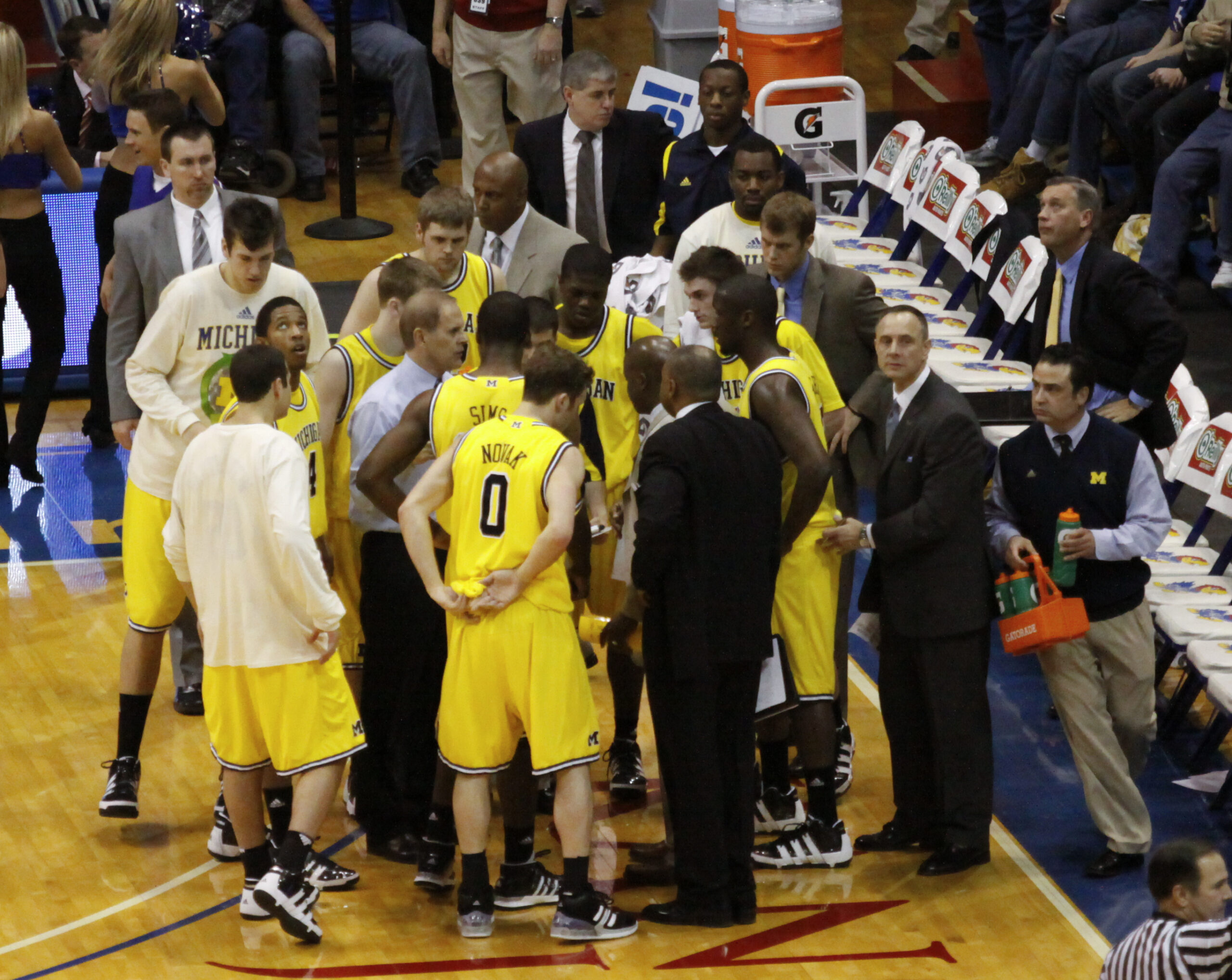
A coach signals to the table, the horn sounds, and ten thousand people relax for sixty seconds. On the broadcast it registers as a neutral event, a pause in which somebody draws on a whiteboard. Almost nobody in the building treats it as a transaction, which is what it is.
Two things get spent. One is a unit from a fixed allocation that will not be replenished, and the second is the state of the game at the exact moment the horn went. That second cost is the one that disappears from the analysis, because it is invisible: nobody sees the thing that would have happened next.
Three situations turn a timeout from a tool into a loss. In each one the coach gets what he asked for and pays more than it was worth, and in each one the mistake is visible live if you know what to check.
The three moments, in short
- During your own run. A stoppage is symmetric. You are buying a huddle for yourself and handing an identical one to a bench that badly needed it.
- Early, on a cheap problem. A timeout spent avoiding a low-value turnover in the second quarter costs a timeout that would have been worth a possession and several seconds in the last two minutes.
- Instead of a fast restart. Late in a close game, stopping to draw a play trades an attack against a scrambling defence for one against five set defenders who now know the situation.
- The underlying rule. The price of a timeout rises through the game. Spend the cheap ones on cheap problems and keep the expensive ones for the situations that pay.
- The question to ask live. Not what does the coach want to say, but which of the two benches needed the pause more.
What a timeout actually costs
The visible cost is the unit. Allocations differ between competitions, but two features are close to universal: unused timeouts expire at some boundary rather than accumulating indefinitely, and there is a cap on how many can be used in the closing minutes. Both mean a coach cannot simply carry everything to the end.
The invisible cost is the game state. A timeout freezes the situation and then restarts it with both sides organised. If the situation was in your favour, freezing it destroys the part of your advantage that came from the other side being disorganised, which in a fast sport is usually most of it.
The third cost is rarely counted at all: rest. A stoppage is a break for ten players, not five. Against a side whose best players have been on court for long stretches, giving them a minute is a genuine concession, and it is the reason experienced coaches will ride out a bad stretch rather than stop it.
Basketball timeout strategy starts with the price, not the moment
The mistake underneath all three failures is treating every timeout as interchangeable. They are not. The same unit is worth very different amounts depending on when it is spent, and the curve is steep rather than gradual.
In the first three quarters a timeout is worth roughly the problem it solves. It prevents a turnover, it interrupts an opponent’s run, it gets a message to five players who cannot hear the bench. Those are real but modest gains.
In the last two minutes the same unit does something else entirely. Several senior competitions allow a team that calls a timeout in that window to restart from the frontcourt rather than the baseline, which converts a timeout into roughly twenty metres of court and several seconds of clock. It also lets a side stop the clock after an inbound rather than before it. A coach who reaches the final minute with no timeouts has lost access to that, and the loss is much larger than the sum of the small problems the timeouts solved earlier.
Moment one: stopping your own run
A side scores eight unanswered points. The opponent looks rattled, the shot selection has degraded, and the bench opposite is standing up. This is the moment a coach on the winning side sometimes calls a timeout, usually described afterwards as settling his team or getting a set play in.
What he has actually done is fix the other side’s problem. The opposing coach now gets to substitute, change the defensive assignment, calm five players and inbound the ball against a set defence. He would have paid for that stoppage and did not have to.
The tell is on the losing bench. If the opposing coach is halfway onto the court signalling for a timeout when the horn goes, the wrong team has just called it. Runs end on their own soon enough; the disorganisation that produces them is worth more than the reassurance a huddle provides, and letting it run is one of the harder pieces of discipline in the modern coaching repertoire.
Moment two: paying a late price for an early problem
An inbounder cannot find a target. The clock on the throw-in is running down, the pass is not there, and a timeout avoids a turnover. It looks obviously correct, and in the first half it usually is not.
The exchange is a turnover in the second quarter against a timeout in the last two minutes. One of those is a single possession in a game that will have well over a hundred. The other is court position, clock and the ability to organise a final defensive assignment. They are not close in value, and a coach who has made that trade three times by half time will be short at the end.
The same logic applies to backcourt violations, shot-clock trouble at the end of a mediocre possession, and the timeout used to substitute when a natural dead ball is a few seconds away. All three buy something small at a price that will not be visible for another half an hour.
Moment three: calling one when a fast restart was worth more
Under a minute, one score behind, and a defensive rebound comes down with three opponents still in the offensive half. The instinct is to stop, huddle and run something designed. The instinct is frequently wrong.
A defence that has not recovered is the best scoring opportunity available in the sport, and it lasts about three seconds. A set defence in the final minute of a close game, fully aware of the situation and the clock, is close to the worst. Trading the first for the second is a large concession, and the play drawn up in the huddle has to be very good to make up the difference.
There is a related version in competitions where the clock stops automatically after a made basket in the closing minutes. A timeout called at that moment buys the huddle and nothing else, because the clock had already stopped and the inbound was not under pressure. Coaches still spend them there, and the unit is gone.
The symmetry nobody accounts for
Every argument above rests on one property: a stoppage is shared. The instruction, the rest, the substitution window and the chance to reset are available to both benches equally, and only one of them paid.
That asymmetry in price and symmetry in benefit is why the question worth asking is never what the calling coach gained. It is what the other coach gained, and whether he would have called one himself within the next thirty seconds. If the answer is yes, the timeout was a gift regardless of how well the play out of it was drawn.
It also explains the timeouts that look passive and are not. A coach standing still while his team concedes six straight points may be holding a unit he expects to need in four minutes and betting that the run ends before then. Sometimes it does not, and he is criticised for the wrong thing.
The price of a timeout, quarter by quarter
| Game state | What the timeout buys | What it costs | Usual verdict |
|---|---|---|---|
| First half, routine trouble | One avoided turnover, one instruction | A unit that expires at the interval anyway | Cheap, often correct |
| First half, during your own run | Reassurance | A free reset for the opponent | Rarely worth it |
| Third quarter, opponent run | An interruption and a substitution window | A unit with rising value | Defensible |
| Last four minutes, level | A set play against a set defence | The transition chance you had | Depends on the break |
| Last two minutes, trailing | Court position, clock, organisation | Almost nothing you will need later | Usually correct |
| Last thirty seconds, no timeouts left | Nothing | The earlier spending | The bill for moment two |
The pattern holds outside basketball with different numbers. Ice hockey allows a single short timeout for a whole game, which makes the price absolute rather than rising. Volleyball resets the allocation every set, so hoarding is pointless. Association football has no timeouts at all, which is why managers bank instructions for goal kicks, injuries and cooling breaks, and why the technical area exists in the first place.
When calling one is plainly correct
The three failures above are not an argument for never stopping. There are situations where the timeout is the cheapest available answer and hesitating costs more.
An opponent’s run that has already changed the score by eight or ten points is one. At that point the game state is no longer in your favour, so the symmetry argument disappears and the stoppage is simply an intervention you need. A defensive assignment before a critical inbound near your own basket is another, because a broken assignment there is worth more than the unit. So is a genuine turnover risk inside the last minute, when a possession is worth more than anything the timeout could have bought later, since there is no later.
And there is a medical version that overrides all of it. A player who is visibly hurt, disoriented or struggling to breathe is a reason to stop play immediately, and no strategic accounting applies. That decision belongs to the medical staff rather than the bench, and the trend across competitions has been to remove it from the coach’s discretion entirely.
Freezing a shooter, and what the evidence supports
The timeout called immediately before a free throw or a decisive kick is one of the most argued-about uses of the resource, and the honest position is that the effect is small and contested.
Studies across sports have looked at whether a stoppage before an attempt reduces conversion, and the results have not converged on a clear answer. Some analyses find a small effect, others find none once the situation is controlled for, and the samples involved are rarely large enough to settle it. What can be said is that the effect, if it exists, is nowhere near large enough to justify spending a unit that would otherwise buy court position later.
The psychological framing is more interesting than the arithmetic. A player who has taken thousands of the same attempt is not obviously disturbed by an extra minute, and the literature on how elite competitors prepare for high-pressure moments suggests routine is more robust than the tactic assumes.
Judging the call in four questions
Live, with no replay and no time to think, four questions are enough to form a view of any timeout as it happens.
- Who was in trouble? If it was the other team, the timeout was probably a gift.
- Would this instruction survive to the next dead ball? If yes, the coach paid for something he could have had free.
- How many minutes are left, and what does this unit buy later? Before the last four minutes, it buys very little; after, it buys a possession’s worth of court.
- Was the fast option available? If three defenders were still in the wrong half, the huddle cost more than it delivered.
Applied across one close finish, those four questions will identify most of the decisions that get argued about afterwards, including the ones that worked. A timeout that produced a good shot can still have been the wrong call, which is the part that makes this difficult to discuss in the minutes after a tournament game decided by a single possession. Under the rules published by the international federation and by most senior leagues, the request itself is straightforward; what it is worth is not.
Frequently Asked Questions
Can a player call a timeout, or only the coach?
It depends on the competition. Under international rules the request goes through the scorer’s table and is made by the coach, while several professional leagues allow a player on court to call one directly. The distinction matters late in games, because it changes who can stop a possession that is going wrong.
Why do coaches save timeouts they never use?
Because the value is in having them available rather than in spending them. A side with two timeouts in the final minute has options a side with none does not, including advancing the ball and stopping the clock after an inbound. Finishing a game with one unused is not automatically a mistake.
Does advancing the ball apply in every competition?
No. Several senior competitions allow it in the closing minutes and others do not, and the exact window differs where it exists. It is the single biggest reason the price of a timeout rises late, so it is worth knowing which rule applies before judging a decision.
Is a long stoppage bad for the team that is winning?
Often, yes, and for the reasons above rather than anything mystical about momentum. The winning side is usually the better organised one at that moment, and a stoppage removes that edge while giving the opponent rest and a chance to change what is not working.
How many timeouts should a coach have left with two minutes to play?
There is no fixed number, but a trailing side with none has a real problem and a trailing side with two has most of the tools the rules provide. The useful habit is to track the count from the third quarter onward, because that is when the spending decisions start to bind.
Next close finish, watch the losing bench during the winning team’s run. If the coach opposite is already asking for a stoppage when the other one calls it, you have watched a timeout change hands for nothing.