A guard grabs the defensive rebound, outlets it to the wing, and four players are already sprinting. Broadcasts follow the ball, so the eye goes with it, to the two rim runners filling the outside lanes and the ball handler pushing the pace. The player who actually decides whether the possession ends in a clean look or a contested one is usually still behind the play, jogging up the middle of the floor, arriving a full two seconds after everyone else.
That trailing player, almost always a big who is not fast enough to beat anyone down the floor, is not late by accident. He is timed to arrive exactly when the defense has already committed to the first wave, which is the entire point of the position and the reason a well-coached trailer changes a fast break’s efficiency more than a faster fourth man ever could.
What follows breaks the trailer’s job into lane assignment, the drag screen he sets on arrival, the trail three he sometimes takes instead, and the specific defensive rotation his timing is built to break.
The trailer’s job in five lines
- Lane. The middle of the floor, arriving after the first two runners, not another wide lane.
- Timing. He is meant to arrive after the defense has already committed to the ball and the rim runners.
- First option. A drag screen for the ball handler at the level the defense is weakest.
- Second option. A trail three if the defense sags off him to protect the rim.
- Target. The low man, the defender who rotated to help and left his own assignment open.
Lane assignments after a change of possession
A fast break with five players sprinting in five random directions is not a fast break, it is a footrace, and footraces are easy for a defense to defend because nothing about the spacing forces a decision. The three-lane structure, wide left, wide right, and a ball handler pushing the middle, exists specifically to put one defender at a time in a position where he has to choose between two threats he cannot cover simultaneously.
The trailer’s lane assignment sits behind that first structure rather than inside it. He does not occupy a fourth lane so much as he arrives into whichever gap the first three players have already created, which means his path down the floor is read on the move rather than fixed before the possession starts.
Why the trailing big is not just filling space
A trailer who simply jogs up the middle and stands near the free-throw line is filling space, and a defense that has already rotated to the ball and the rim runners will happily leave one help defender on him and consider the possession solved. The value only appears once the trailer arrives with an actual decision attached to his arrival, a screen to set or a shot to take, rather than a body to park.
This is the same distinction that separates a useful screen from a decorative one in half-court sets, and it shows up again in the reasoning covered in innovative coaching techniques built around performance, where a repeated action only earns its place in a system if it consistently changes what a defender has to do. A trailer’s late arrival is the mechanism that creates a genuine decision rather than a passive final option.
The drag screen: what it forces the defense to solve
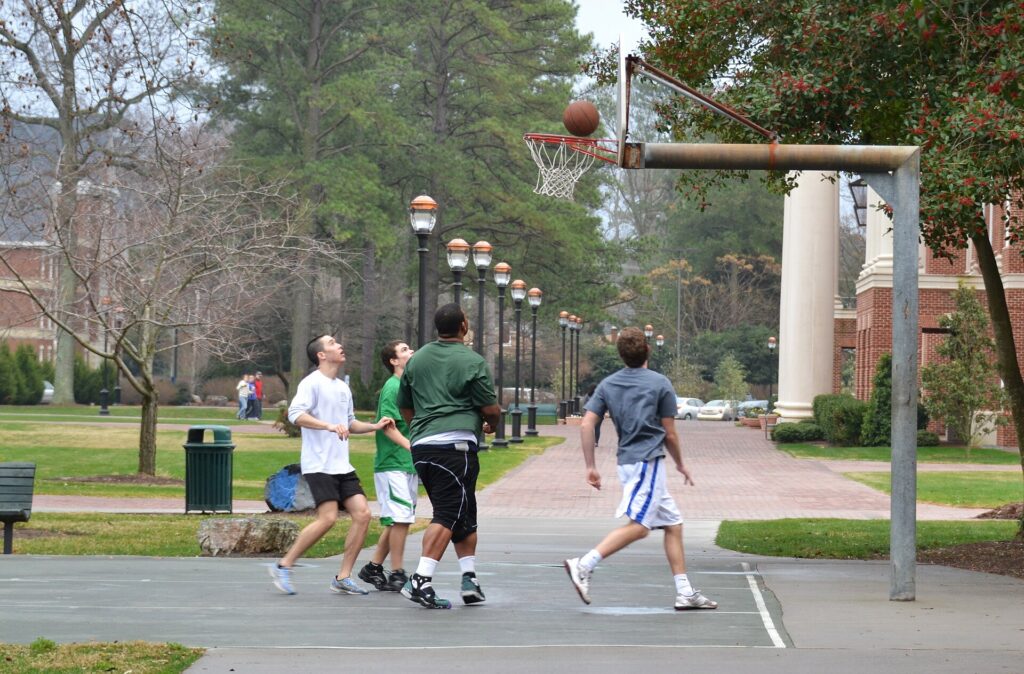
A drag screen is simply a ball screen set in transition rather than in a set half-court possession, usually around the level of the logo or just above the three-point arc, well before the defense has finished organizing itself around the ball. The trailer sets it the moment he arrives, which is precisely why his timing matters more than his speed.
The screen forces an immediate choice on a defense that has not yet recovered its shape: switch onto a smaller, faster ball handler with a big man who is not built for that matchup, or fight through the screen and concede a clean driving lane before the last two defenders have finished retreating. Neither answer is comfortable, and a defense given no time to organize picks whichever mistake seems smaller in that specific second.
The trail three and when it is live
A defense that has scouted the drag screen well will sometimes sag its last help defender off the trailer entirely, protecting the rim against the two runners instead and accepting the trailer as a jump shooter rather than a screener. The correct response to that specific coverage is not to force the screen anyway, it is to shoot.
A trailer who can catch and rise from three without hesitation the instant he sees a defender sagging off him turns that defensive choice into a bad one immediately, which is why modern transition offense increasingly recruits shooting bigs into the trailer role rather than pure rim protectors who can only finish inside.
Reading the low man: the defender the trailer attacks
The single defender whose decision the entire sequence is built around is usually called the low man, the last defender back who has typically abandoned his own rim runner assignment to help stop the ball. He is, by definition, guarding two threats with one body the moment the trailer arrives.
A trailer arriving with a live drag screen forces the low man into an immediate binary: step up to help on the ball screen and leave the trailer open for the pop, or stay attached to the trailer and concede the drag screen cleanly. There is no version of that choice where the low man covers both correctly, which is the entire mechanical reason the position is worth an extra half-second of patience on the sprint upcourt.
Two footwork errors that stall the trailer’s value
The first common error is arriving too early, sprinting into the drag screen spot before the ball handler and the two runners have actually forced the defense into its first commitment. A screen set before the defense has anything to react to just gets switched calmly, since nothing about the timing pressured anyone into a rushed decision.
The second is setting the screen at the wrong angle relative to where the low man is standing, square to the sideline rather than angled to seal the specific defender the ball handler needs removed from the driving lane. A correctly timed screen at the wrong angle produces almost the same outcome as no screen at all, because the defender it was meant to seal simply slides around it.
Fast break trailer basketball, by numbers
| Trailer action | What it forces | Best low-man counter |
|---|---|---|
| Drag screen, hard angle | Switch or two defenders on the ball | Switch early, live with the mismatch |
| Drag screen, soft angle | Ball handler can reject and attack the other side | Show and recover rather than switch |
| Trail three, defender sagging | An open catch-and-shoot look | Stay attached instead of helping |
| Slip to the rim | A vacated screen turning into a direct roll | Tag the roller with the nearest wing defender |
Reading the four rows together shows why a defense cannot pre-decide one blanket answer for every trailer entry. The correct read depends on which action the trailer chooses, which is exactly the decision his timing is designed to delay until the defense has already spent its first, more urgent decision on the ball.
What a defense does to take the trailer away
The most reliable counter is not a rule applied to the trailer at all, it is early recognition further up the floor: a defense that identifies the outlet pass immediately and gets its first two defenders back into legal guarding position before the ball crosses half court removes most of the pressure the trailer’s late arrival is designed to create.
A second, more targeted counter assigns a specific defender to sprint with the trailer from the moment of the rebound rather than leaving his coverage to whichever help defender happens to end up nearest him, denying the free release the low-man dilemma depends on. Both counters cost the defense speed elsewhere on the floor, which is the trade a coach is actually managing rather than eliminating.
Coaching cues that make the fifth man’s job repeatable
The cue that separates a trailer who helps a fast break from one who slows it down is almost always verbal and given well before the possession, not adjusted in real time: run to the level of the free-throw line extended, not the rim, and read the ball handler’s hip before deciding whether to screen or pop. A trailer told simply to run the floor hard tends to arrive too fast and too early, solving the wrong problem.
The second cue concerns spacing relative to the two rim runners rather than the ball: the trailer’s arrival should never collapse the same driving lane the runners are trying to occupy, since a big man and a cutting wing contesting the same six feet of floor cancels out the advantage both were meant to create separately.
Why some transition offenses skip the trailer action entirely
Not every roster benefits from building a possession around a trailing big, and coaches with a roster of interchangeable, mobile forwards sometimes remove the drag screen option altogether in favor of a fourth or fifth player simply spacing to the corner and staying out of the driving lane. That choice is not a failure to use the trailer correctly, it is a recognition that a slower, more traditional big may cost the possession more in lost spacing than his screen gains in defensive confusion.
The decision generally comes down to a specific personnel question a coaching staff answers in practice rather than in a game: does this particular player set a live screen and pop or roll convincingly enough to make the low man’s dilemma real, or does his presence simply give the defense one more stationary body to key on. A team without a credible trailer is usually better off treating the fourth and fifth runners as spacers rather than forcing an action their personnel cannot execute.
How the role changes once the defense sets up early
Everything described so far assumes a defense still scrambling to match up, which is the entire premise of a fast break. Once the first two runners fail to generate a clean advantage and the possession stalls into something closer to a secondary break, the trailer’s job shifts from exploiting a scramble to initiating a half-court action, and the drag screen he set on arrival often becomes the first screen of an actual set rather than the decisive one.
Recognizing that shift in real time is a genuine skill, not an automatic transition. A trailer who keeps attacking as though the defense is still disorganized after it has already matched up is usually forcing a low-percentage read into a set defense, while a trailer who recognizes the stall and resets into a half-court entry, calling out a side pick-and-roll or clearing to the opposite corner, preserves the possession instead of wasting it on a read that no longer applies.
What film study shows about trailer decision speed
Coaches who chart transition possessions separately from half-court ones consistently find that the trailer’s decision, screen, pop, or slip, gets made within roughly a second and a half of crossing half court in the possessions that produce good shots, and considerably later in the ones that stall into a contested attempt near the shot clock. The gap is not about athleticism. It is about how quickly the trailer reads the low man’s body position rather than waiting to see where the ball actually goes.
This is one of the more teachable elements of the position precisely because it does not depend on physical tools a coaching staff cannot change. A trailer who is coached specifically to watch the low man’s hips rather than the ball handler’s path tends to make that read faster within a single practice week, which is part of why the role has become something staffs actively develop rather than simply assign to whichever big happens to be on the floor.
Frequently Asked Questions
Does the trailer always have to be a big man?
No, though it usually is one, since the drag screen and the physical mismatch it creates depend on sending a player defenses are reluctant to switch onto smaller guards.
What makes a trailer’s timing too early rather than too late?
Arriving before the ball handler and the two rim runners have forced any defensive commitment, which lets the defense switch or help calmly instead of reacting under pressure.
Why does the low man matter more than the other defenders in transition?
Because he is the one defender typically covering two assignments, the ball screen and the trailer, at the exact moment the trailer arrives, which is the specific dilemma the whole sequence is built to create.
Is the trail three a better option than the drag screen?
Neither is universally better. The correct choice depends on whether the low man sags off the trailer or stays attached, which the trailer has to read in the moment rather than decide in advance.
Can a fast defense simply eliminate the trailer’s advantage?
Largely, yes, if the first two defenders get back into legal position before the ball crosses half court, since most of the trailer’s value depends on arriving into a defense that has not finished organizing.
The fifth man down the floor rarely shows up on a highlight the way the finish does. The finish, more often than not, was decided two seconds earlier, by a screen angle and a low man who had already lost the argument before the ball arrived.