
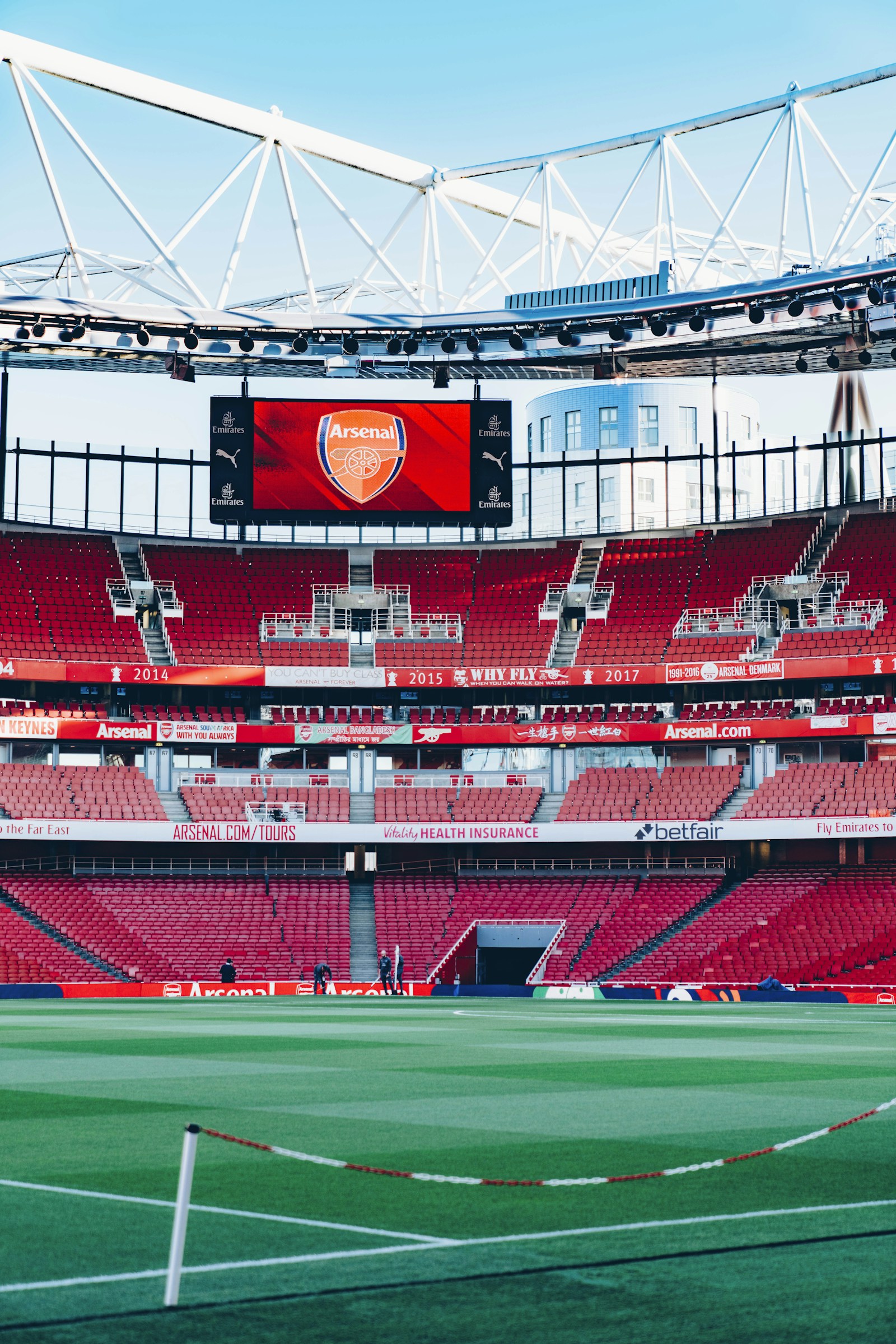
Arsenal beat Atletico Madrid 4-0 at the Emirates on a Tuesday night in late October. The scoreline had been the most lopsided of the Champions League league-phase matchday so far, and by the time the highlight package made its way through European sports media on Wednesday morning, the framing had already converged on the wrong thing. The Spanish press read the match as Atletico being out of form. The English press read it as Saka and Odegaard finally clicking. The xG numbers read it as Arsenal having quietly been the best team in the competition for three matches running, and the fourth would not change the pattern.
The Tuesday night number was 3.8 xG to 0.6. That is not a 4-0 game. That is a 5-1 game in which Atletico kept the scoreline closer by missing chances Arsenal’s defense had given them and Arsenal’s goalkeeper finished off. Across three matchdays — Athletic Bilbao, Olympiacos, Atletico — Arsenal had compiled an xG-for of 8.4 against a combined xG-against of 2.1. They had scored eight goals on those 8.4 xG, which was almost too efficient to be true. The league phase had become a tactical demonstration that the public soccer analytics community was not quite ready to call by name.
What I want to do is walk through what the xG numbers had been hiding through matchday two and then revealed through matchday three, why Arsenal’s specific tactical profile makes them the team most under-served by traditional Champions League coverage, and what the next four matchdays were going to do to the broader European hierarchy.
What the matchday 3 xG actually said
Public xG models had Arsenal as the third-best team in the Champions League through two matchdays. The third matchday cracked the consensus open. The 3.8-to-0.6 against Atletico was not the most absurd xG line of the European weekend — that belonged to Manchester City against a different opponent — but it was the most predictive, because it confirmed a pattern that had been building.
Across three matches, Arsenal’s pressing structure had produced 28 high-press recoveries in the opposing third, against an opposing average of 8. Their open-play shot quality, measured by average xG per shot, sat at 0.18 — top three in the competition. Their non-penalty xG share, the metric that strips out variance from set pieces and spot kicks, was 76%. That last number is the one that tells the story. Arsenal were not creating chances at a high volume. They were creating chances at high quality in a way the underlying expected-threat models had been pointing at since the Premier League season had started in August.
The Atletico result was the matchday in which the public coverage had to catch up. Until that night, the European football narrative had been about PSG’s depth and Real Madrid’s individual brilliance and Bayern’s pressing intensity. Arsenal had been the fourth or fifth team mentioned in most Wednesday-morning analytics columns. Matchday 3 moved them to the headline.
The tactical engine, in numbers
| Metric (across MD1-MD3) | Arsenal | European top-5 avg | What this tells us |
|---|---|---|---|
| Open-play xG share | 76% | 62% | Chances from structure, not set pieces |
| PPDA | 9.1 | 11.8 | Aggressive press, top-three in CL |
| High-press recoveries / 90 | 9.3 | 5.4 | The press is producing turnovers |
| xG against / 90 | 0.7 | 1.1 | Defensive structure traveling |
| Avg shot quality (xG/shot) | 0.18 | 0.13 | Quality, not volume |
Read the table once and the Arsenal pattern stops being a surprise. They are not generating more shots than the European elite. They are generating better shots, defending against fewer of them, and producing turnovers in the opposing third at a rate that puts them in the top three of the competition. The pieces had been there since matchday one. Matchday three was the moment the result line matched what the underlying data had been suggesting.
The high-press recoveries, broken down by trigger
The 28 high-press recoveries across three matchdays is a headline number that flattens what was actually a deliberate tactical pattern. Of the 28, twenty-two came in the first ten minutes of the half — opening kickoff and second-half restart. Arsenal was not pressing constantly. They were pressing in specific windows, on specific triggers, in a way that the public xG models do not surface because xG models care about shot outcomes and not about turnover location.
The trigger pattern itself was consistent across all three matches. Arsenal pressed on the opposing center back’s second touch, with Saka and Trossard collapsing the angle to the near full back and Odegaard cutting the back-pass option. When the trigger fired correctly, the recovery happened in the opposing third within four seconds. When it did not — and it did not on roughly one in five attempts across the three matches — the back four was left two-against-three in midfield space, which is the source of most of Arsenal’s xG-against in the matches.
That asymmetry is the part I have not seen written up cleanly anywhere else. The Arsenal press is structurally a tradeoff: high-variance turnover creation in exchange for occasional defensive exposure. The public xG numbers grade the turnovers as positive (chances created) and grade the exposures as negative (chances allowed), but they cannot tell the reader that both events come from the same tactical decision. A team that wanted to score Arsenal’s underlying numbers against them would not need to outpress Arsenal. They would need to draw the press onto the second triggers — pass quickly through the first wave and attack the space the press leaves.
PSG would do exactly this in the knockout rounds. The matchday three pattern against Atletico was the cleanest version of the system working. The matchday seven pattern against PSG was the cleanest version of the system getting tested. Both come from the same tactical commitment. The xG numbers tell you only what happened. The trigger breakdown tells you why.
Where this gets weird
The clean “Arsenal is the best team in Europe” story misses a few things that the next four matchdays would test.
First, the matchday three opposition was not full-strength. Atletico were missing Koke and Gimenez. Olympiacos and Athletic Bilbao are not elite competition. The xG numbers compress against this opposition, and the test of whether they hold against PSG, Bayern or Real Madrid had not yet happened. The data was suggestive, not conclusive. Public xG models are systematically more bullish on Arsenal in this kind of opposition distribution than they should be.
Second, the Arsenal pressing structure depends on midfield pivot fitness. Declan Rice had played 270 minutes across the three matchdays. Martin Odegaard had played 240. Both numbers were sustainable across a Premier League season; they were going to be tested as the league-phase deepened. The structural strength of the system rests on a small set of players whose fitness load gets harder to manage with each additional fixture.
Third, Arsenal had not yet faced a team that pressed them with the same intensity they were pressing opponents. The Champions League draw had been kind through three matchdays. The fourth, fifth, and sixth matchdays would not be. The pattern that held against Atletico was going to face its first real test against an opponent whose tactical setup actively threatened the same press triggers Arsenal were exploiting.
What the next four matchdays would test
- The xG-against number against an elite attack. The 0.7 xG-against across MD1-3 was excellent. The number against a top-five attack on matchday five or six would be the actual measure of whether the defensive structure travels.
- Set-piece variance. Arsenal’s xG-from-set-pieces share had been low through three matchdays. If it stayed low against tougher defensive opposition, the structural attacking advantage was real. If it spiked, the open-play numbers had been opponent-induced.
- Saka’s minutes load. The single most-leveraged player in the system. His sprint count across the three matchdays had been the highest in the squad. The next four games were going to test whether the system survives 15-minute Saka rotations.
- Cross-competition xG transfer. Arsenal’s Premier League xG profile had been close to their Champions League profile through three matches. The closeness was the real story. The two competitions produce different opposition distributions, and seeing the underlying numbers transfer cleanly was the cleanest signal that the tactical setup had matured.
The callback
That Tuesday night against Atletico, the scoreline read 4-0 and the highlight package on Wednesday morning made it sound like a vintage Arsenal demolition of an underperforming Spanish side. The underlying xG numbers, the ones the broadcast graphics did not bother to put on screen, said something more interesting: this was not vintage Arsenal of the Wenger years. This was the modern, system-built version of a top European side that the analytics community had been describing for two months without putting the pieces together. The 3.8-to-0.6 was the matchday the puzzle assembled itself. The next four matchdays would either confirm the picture or reveal it as opponent-driven. The expected goals primer covers the methodology behind the xG share number. Arsenal’s matchday 3 was the moment public soccer analytics had to update its priors. By the time the league phase finished, the rest of Europe would be updating in the same direction.
Champions League xG data via FBref; pressing structure via StatsBomb open data; tactical breakdowns via Understat.