
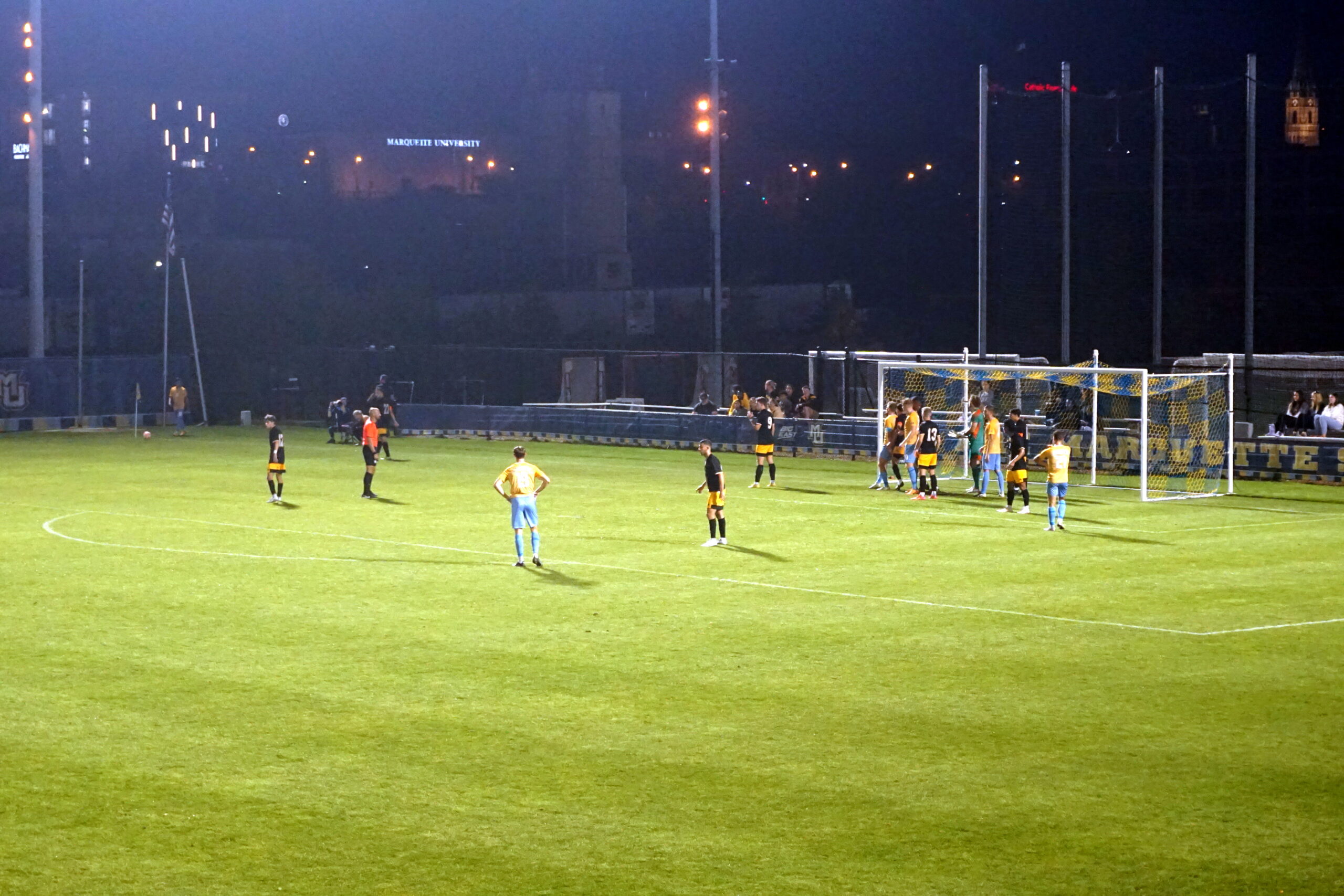
A corner comes in, a header wins the space six yards out, and within seconds three different explanations arrive on commentary: the marker was ball-watching, the zone was left uncovered, nobody picked up the runner. Often all three descriptions are pointing at the same failure from different angles, because most set-piece marking systems are not actually broken when a goal goes in. They are working exactly as designed, and the design itself concedes something specific.
Zonal marking, man marking and the hybrid systems most top sides now use are not ranked from worst to best. Each one trades a specific vulnerability for a specific strength, and understanding which trade a team has made explains far more about a conceded goal than assigning blame to whichever individual player was standing nearest the scorer.
What follows compares the three systems on the same two tests, coverage of space and coverage of runners, and then works through why the postmortem after a set-piece goal so often blames the wrong part of the structure.
The comparison in six lines
- Zonal marking. Defenders own areas of the box, not specific attackers.
- Man marking. Defenders are assigned specific attackers and follow them anywhere in the box.
- Hybrid. A mix, typically zonal near the goal with man marking on the most dangerous individual runners.
- What zonal concedes. A well-timed run into a zone’s blind spot, arriving faster than the zone defender can react.
- What man marking concedes. Space created by blocking runs and coordinated pick plays between attackers.
- What hybrid tries to fix. Reduce both vulnerabilities at the cost of added coordination complexity.
What a set-piece marking system is actually solving
A dead ball delivered into a crowded box creates a coordination problem for the defense unlike almost anything else in open play: several attackers moving simultaneously toward a small area, with the defense needing to cover both the space the ball might land in and the specific runners most likely to reach it first.
No marking system solves both halves of that problem perfectly, because covering space well generally means defenders committing to fixed positions rather than following individual runners, while covering runners well generally means defenders committing to individuals rather than owning any specific patch of ground. The three systems below represent three different answers to that same unavoidable trade-off.
Zonal vs man marking, on the same two tests
| Test | Zonal marking | Man marking |
|---|---|---|
| Coverage of dangerous space | Strong: every area of the box has an assigned defender | Weak: space opens wherever an attacker pulls his marker away from it |
| Coverage of a specific dangerous runner | Weak: a fast, well-timed run can beat a zone defender to the spot | Strong: the most dangerous attacker is tracked individually, everywhere |
| Vulnerability to blocking and screens | Lower: defenders are not chasing a moving target through traffic | Higher: a blocking run can separate a marker from his assignment |
| Vulnerability to a mistimed jump | Higher: a single zone defender beaten cleanly leaves the area open | Lower: a beaten marker still has a teammate covering nearby space in most systems |
Reading down either column tells you what a specific goal actually exposed. A goal scored by a runner arriving a half-step ahead of his marker into open space is a zonal failure in the classic sense. A goal scored by an attacker who used a teammate’s body to shake a defender loose is a man-marking failure in the classic sense.
What zonal marking concedes by design
Zonal marking accepts, as a structural trade-off, that any single defender guarding a fixed area can be beaten by a well-timed, well-disguised run arriving into that area a fraction of a second before he reacts to it. The system is not failing when this happens. It is absorbing exactly the risk it was built around in exchange for near-total coverage of the box’s overall space.
Coaches building these patterns deliberately draw on the same tactical literacy covered in innovative coaching technique breakdowns, where seam-exploiting movement gets isolated and drilled specifically. This is why zonal systems are particularly exposed to attacking teams that specifically design runs to exploit the gap between two adjacent zones, arriving at the seam rather than the center of either defender’s assigned area, which is a coached, deliberate attacking pattern rather than a lucky run.
What man marking concedes by design
Man marking accepts a different structural risk: a defender fully occupied tracking one specific attacker is vulnerable to that attacker’s teammates creating separation through coordinated movement, screens and blocks that a well-drilled attacking side can execute with genuine precision at a set piece.
The clearest example is a decoy run designed purely to occupy a marker’s path, freeing a different attacker entirely to arrive unmarked into space the decoy run has cleared. Man marking is not failing in this scenario either. It is conceding exactly the vulnerability the system trades for its strength in shadowing the single most dangerous individual threat.
The hybrid system, and what it tries to fix
Most elite teams now use a hybrid approach: zonal coverage of the goal-adjacent space where a mistimed jump is most costly, combined with man marking assigned specifically to the one or two attackers a scouting report identifies as the most significant aerial or movement threat.
Any thorough tactical preview of a knockout tie at the highest level now assumes some version of this hybrid setup as the default rather than the exception. This reduces both weaknesses without eliminating either. The zonal component still concedes the well-timed-run risk in the areas it covers, and the man-marking component still concedes the blocking-run risk for whichever specific attacker it assigns, but combining both narrows the total space where either failure mode is live at any given delivery.
Why blame after a conceded goal usually lands on the wrong system
A goal conceded from a hybrid setup is frequently described afterward as a pure marking failure, when the more accurate description is that the specific weakness built into whichever component, zonal or man, covered that part of the box on that specific delivery was exploited exactly as its structural trade-off predicts.
This matters because the corrective response differs depending on which failure actually occurred. A team correcting a seam-run problem in its zonal coverage needs different training than a team correcting a blocking-run problem in its man-marking assignments, and misdiagnosing which one happened produces a training fix aimed at the wrong vulnerability entirely.
Identifying the setup from the first replay

The fastest tell is where defenders are looking in the moment the ball is delivered. Zonal defenders are typically oriented toward the flight of the ball and their assigned patch of ground. Man markers are oriented toward their specific assigned attacker, often with a hand or arm maintaining physical contact regardless of where the ball itself is heading.
A hybrid setup shows both patterns simultaneously in different parts of the box, which is usually visible within the first second of the delivery once you know to look for the split rather than assuming the whole defensive line is using one uniform approach.
Which system suits which kind of attacking threat
A team facing an opponent with one clearly dominant aerial threat and comparatively weak supporting runners benefits more from leaning toward man marking on that individual, since the coordinated blocking runs that exploit man marking require multiple credible attacking options working together.
A team facing an opponent that attacks set pieces with several interchangeable runners and well-drilled movement patterns, rather than one standout aerial presence, benefits more from leaning toward zonal coverage, since that approach is less exposed to a single dominant individual and more resilient against distributed attacking threats across the box.
What elite teams actually do differently
The clearest difference between a well-drilled defensive unit and an average one is not which system it uses, since nearly every top team now uses some version of the hybrid approach. It is how precisely the handoff between the zonal and man-marking components is coached, particularly around who is responsible for a runner crossing from one marker’s zone into another’s assignment mid-delivery.
It is the kind of granular detail that separates genuine coaching for peak performance from a whiteboard diagram that never survives contact with a real delivery. That handoff moment, more than the system on the whiteboard, is where most elite-level set-piece goals actually originate, which is why the best defensive set-piece units spend disproportionate training time on transition moments between zones rather than on either pure system in isolation.
How this plays out on free kicks versus corners
The same three systems apply to direct and indirect free kicks delivered into the box, but the specific trade-offs shift slightly because a free kick typically allows the defense marginally more time to organize than a corner does, and the delivery often originates from a wider range of angles and distances than the relatively fixed corner position.
This extra setup time generally favors zonal and hybrid systems on free kicks specifically, since the additional seconds allow defenders to settle into their assigned areas more completely than the more compressed sequence around a corner permits, which is one reason some teams visibly shift their marking approach between the two situations rather than applying one uniform system to every dead ball delivered into the box.
What data on set-piece goals actually shows
Analysis of set-piece goals across multiple competitions generally finds that teams using a hybrid approach concede a lower rate of set-piece goals relative to the number of deliveries faced than teams using either pure system in isolation, which is consistent with the theoretical trade-off described throughout this piece rather than a coincidence specific to any one league or season.
The data also shows that the specific failure mode matters for how a goal gets coded in this kind of analysis: goals attributed to a seam run between zones and goals attributed to a blocking or screening play are tracked separately by analysts precisely because they call for different corrective training, reinforcing the point that diagnosing which structural weakness was actually exploited matters more than simply logging that a marking failure occurred.
How goalkeepers factor into all three systems
A goalkeeper’s role at a set piece is somewhat independent of which marking system the outfield defenders use, though the two interact more than casual analysis usually acknowledges, since a goalkeeper committed to attacking a crowded near-post delivery is relying on his outfield defenders to cover exactly the space he has vacated by coming for the ball.
A zonal system generally supports a more assertive, ball-attacking goalkeeper better than a man-marking system does, since zonal defenders are already oriented toward space rather than toward a specific attacker and can more naturally adjust to cover a gap the goalkeeper’s positioning has created. A heavily man-marked setup, by contrast, can leave that same vacated space uncovered if every outfield defender remains fixed on a specific individual rather than reacting to where the goalkeeper has actually committed.
Frequently Asked Questions
Is one of the three systems objectively better than the others?
No. Each concedes a specific, predictable vulnerability in exchange for a specific strength, and the right choice depends on the attacking threat a team is actually facing.
Why have most top teams moved toward hybrid systems?
Because a pure system concentrates its single structural weakness across the whole box, while a hybrid approach narrows the space where either weakness is live at any given moment, at the cost of added coordination complexity.
Is man marking more physically demanding than zonal marking?
Generally yes, since it requires continuous tracking of a moving individual through traffic rather than holding a fixed position, which is part of why it is typically reserved for the one or two most significant threats rather than applied across the whole defense.
Can you tell which system a team is using just by watching one set piece?
Usually yes, by watching where defenders orient their attention at the moment of delivery: toward the ball and a fixed area for zonal defenders, toward a specific attacker for man markers.
Why do announcers so often blame the wrong player after a set-piece goal?
Because the visible failure, a player left unmarked, is usually the symptom of a structural trade-off rather than an individual lapse, and identifying the actual cause requires knowing which system was in use and where its known weakness sits.
The next set-piece goal worth rewatching is worth rewatching for the system, not the scorer. The runner did not necessarily do anything special. He most likely found the exact gap the defense’s own structure was always going to leave somewhere.