
Half-time lasts fifteen minutes and produces about ninety seconds of actual instruction. Whatever was decided in that room shows up on the pitch almost immediately, because a change made at half-time has to be visible before players forget it, and because the side that made it wants the benefit while the opposition is still reading.
The window is short. Six minutes after the restart, both teams have settled, substitutions start arriving, and the score begins to distort everything. Before that, the picture is unusually clean: same eleven players, different instructions, no new information for anybody to react to.
The method below uses four observations, takes about ten minutes of attention, and needs no tracking data, no subscription and no replay. It will not tell you what was said. It will tell you what changed, which is the only part a report can honestly carry.
The six-minute checklist
- Pressing trigger. Where the first challenge of the half happens, and what provokes it.
- Line height. How far the deepest outfield defender is from his own goal when the opponent has the ball in midfield.
- One named player. Chosen at half-time, watched continuously, ignoring the ball.
- Entry point. Where the ball crosses into the final third: wide, central, or over the top.
- The control. Write down what the first half looked like on all four before the whistle goes.
- The discipline. Nothing you log after the sixty-minute mark belongs in this reading.
Why the first six minutes are the honest window
Two things pollute tactical reading after that point, and both are avoidable if you look early. The first is substitution. Once a coach has changed personnel, any shift you observe has at least two possible causes, and separating them by eye is guesswork.
The second is the scoreboard. A goal in the fiftieth minute reorganises both teams within a minute, and everything after it is a response to the score rather than to a plan. The six-minute window usually sits before either event, which makes it the only stretch of the match where a change of behaviour has one plausible explanation.
There is a third, quieter reason. Instructions decay. A coaching point delivered at half-time is executed most faithfully in the minutes immediately afterwards, and by the seventieth minute players have reverted at least partway to their habits. If you want to see the instruction rather than the residue of it, watch it while it is fresh.
Reading second half tactical adjustments without tracking data
Everything below is visible from a seat in the ground or from a standard broadcast wide shot. The requirement is not equipment, it is a decision about where to look, held for six minutes against the natural instinct to follow the ball.
Work through it in this order, because each observation is easier once the previous one is fixed:
- Before the restart, write one line describing each of the four items as they were in the first half.
- From the kick-off, log where the first attempted press or tackle occurs, and what preceded it.
- At the first natural stoppage, note where the deepest defender is standing relative to the halfway line.
- Pick the one player you decided on at half-time and watch only him for two full minutes.
- Log the first four entries into the final third by each side, and whether they were wide, central or in behind.
- At the six-minute mark, compare each line against the note you wrote before the restart.
The comparison at the end is the whole method. Without the control note, you will find changes that were always there, which is the most common error in this kind of writing.
Step one: where the first press starts
Pressing is the easiest adjustment to see and the most frequently changed at half-time. What you are looking for is not effort but a starting line: the point on the pitch where the first defender leaves his position to challenge.
Three positions cover almost everything. High, with a forward closing the goalkeeper or centre-backs. Middle, with the first challenge arriving as the ball reaches the opposition’s deepest midfielder. Low, with nobody engaging until the ball crosses the halfway line. A side that pressed in midfield for forty-five minutes and now confronts the goalkeeper has changed something specific, and it will be visible in the first two goal kicks.
The trigger matters as much as the height. Watch what makes the press start: a back pass, a touch towards the touchline, a particular player receiving. Sides frequently switch triggers at half-time without moving the line at all, most often to funnel the ball towards a defender they have decided is uncomfortable in possession. The build-up patterns these presses are designed to break are the same ones covered in most serious preview work.
Step two: the height of the defensive line
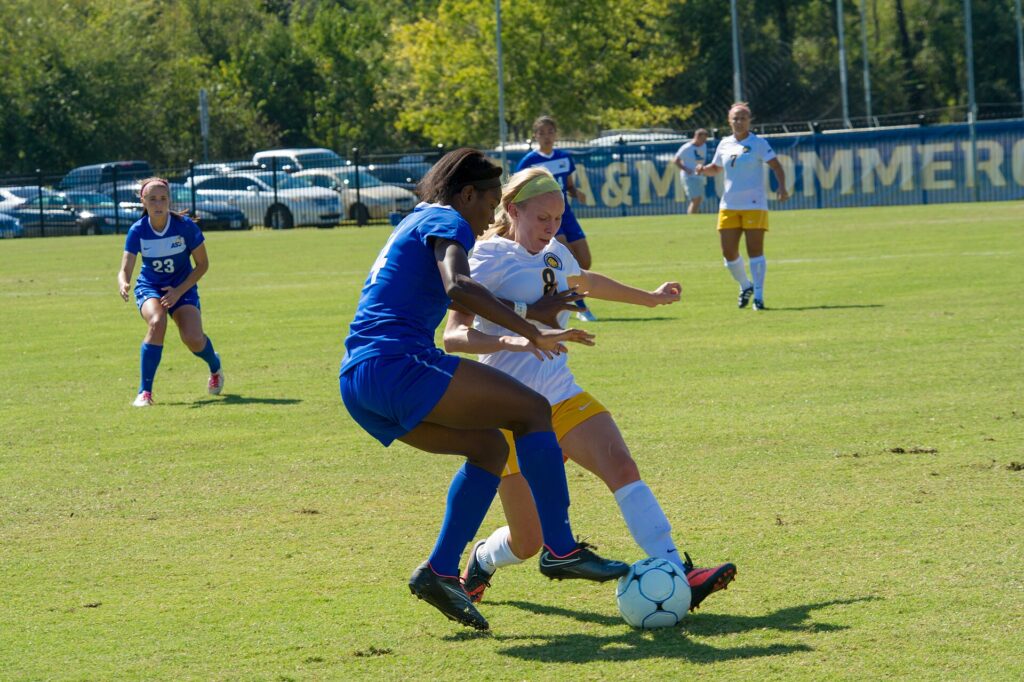
The line is the second most common half-time change and the least reliably reported, because it is invisible if you are watching the ball. Fix your eyes on the deepest outfield defender at a moment when the opposition has settled possession in midfield, and note where he is standing.
Ten yards is a large change and it is legible from any seat. A line that has dropped is usually answering a runner in behind or a long diagonal that hurt somebody in the first half. A line that has moved up is usually attached to the press, because a high press with a deep line leaves a stretch of pitch nobody is defending and every coach knows it.
The useful cross-check is the space between defence and midfield. A line that drops without the midfield dropping with it produces a wide corridor in front of the back four, and if you see the opposition’s deeper midfielders suddenly receiving unopposed, that gap is the reason. That single observation explains a large share of second-half collapses, and it can be made without any data at all.
Step three: one player, chosen at half-time
Choose one player before the restart and watch only him for two minutes. Pick the player the first half made a question of: the winger who was isolated, the midfielder who was overrun, the forward who kept dropping into space nobody occupied.
What you are checking is starting position rather than action. Is he on the same touchline? Is he starting inside the full-back rather than outside him? Has he been moved to the other side of a midfield three? Coaches make this kind of change constantly and it is almost never announced, because no substitution is involved and no formation graphic changes.
Two minutes of continuous attention on one player feels wasteful and is the single most productive habit in this method. It is also the observation most likely to survive scrutiny later, because a change in a player’s starting position is a fact rather than an interpretation.
Step four: the entry point into the final third
Where the ball arrives in the final third tells you what the side has been told to attack. Log the first four entries for each team and classify each one: down the outside, through the middle, or over the top.
A first half of wide entries followed by a second half of balls played early into a forward’s chest is a plan change, not a coincidence. So is a switch from long diagonals to short combinations on one flank. These are the adjustments most visible in a highlight package, which is why they are also the ones most often described correctly.
The subtlety worth catching is a change in which flank. Sides frequently move their point of attack at half-time to target a specific full-back, and it shows up in the first three or four entries before it shows up anywhere else. If both sides have switched flanks, one of them has usually reacted rather than planned.
The four adjustments you will actually see
| Adjustment | What appears in six minutes | What it usually answers | How confidently it can be written |
|---|---|---|---|
| Press moved higher or lower | The first challenge starts nearer or further from the opposition goal | An inability to win the ball, or a fear of the ball in behind | High, if the trigger is described rather than the intent |
| Defensive line moved | The deepest defender stands ten or more yards differently | Runs in behind, or a need to compress the pitch | High, and easy to verify on a replay |
| One player repositioned | Different starting side, channel or depth | An individual mismatch from the first half | High for the fact, low for the reason |
| Point of attack switched | Final-third entries arrive on the other flank | A full-back who struggled, or a numerical advantage | Moderate, and stronger after eight or ten entries |
The right-hand column is the one that keeps a report honest. Everything in the second column can be stated as observation. Nothing in the third column can be stated as fact unless somebody says it out loud afterwards.
Substitutions are the loudest change and the least informative
A substitution is the change everyone notices and the hardest to interpret, because it has at least four possible causes and the visible evidence rarely separates them. Fitness, injury management, a tactical decision, a message to the player removed: all four look identical from the stand.
Timing narrows it slightly. A change made in the first minute of the half was decided at half-time and is a plan. A change made at the hour is closer to routine. A change made within a minute of conceding is a reaction, and everything you saw before it belongs to a different match. Even so, the read is weaker than any of the four observations above.
The stronger use of a substitution is as a confirmation. If you have already logged a line dropping ten yards and a wide player moved inside, and then a defensive midfielder appears at the hour, the substitution supports a reading you already had. On its own it supports very little, which is exactly the opposite of how it is usually written up. The physical side of those decisions belongs to a separate conversation about workload across a congested calendar.
What can be claimed, and what cannot
The method produces observations, and observations have limits that are worth stating before writing anything. You can claim that the press started higher. You cannot claim that the coach told them to press higher, because you were not in the room and the two are not the same sentence.
You can claim that a player started the second half in a different position. You cannot claim it was because he had been ineffective, unless he says so or the coach does. The distance between a change and a motive is where most tactical writing quietly stops being reporting.
The safe construction is descriptive and dated: after the restart, the defensive line sat roughly ten yards deeper, and the opposition’s entries into the final third moved from the left to the right. That sentence survives a second reading, a replay, and a press officer. The interpretive version usually does not, and it is the kind of claim that access to real tracking data is often used to dress up rather than to test.
Practising the method on a match you can rewatch

The routine is easier to learn on a recording, because you can check yourself. Watch the last ten minutes of a first half, write the four control lines, then watch six minutes of the second and write the comparison.
Then skip to the seventieth minute and see how much of what you logged has survived. Instructions that persist for twenty-five minutes were plans. Instructions that vanish after ten were either misread or abandoned, and both outcomes teach you something about your own eye.
Ten matches is enough to stop needing the checklist. After that the four observations happen automatically in the first two minutes after the restart, which frees the rest of the half for everything else that is going on. The habit itself is closer to the way coaching staffs review their own footage than to the way most people watch.
Frequently Asked Questions
Does this work without a wide camera angle?
Partly. Pressing triggers and final-third entry points read fine on a standard broadcast follow shot. Defensive line height is much harder, because the deepest defender is often out of frame, and it is the one item that genuinely benefits from being in the ground or from a tactical camera feed.
Why six minutes rather than ten or fifteen?
Because substitutions and goals arrive with increasing frequency after that, and each one adds a competing explanation. Six is long enough for four or five possessions each and short enough to stay clean. If nothing has happened by then, extending to ten costs little.
What if a team makes no adjustment at all?
That is a finding, and a common one. Sides that are winning comfortably often change nothing, and the correct report says so. Writing an adjustment that did not happen is the failure mode this method exists to prevent.
Can the same checklist be used in other sports?
The structure transfers with different items. In basketball the equivalents are the coverage on the ball screen, the height of the pick-up point and which player is being hunted in a switch. The principle is the same: fix a small number of observables, record a control, and compare after a short window.
How do I avoid seeing changes that are not there?
The control note before the restart does most of the work. Memory of the first half is unreliable and biased towards whatever happened last, so writing four lines before the whistle removes the largest source of invented adjustment.
The next time a match turns after the interval, resist the substitution and watch the line instead. Second half tactical adjustments are usually decided in the first two minutes and described, wrongly, an hour later.