
Two changes on the hour, both of them like for like, both of them in a match that was level. One of them was decided on Thursday. The other was decided about ninety seconds earlier, on the touchline, by a coach who had just watched the same player lose a third duel in a row.
From the stand they are identical events. In a report they usually get the same sentence, which is a fabricated one: the coach responded by bringing on a fresh pair of legs. Nobody knows whether he responded to anything, and the word doing the work in that sentence is unsupported.
Substitutions can be read, but only for a narrow set of things, and the narrowness is the useful part. Timing, sequence and the replacement’s role carry real information. Motive does not, and almost every misleading sentence in this area comes from writing about motive as though it were visible.
Four changes, four readings
- The scheduled change. On or around the hour, like for like, made whatever the score is.
- The reactive change. Off-cycle, often within minutes of a goal or a booking, and usually positional.
- The double change. Two at once, which is almost always a change of shape wearing two names.
- The message. An early change, a captain removed, or a substitute withdrawn. Loud, rare, and easy to over-read.
- The only reliable evidence. Timing, sequence, and what the replacement does on the pitch.
- The line not to cross. Any sentence in which the coach’s intention is stated rather than quoted.
Why the hour is the default
The hour mark is a convention rather than a rule, and it exists for three reasons that have nothing to do with any individual match. Physical output declines measurably in the final third of a game. The pattern of the match is settled enough by then for a coach to know what he is changing. And a substitute introduced with half an hour left has enough time to affect the result.
Around that convention sits a structural constraint that has reshaped the whole subject. Competitions that permit five substitutions restrict them to three windows during play, plus the interval, which pushes coaches towards grouping changes rather than making them one at a time. The result is that the timing of a change is now partly an inventory problem: using a window on one player costs the ability to make a separate change ten minutes later.
That matters for reading. A single change made alone at the hour is a choice to spend a window on one player, which is itself information. Two made together may mean the coach wanted one of them and took the second because the window was open. Both readings are available, and the difference between them is usually visible in what the second substitute actually does.
Four substitution patterns and what each one supports
| Pattern | What it looks like | What it supports in writing | What it does not support |
|---|---|---|---|
| Scheduled | Hour mark, like for like, no preceding incident | A planned rotation of minutes across a congested run | Any claim about the performance of the player removed |
| Reactive | Off-cycle, follows a goal, a booking or a repeated problem | That a specific situation preceded it, stated as sequence | That the coach was unhappy with an individual |
| Double | Two together, at least one changing position | A change of shape, verifiable by watching the next five minutes | That both players were being replaced for the same reason |
| Message | Very early, a captain removed, or a substitute substituted | That the change was unusual, with the unusual feature named | Anything about discipline, attitude or a dressing-room dispute |
The right-hand column is the useful half of the table. It is a list of the sentences that get written every weekend without evidence.
The scheduled change: decided before kick-off
Most substitutions are boring, and the reporting problem is that boring events still need a sentence. A forward with a heavy schedule comes off at sixty-two minutes in a match his side is comfortably controlling, and the plan for that existed on Thursday.
The tells are consistent. It is like for like, it happens in a quiet passage of play rather than immediately after an incident, the substitute has been warming up for several minutes without urgency, and the same player has come off at a similar time in recent fixtures. That last check is the strongest one available and it takes two minutes with a fixture list.
Written honestly, the scheduled change deserves a clause rather than a paragraph. The temptation is to attach meaning to it because it happened at a moment when the match turned, and the correlation is almost always accidental. Squad rotation across a season is a workload decision belonging to the same conversation as recovery between fixtures, not to the ninety minutes in front of you.
The reactive change: a problem being answered
Reactive changes are the ones worth writing about, and they identify themselves by timing. They arrive off-cycle: in the forty-eighth minute, or four minutes after conceding, or immediately following a booking for a defender who has already been beaten twice on the same side.
The second tell is positional. A reactive change usually alters something about the shape, even when it looks like a straight swap: a wide player moved to the other flank, a midfielder pushed higher, a full-back replaced by someone who defends deeper. Watch the next three minutes rather than the substitution board.
What can be written is the sequence, stated as sequence. The defender was booked in the fifty-first minute, and was replaced in the fifty-fourth. That sentence is checkable and it lets the reader draw the obvious inference without the writer claiming to know it. The version that says the coach could not risk a second yellow has crossed into invention, and the fact that it is probably correct is not a defence.
The double change: a shape change with two names
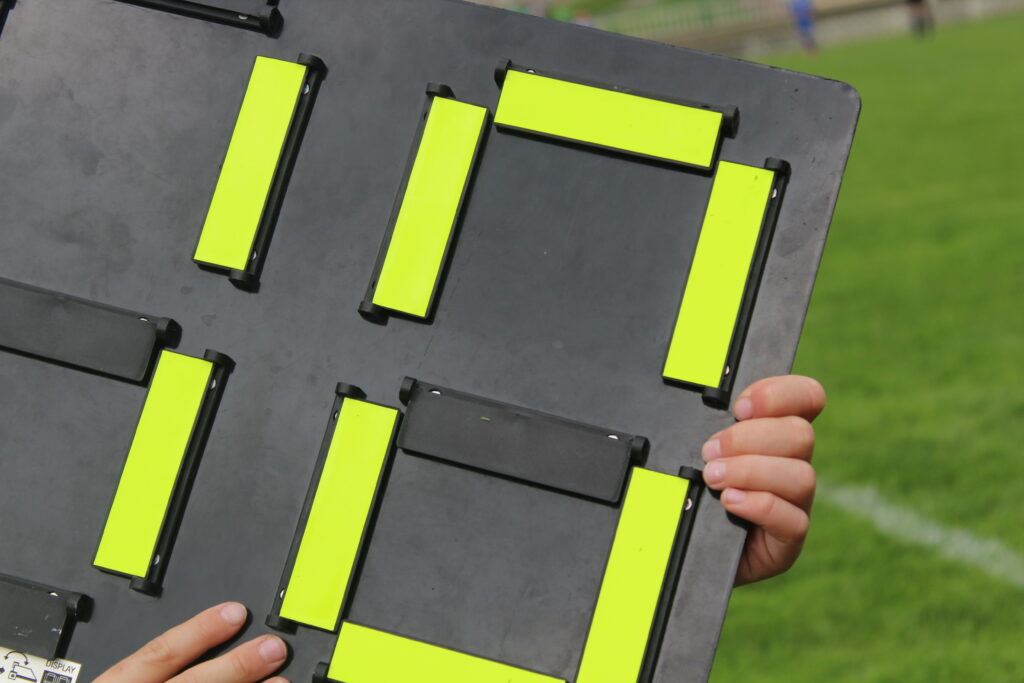
Two substitutions made together are almost never two separate decisions. They are a single structural decision that happens to require two bodies, and treating them as two individual replacements produces two wrong readings instead of one.
The way to test it is to ignore who came off and watch where the remaining players stand. A double change that moves a side from one back line to another will be visible within a minute: a midfielder dropping between the centre-backs, a full-back pushing permanently high, a forward dropping into a deeper role.
The window rule reinforces this. Since changes have to be grouped, a coach who wants one substitution and expects to want another soon has an incentive to make both at once. That produces genuine pairs and also produces coincidental ones, and the difference shows up in whether the second substitute changes anything about the shape or simply occupies the same position as the player he replaced. Squad construction decisions of this kind sit close to how a roster is assembled in the first place.
The change that is a message
A small number of changes are communicative, and they are recognisable because they violate a convention. A player replaced before half an hour without an injury. A captain removed while the side is chasing a goal. A substitute taken off after twenty minutes on the pitch.
These are rare, and their rarity is exactly why they get over-read. The honest treatment is to name the unusual feature and stop. A substitute being withdrawn is unusual; writing that a coach humiliated a player is a characterisation, and it is the kind of sentence that generates a week of coverage on no evidence at all.
There is also a mundane explanation for a large share of these, which is that the player was carrying something and it did not become obvious until he ran on it. Coaches rarely explain the difference and are not obliged to, and a report that assumes the dramatic reading will be wrong more often than it is right.
Read the replacement, not the player removed

The most useful single habit in this area is to stop watching who walks off and start watching what the substitute does with the ball. The player removed tells you almost nothing. The player introduced tells you what the coach wants the next twenty minutes to look like.
Three things are worth logging immediately. Where does he take up position, as distinct from the position listed on the graphic? What is his first involvement, and is he asking for the ball or defending? And does the team’s point of entry into the final third move in the following five minutes?
This is also the check that separates a genuine tactical change from a like-for-like swap dressed up as one. If the shape, the entry points and the pressing line are identical five minutes later, no tactical change occurred, whatever the graphic said. That comparison is the same one used for any before-and-after claim in match analysis, and it fails as often as it succeeds.
Timing alone, and what it can carry
Everything above depends on other observations. The clock, by itself, still narrows the field considerably, and it is the one variable available to anyone reading a match summary hours later without having watched a minute of it.
Strip away everything else and the clock still supports a few claims. A change in the first twenty minutes is either injury or emergency, and the distinction is usually visible from the way the player leaves the pitch. A change in the opening two minutes of the second half was decided at half-time. A change after the eightieth minute in a level match is about the final ten minutes specifically and nothing else.
Two additional patterns are worth noting because they are frequently misreported. A change made while the ball is out of play near the halfway line, with no urgency, is nearly always planned. A change made at a corner, with a substitute jogging on mid-phase, is not.
None of these is conclusive. All of them are checkable, and the difference between a checkable claim and a plausible one is the difference between a report that survives the following week and one that quietly does not.
Writing about a bench decision without guessing
Three rules cover almost every case. State the timing and the sequence rather than the reason. Describe what changed on the pitch afterwards, using something a reader could verify on a replay. And attribute intention only to a quote.
The construction that does the most work is comparative and dated: after the double change on the hour, the side pressed from the halfway line rather than from the edge of their own third, and the point of attack moved from the left to the right. Every clause there is observable.
What that sentence gives up is the pleasure of explanation, and it is a real loss. It gains the ability to be wrong in public without having invented anything, which over a season is the more valuable of the two. Substitution patterns are one of the few areas where the honest version and the confident version look almost identical on the page.
Frequently Asked Questions
Does the five-substitution rule apply everywhere?
No. It is available to competitions that choose to adopt it under the laws as published, and the number of permitted changes and windows varies between leagues and levels. Checking the specific competition’s rules before writing about a bench decision is worth the thirty seconds it takes, because the constraint shapes the timing.
Why do coaches so often change two players at once?
Partly because a shape change usually requires two, and partly because changes have to be grouped into a limited number of windows. Making one substitution alone spends a window, so a coach who anticipates a second change has an incentive to make both together.
Can you tell an injury substitution from a tactical one?
Usually, and mostly from behaviour rather than timing. A player who stops, signals to the bench, or receives attention before leaving is a different case from one who is called off at a stoppage. The ambiguous cases are real, and the correct treatment is to describe what was visible rather than to choose.
Is there a reliable way to tell if a change worked?
Not from one match. The change coincides with a dozen other things, including fatigue in the opposition, the score, and the natural rhythm of a late period. What can be assessed is whether the intended change of shape actually occurred, which is a smaller claim and a checkable one.
How should a report handle a substitution that preceded a collapse?
By reporting the sequence and resisting the causal sentence. The change happened, then the goals happened, and the mechanism connecting them requires evidence beyond the order of events. Naming what changed structurally is fair; asserting that the change caused the collapse is not.
Next time a board goes up on the hour, look away from it and watch where the substitute stands thirty seconds later. That is the part of a bench decision anybody can verify, and it is nearly always the part left out.