The blocker’s problem starts before the set leaves the setter’s hands. A hitter is running along the net, parallel to it rather than towards it, moving away from the ball at the exact moment everyone else on the court is converging on it. By the time the block has decided where to go, the hitter has already taken off from one foot and is drifting past the point the block chose.
That is the slide, and it is one of the few attacking patterns in any sport that wins primarily by arriving somewhere the defence has just left. Nothing about it is faster or higher than a conventional approach. It is later, and lateness is the weapon.
Broken into its parts, the play is a running approach, a single-leg take-off borrowed from basketball, and a timing relationship with the setter that has to be agreed in advance. Two specific errors make it easy to defend, and both are visible from the stands.
The slide, broken into four parts
- The approach. Along the net, away from the setter, usually behind her rather than in front.
- The take-off. One foot, converting forward running speed into height and lateral drift.
- The tempo. Set and hitter arrive together at a point that keeps moving.
- The contact. Made while still travelling, with the hitting shoulder ahead of the body.
- The blocking problem. A moving target reached by lateral movement, against a block that starts square to the net.
- The two errors. Leaving too early, and drifting away from the net.
What the play is solving
A conventional attack has a fixed address. The hitter approaches at an angle towards a spot near the net, jumps from two feet, and the ball is set to that spot. Blockers know where the collision will happen well before it does, and the whole defensive system is built on that predictability.
The slide removes the fixed address. Because the hitter is travelling along the net rather than into it, the contact point can happen anywhere along a stretch of two or three metres, and it is decided by the flight of the set rather than by a location agreed in advance. A block that commits early is beaten by a metre; a block that waits is late.
It also solves a spacing problem for the offence, and it does so within the same rotation rules that govern every other attack in the sport. Running an attacker behind the setter opens the middle for someone else and spreads three attacking options across the full width of the net. The pattern is difficult to defend not because any one hit is unstoppable but because the defence has to cover more court with the same number of bodies.
The volleyball slide attack, step by step
The mechanics are consistent whether the hitter is a middle or an opposite, and the sequence is short enough to learn quickly and difficult enough to take a season to time.
The run begins as the pass is travelling to the setter, not after the set has been released. The hitter moves laterally along the net, gathering speed over three or four steps, with the shoulders staying roughly parallel to the net rather than turning into it. The final step is a long one, planted on the foot nearest the net, and the take-off is from that single leg.
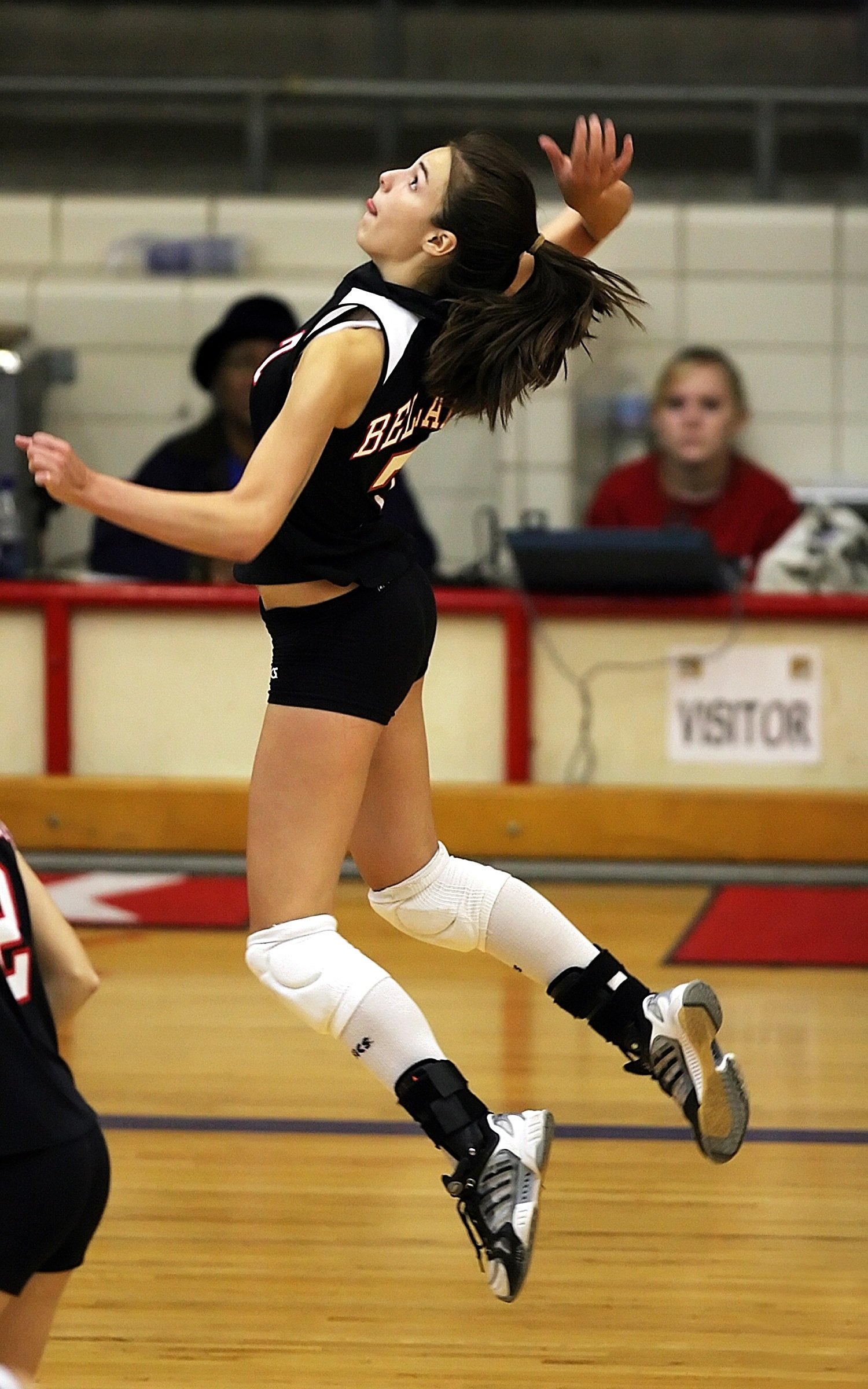
In the air, the body continues to travel sideways. The hitting arm comes through late, the contact is made above and slightly behind the leading shoulder, and the follow-through carries the player past the point of take-off. The landing is on one or both feet several feet from where the jump started, which is why the play looks like a running lay-up performed at a wall.
The approach path: away from the setter, along the net
The path is the part beginners get wrong, because the instinct is to run at the ball. In a slide the hitter runs away from the setter, and the ball is delivered into space the hitter is moving into rather than to a spot she is arriving at.
Three or four steps is the usual length, and the shape matters more than the number. The first steps are for speed, the penultimate is a gather, and the last is long and low, converting horizontal momentum into the plant. A run that is too short leaves the hitter without the speed to drift, which removes the entire advantage.
Distance from the net is the second variable and the one that decides whether the attack has any angle at all. The path should be close enough that the hitter can reach over the net at contact and far enough that she never has to shorten her stride to avoid touching it. Most of the ugly, blocked slides at club level are hitters who ran the right path a metre too far back.
The single-leg take-off, and what it buys
Jumping from one foot is the defining feature and it is a trade rather than an improvement. A two-foot jump produces more height for most players. A one-foot jump preserves horizontal speed, which is what makes the contact point unpredictable.
The mechanics are the same as a basketball lay-up: a long final stride, a plant on the outside leg, and the opposite knee driven upwards to convert speed into lift. Players who have played basketball tend to pick it up in an afternoon; players who have only ever jumped from two feet often need weeks to stop planting both.
The other thing it buys is late commitment. A two-foot jumper has to be in position before she jumps, which means the block knows the address. A one-foot jumper is still moving at take-off, so the address is decided in the air, and the blocker’s decision has to be made against a target that has not finished choosing. The physical demand is real, and single-leg landings deserve the same attention any club gives to the joints that absorb repeated landings.
Tempo: the relationship with the setter
The slide fails or works on one agreement: where the ball is going to be, relative to where the hitter will be, at a moment neither of them can see the other clearly.
The setter delivers a flatter, faster ball travelling in the same direction as the hitter, so that hitter and ball converge rather than meet at a fixed point. A ball set to where the hitter is at the moment of release will be behind her; a ball set to where she is going arrives on her hitting shoulder.
Tempo is graded like any other set. A slower slide gives the hitter more margin and gives the block more time to slide with her. A faster one arrives almost as the hitter takes off and is close to unblockable when it works, and unhittable when the pass is imperfect. Most teams run the slower version by default and keep the fast one for a clean first contact, which is a decision made in the moment by the setter rather than called in advance.
The blocking problem it creates
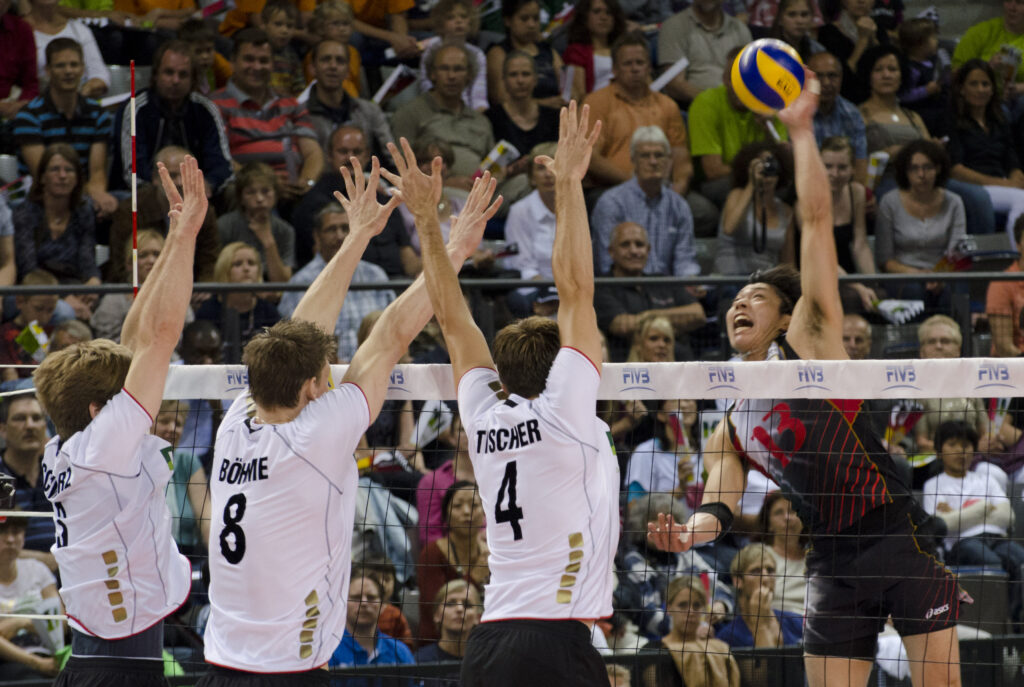
A block is organised around square footwork: the middle blocker moves along the net, plants, and jumps facing the attacker. Against a slide, all three of those are compromised.
First, the target is moving laterally, so the blocker has to move in the same direction rather than to a point. Second, the attacker’s contact is late, so a blocker who jumps on the hitter’s take-off will be descending as the ball is struck. Third, the direction of travel means the hitter can score into a court the blocker has just vacated, because the block’s own momentum carries it away from part of the angle it was covering.
Defences answer with a decision rather than with better footwork. Either the block concedes the line and takes away the sharp angle, or it releases one blocker to travel with the hitter and accepts a smaller block elsewhere. Both are concessions, which is the point: a well-run slide does not need to beat the block, it needs to force somebody to give something up. The pattern shows up in coaching material across several sports as an example of attacking a defence’s structure rather than its individuals.
Error one: leaving too early
The most common failure at every level below the professional game is starting the run before the pass has settled. It looks committed and it destroys the play.
An early runner arrives at her take-off point before the set has been released, which means the setter is now delivering to a hitter who has already stopped travelling. The whole advantage disappears: the contact point becomes fixed, the blocker has a stationary address, and the attack becomes a badly angled conventional hit from an awkward position.
It also gives the read to the defence. Blockers watch hitters’ feet during the pass, and a middle who breaks laterally early has announced the play while the ball is still travelling to the setter. The correction is small and unnatural: hold the first step until the pass is at its peak, then run.
Error two: drifting off the net
The second error is spatial and it usually comes from fear of the net rather than from bad footwork. The hitter’s path curves away, the take-off happens a metre back, and the contact is made behind rather than above.
From there the only available shot is a deep, flat swing into the middle of the court, which is the easiest ball in volleyball to dig. The sharp angle is gone, the ability to hit over a late block is gone, and the attack has become predictable in exactly the way the play exists to avoid.
Coaches usually correct this with a physical reference rather than an instruction, such as running a line marked on the floor at a fixed distance from the net, because telling a player to stay closer to the net produces a player thinking about the net rather than the ball. Once the path is habitual, attention returns to the set, which is where it belongs.
How defences take it away
| Defensive response | How it works | What it concedes |
|---|---|---|
| Release the blocker to travel | One blocker moves along the net with the hitter | A weaker block against the other attacking options |
| Concede the line, take the angle | The block sets early and protects the sharp cross-court | The straight shot down the sideline, defended from the floor |
| Read the setter’s shoulders | The block commits on the release rather than the run | Vulnerability to a setter who disguises the delivery |
| Serve tough to the passer | A poor first contact removes the option entirely | Risk of service errors, which are free points |
| Defend the line from the floor | Accept a single blocker and position two diggers deep | The tip and the sharp roll shot into open court |
The last row is the one most club teams should reach for first, because serving is cheaper to improve than blocking footwork and it removes the play at source.
Watching for it from the stands
The play announces itself if you know where to look, and the tell is in the feet rather than the ball. During the pass, watch the middle or the opposite rather than the setter.
A hitter preparing a conventional attack retreats from the net and squares up to it. A hitter preparing a slide holds her position, then breaks laterally, staying parallel to the net. That break happens before the set is released, and it is the single clearest advance warning available to anyone watching.
Then watch the blocker’s first movement rather than the hit. A blocker who steps square is beaten; one who turns and runs has read it. Over a set, the ratio of those two responses tells you more about how the match is going than the point count on the volleyball slide attack itself. The reading habit is the same one that makes any less familiar sport legible within a few matches.
Frequently Asked Questions
Is the slide only for middle blockers?
No, though middles run it most often because their starting position and their role in the offence suit it. Opposites and right-side hitters run slides regularly, and in some systems a slide from the right is a primary option rather than a variation.
Why is it more common in the women’s game?
The pattern is used widely in both, but it is a larger part of the women’s offence because the relative advantage of a late, mobile contact point is greater when the block is lower relative to the net. Men’s teams tend to use it as a change of pace rather than a staple.
How long does it take to learn?
The take-off is learned quickly by anyone with a basketball background and takes a few weeks otherwise. The timing with a setter takes considerably longer, because it is a shared skill rather than an individual one and it has to be rebuilt whenever the setter changes.
Is a one-foot take-off harder on the body?
It loads one leg on both take-off and landing, so the demand is asymmetric in a way a two-foot jump is not. Programmes that use it heavily generally pay attention to single-leg strength and landing mechanics, which is standard practice for any repeated unilateral jump.
What is the difference between a slide and a quick attack?
A quick attack is fast and vertical, with the hitter already in the air as the setter releases, at a fixed point close to the setter. A slide is lateral and late, with the hitter travelling along the net and the contact point undetermined until the ball is in flight. They solve the same problem from opposite directions.
Watch the middle’s feet during the next serve receive, not the setter’s hands. Everything the play does to a block has already been decided by then.