
The third goal goes in after twenty-eight minutes. There are sixty-two minutes left, a filed report due forty minutes after the whistle, and the only genuinely uncertain question remaining is how many.
Every reporter has sat through that hour. The instinct is to keep taking notes on the match as though it were still a contest, and the resulting piece reads like a list, because a list is what the second half was. The match stopped producing a story and the notebook kept filling with events.
The problem is not that nothing is happening. It is that the thing the report normally organises itself around, the moment the outcome turned, happened early and briefly. Once that is accepted, four angles are available that hold up on a second reading, and two that never do.
What changes when the result stops being in doubt
- The spine of the report moves. Not the turning point, because it was over by the half hour.
- The clock stops being the structure. Chronology is the weakest possible order here.
- Most match numbers degrade. They were produced by two teams playing different games.
- The losing side becomes the subject. Usually the more informative half of the story.
- Two angles look tempting and read as padding. The historic comparison and the crowd.
- Length is not the fix. A short honest report beats nine hundred words of event listing.
The reporting problem, restated
A standard match report has a comfortable shape because a close match supplies it. There is a moment where the result tipped, a decision that produced it, and a set of numbers that describe the balance either side of that moment. All three are available and all three point the same way.
In a rout the moment exists but it is small and it is early. Writing eight hundred words around a twelve-minute passage forces enormous weight onto one incident, and readers notice the strain. Writing chronologically instead produces the list: fourth goal, substitution, fifth goal, late consolation, full time.
The useful move is to change what the report is about. It is no longer about how the result was decided, because that took very little time and very little explaining. It is about why one side was capable of that and the other was not, which is a different question with better evidence behind it.
Four angles that survive a one-sided game
Each of the four can be reported from the match itself, without a source telling you what happened in the dressing room.
| Angle | Evidence available on the day | What it cannot claim |
|---|---|---|
| The mechanism of the collapse | The passage between the first and second concessions | That the same thing will happen again |
| The substitution pattern | Who came off, when, and what that protected | A manager’s private reasoning |
| The next fixture | Bookings, minutes played, injuries, the schedule | Selection that has not been made yet |
| The number that was already true | Season-level figures this match confirmed | That one match established anything |
The third column matters more than the second. Each of these angles has a version that overreaches, and the overreaching version is what turns a defensible report into one that reads badly a fortnight later.
Angle one: the mechanism of the collapse
The first concession is usually the least interesting goal in a rout. What is worth reporting is the passage between the first and the second, because that is where a team either reorganised or did not, and the difference is visible.
Specific things to have watched for: whether the defensive line held its height or dropped fifteen metres, whether the midfield kept its distances or split, whether the press was abandoned by decision or by exhaustion, and how long the losing side kept the ball for after conceding. Those four observations produce a paragraph that explains the scoreline rather than restating it.
The honest framing is descriptive. A team can be described as having stopped stepping up, as having conceded the space between the lines, as having lost its shape within four minutes of the second goal. Those are things that happened on camera. What cannot be reported is why, unless somebody involved says so afterwards, and the difference between the two is the whole of the article’s credibility.
Angle two: the substitution pattern and what it concedes
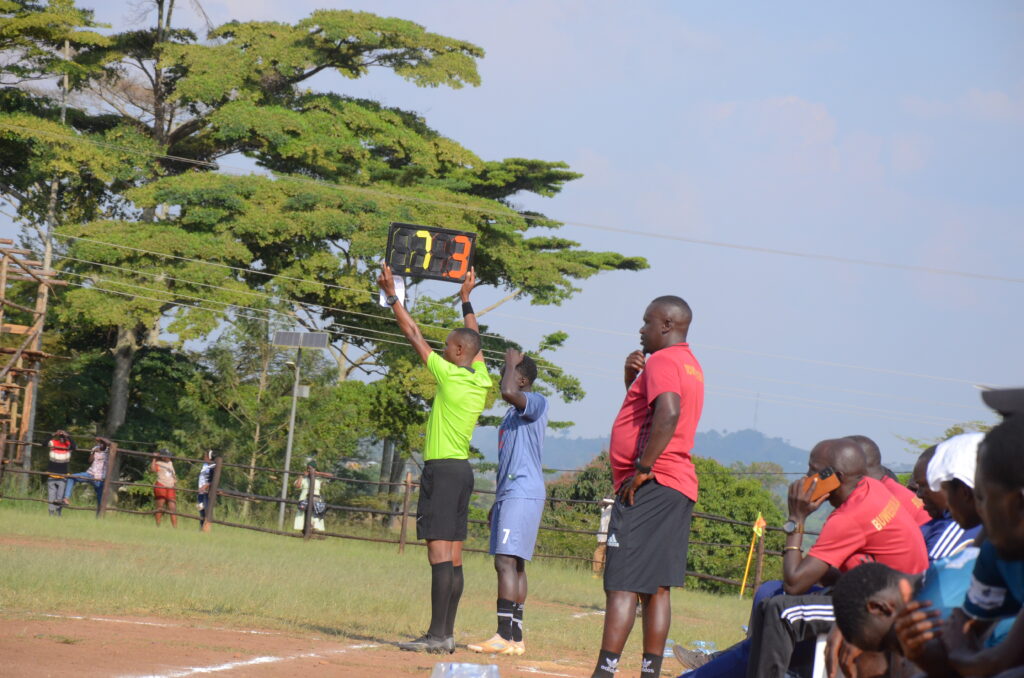
Substitutions in a settled match are among the most readable decisions in sport, because the manager is no longer trying to win and is therefore doing something else in plain view.
Removing a defender who is on a booking is protection. Removing the two most physically loaded players is a decision about the next fixture. Bringing on a teenager at seventy minutes is a decision about the season. Making no changes at all is also a decision, and in a heavy defeat it is a loud one.
The winning side’s changes are usually the less interesting half, with one exception: what a manager does when the match is won tells you what he is worried about. Withdrawing a key player early in a five-goal lead is a fitness statement, and it is frequently the most newsworthy thing in the second half. Reading changes without inventing motives is a skill in itself, and it sits close to what makes the previous week’s results useful for the coming one.
Angle three: the fixture that follows
A heavy defeat is only occasionally about the ninety minutes. It is often about the week, and the week is documented.
Suspensions accumulated, minutes given to players returning from injury, a squad that has played three matches in seven days, a manager who has now used the same eleven for a month. None of that requires an unnamed source, and all of it is more predictive than the scoreline itself.
The constraint is that this angle drifts easily into speculation about selection, which is the point at which it stops being reporting. What can be written is what is now unavailable, what is now accumulated, and what the calendar says next. What cannot be written is who will play, and the sentence that starts a paragraph with a manager’s likely thinking is the one to cut.
Angle four: the number that was already true
Season-level figures survive a blowout in a way that match figures do not, and this is the angle that gives the numbers a defensible role.
If a side has now conceded first in most of its matches, or if a striker’s finishing has been running above his chance quality for two months, a heavy result is a place to report that trend rather than evidence for it. The distinction is stated in one clause, and the clause is what protects the claim.
The trap is the reverse construction, in which a single lopsided match is presented as the point at which something became clear. Very little becomes clear in a match where one side stopped competing after half an hour. The season number was true before this match and remains true after it, and saying so is both more accurate and more useful than treating ninety minutes as a revelation. This is the same discipline that keeps the growing supply of match data from producing worse writing rather than better.
The two angles that always read as padding
The first is the historical comparison. The heaviest defeat since a date, the first time a club has conceded that many at home in a decade, the worst margin in a fixture’s history. These are easy to obtain and almost always empty, because they describe a coincidence of magnitude rather than anything about the match. A record margin tells the reader that a number was large, which they already knew from the score.
The second is the crowd. Empty seats after the fourth goal, the volume of the away support, ironic cheering, the boos at the whistle. Two sentences of this can be true and useful colour. Four hundred words of it is a reporter with nothing to say about the football, and readers recognise it instantly, because it is the standard filler of every one-sided report ever filed.
Both have legitimate uses. A historical margin belongs in a piece about a decline that has been building for a season, or about a side whose rise has run ahead of the expectations set for it. Crowd reaction belongs in a report when the reaction is itself the event, such as a protest. Neither belongs as the organising idea of a match report, and both are usually reached for when the writer has decided the match itself is not worth explaining.
Numbers that behave badly in a blowout
Half of the standard recap statistics are produced by two teams trying to do the same thing. When one side stops, those numbers stop describing what they normally describe.
Possession inverts first. A team that is four goals down is usually given the ball, and a possession figure in the sixties for the losing side is a description of the winner’s disinterest rather than the loser’s control. Shot counts follow, because a side chasing a hopeless deficit takes low-quality shots in volume, and a team protecting a large lead declines good ones.
Chance quality models are affected in both directions and the effect is not symmetric. Distance covered rises for the losing side and falls for the winner, which is a scoreline effect and gets reported as effort. Pass accuracy for the winning team climbs in the final twenty minutes because the passes are sideways and unopposed.
The workable habit is to take the numbers from the period before the match was settled and say that is what you have done. A shot count from the first half hour describes a contest; the full-time figure describes an hour of something else.
Tone: contempt, sympathy and the space between
Heavy defeats produce the two worst tones in sports writing, and both come from the same discomfort with having nothing structural to say.
Contempt is the more common. Ridicule of the losing side, a catalogue of individual errors, adjectives doing the work that analysis should be doing. It reads well for a day and badly for a season, and it burns the access that would let a reporter explain the same collapse properly in three weeks’ time.
Sympathy is the quieter failure. A report that dwells on the difficulty of the situation, the youth of the squad and the unfairness of the calendar has stopped describing what happened. Between the two is the register that survives: specific, unsurprised, harder on structures than on individuals, and willing to say plainly that a team was outclassed without turning it into a character study. Codes of practice that govern reporting elsewhere, such as those published by professional journalism bodies, are mostly about that same distance.
Structuring a report with no turning point
The chronological order is the default because it is the easiest, and it is the worst available here. Three structures work better.
The first is mechanism first. Open with how the losing side came apart, place the goals inside that explanation as evidence, and treat the rest of the match in a short passage near the end. The second is consequence first: open with what the result changes, in the table, in the squad or in the fixture list, then explain how the match produced it.
The third is the split report. Treat the match as two distinct events, a contest and an exhibition, mark the point where one became the other, and cover them differently and at different lengths. That approach is honest about what the second half was and it gives the numbers somewhere sensible to live, which is broadly what the conventional news structure was designed to do in the first place.
Whichever is chosen, the second half needs less room than the first. A report in which the final forty-five minutes take up half the words is a report that has not decided what it is about.
Frequently Asked Questions
Should the report be shorter than usual?
Often, yes, and editors resist it. A one-sided match contains less to explain, and a report that is honest about that reads better than one padded to a standard length. Where a longer piece is required, the extra length should come from the losing side’s context rather than from more description of goals.
Is it fair to write mostly about the losing team?
It is usually the accurate choice. A comfortable win is frequently the less complicated half of the story, and the collapse is where the explanation lives. The obligation is to give the winners credit for what they actually did rather than treating the result purely as somebody else’s failure.
Can possession and shot figures be quoted at all?
They can, with the window stated. Figures from the passage while the match was competitive support real claims. Full-time figures from a rout describe two different games added together, and quoting them without that caveat is the most common error in this kind of report.
What about a red card that caused the imbalance?
Then the dismissal is the mechanism and the report is about what changed around it: the shape adopted, who was sacrificed, how long the ten men held. That is a stronger structure than the general rout, because the moment is precise and its consequences are directly observable.
How do you avoid the same piece every time a team collapses?
By changing which of the four angles leads. A club that loses heavily three times in a season produces three different reports if one leads on mechanism, one on the schedule and one on a season-long trend the result confirmed. Repeating the same structure is what makes a run of defeats read as one long article.
Decide early which of the four angles the piece is built on, and cut everything that belongs to the others. The version that fails is nearly always the one that tried to keep all four and filled the gaps with the crowd.