
Offside is the shortest genuinely difficult law in football. It fits on a page, it contains no discretion worth arguing about, and it still produces more confident wrong opinions per weekend than every other law combined.
Almost none of the confusion is about the basic idea. Everybody understands the line, the moment the ball is played and the notion of being ahead of the last defender. The trouble sits in five specific situations where the wording says something the intuition does not, and those five recur every single weekend at every level.
Each one below is resolved by what Law 11 actually says, rather than by what the phrase in common use suggests. Two of them are commonly called wrong by broadcasters as well as by supporters.
The five cases, in short
- The deflection. A ball that comes off a defender by accident does not reset anything.
- The deliberate play. A defender who intentionally plays the ball does reset it, and a save is explicitly not deliberate play.
- The second phase. A rebound from the post, the crossbar or the goalkeeper leaves the offside player still offside.
- The goalkeeper off his line. He is not automatically one of the two players who matter.
- Level. Level is onside, and the parts of the body that count are not all of them.
What Law 11 actually says, in three parts
The law has three separate components and most arguments collapse the second into the first. Keeping them apart resolves the majority of disputes without any further knowledge.
First, position. A player is in an offside position if any part of the head, body or feet is in the opponents’ half and closer to the opponents’ goal line than both the ball and the second-last opponent. Arms and hands are excluded, up to the armpit, because they cannot legally score. Being level with either the ball or the second-last opponent is not an offside position.
Second, the moment. Position is judged at the instant the ball is played or touched by a team-mate, not when it arrives, and not when the player starts running. A striker can be ten yards beyond the defence when the ball reaches him and be perfectly onside if he was level at the moment of the pass.
Third, the offence. Being in an offside position is not an offence. It becomes one only when the player becomes involved in active play by interfering with play, interfering with an opponent, or gaining an advantage from a rebound or a deflection. The full wording is maintained by the board responsible for the laws and it is worth reading once in the original.
Five offside rule situations, resolved by the wording
| Situation | Common assumption | What the law says |
|---|---|---|
| Ball deflects off a defender to a player in an offside position | The defender played it, so he is onside | A deflection is not a deliberate play. The offside offence stands |
| Defender deliberately plays the ball to a player in an offside position | Offside, because he was ahead of everyone | Deliberate play resets it. No offence |
| Shot rebounds off the post to a player who was offside | New phase, new decision | Gaining an advantage from a rebound. Offside |
| Goalkeeper is upfield and one defender is back | The last defender is the reference point | The second-last opponent is, whoever that happens to be |
| Attacker is exactly level with the last defender | Offside by a shoulder | Level is onside, and arms are not counted at all |
Two rows in that table produce most of the shouting: the difference between a deflection and a deliberate play, and the rebound off the woodwork.
Case one: the deflection off a defender

A cross is struck, a defender sticks out a leg without controlling anything, and the ball loops to an attacker who was two yards beyond the line when the cross left the boot. The stadium reaction is immediate and wrong: he came off a defender, so it is on.
The law distinguishes between a deflection and a deliberate play, and the distinction is not about intent to help the opponent. It is about whether the defender had control of what he was doing. A stretched leg, a blocked shot, a ball off the shins in a crowded box: these are deflections, and the attacker’s original offside position remains live.
The practical test used by officials is a set of observable factors: whether the ball travelled a distance and the defender had a clear view of it, whether the ball was moving quickly, whether the defender’s action was controlled or a stretch, and whether he had time to coordinate his body. None of them ask what he wanted to happen. That is why a defender who desperately hoofs a ball clear can still be judged to have played it deliberately, and a defender who calmly blocks a shot has not.
Case two: the deliberate play, and why a save is not one
The reverse case is the one supporters find hardest to accept. An attacker stands in an offside position, a defender under no real pressure heads a ball back towards his own area, and the attacker collects it and scores. No offence has been committed.
The reasoning is that the defence has restarted the phase by choosing to play the ball. If a defender in control decides to play it, the attacker’s position at the earlier pass no longer matters, because the ball reached him through an opponent’s deliberate act rather than through the pass he was ahead of.
There is one explicit exception, and it is the exception people forget: a deliberate save is not a deliberate play. A goalkeeper diving to push a shot away has made a save, not a play, and an attacker in an offside position who scores from the rebound is penalised. The same applies to an outfield player making a save-like intervention on the line. The distinction exists because rewarding an attacker for a defender’s emergency action was never the intention of the law.
Case three: the second phase after a save or a rebound
A shot comes back off the crossbar. A striker who was in an offside position when the shot was struck tucks in the rebound. The crowd calls it a new phase. It is not.
Gaining an advantage from a rebound is one of the three ways an offside position becomes an offence, and the sources of rebound are named explicitly: the goalpost, the crossbar, a match official, or an opponent. A rebound from any of those leaves the offside player still liable.
The genuinely new phase begins when the defending team gains control of the ball and plays it, or when a defender deliberately plays it as described above. Until that happens, everything flowing from the original pass belongs to the original phase. This is the situation that generates the longest arguments in a bar and the shortest ones in a referees’ room, and it is a frequent source of clips that circulate for days with the wrong caption attached.
Case four: the goalkeeper off his line

The law never mentions the goalkeeper as a special reference point. It refers to the second-last opponent, and in the overwhelming majority of cases the goalkeeper is the last, so the second-last is a defender and nobody notices the distinction.
When the goalkeeper is upfield, for a corner in the last minute or after a rushed clearance, the two relevant opponents can both be outfield players. An attacker level with the deepest defender is then onside even if he is well beyond everybody else, and an attacker ahead of the second-deepest defender is offside even with a goalkeeper stranded forty yards away.
This is also why a defender lying injured off the pitch, or one who has stepped over the goal line during a phase of play, is still counted. The law treats a defender who leaves the field of play without the referee’s permission as being on the goal line for offside purposes, precisely to prevent a defence from manufacturing an offside by walking off.
Case five: level is onside, and which parts count
The final case is the one now decided by technology and still argued about in the same terms as thirty years ago. A player level with the second-last opponent is onside, and any doubt over whether he is level goes his way.
What counts is any part of the head, body or feet. Arms and hands are excluded to the bottom of the armpit, because a goal cannot legally be scored with them. That is why an image showing a shoulder ahead of a defender can be an offside and an image showing an outstretched hand cannot.
Semi-automated systems have changed the precision of the measurement without changing the law behind it. The line is drawn from the relevant body part of each player at the frame the ball is played, and the tolerance debate that follows every tight decision is about measurement error, not about the wording. The wording has said level is onside for a long time, and it still does.
Position is not an offence until there is involvement
The most common everyday error is not about any of the five cases. It is treating an offside position as an offence in itself, which produces flag-waving from the stand at every counter-attack.
Interfering with play means playing or touching the ball. Interfering with an opponent covers a shorter list than people assume: obstructing the line of vision, challenging for the ball, making an obvious action that affects an opponent’s ability to play it, or making a movement that clearly deceives or distracts. A player standing in an offside position who does none of those things has done nothing wrong, however irritating that looks from the terrace.
This is why assistants delay their flag. Raising it early on a player who never becomes involved would kill an attack that the law permits, so officials are instructed to wait until involvement is clear, which is also why the flag sometimes arrives after the ball is in the net.
Where the assistant is standing, and what he cannot see
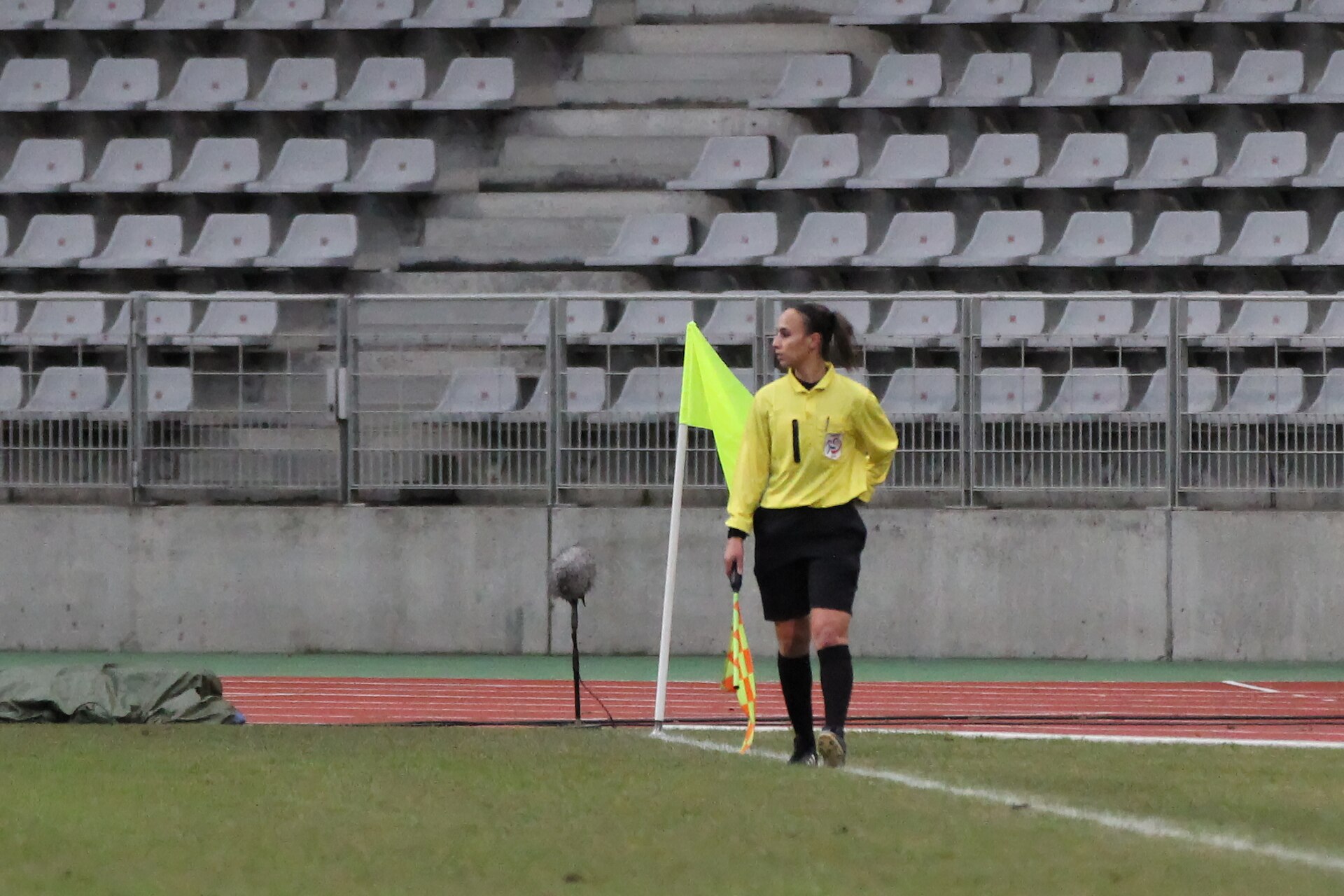
The assistant referee is asked to observe two things that happen in different places at the same instant: the moment of the pass, twenty yards to his left, and the position of the attacker on his line. Human vision cannot fix both simultaneously, and the resulting error is well documented and entirely unavoidable.
The direction of that error is systematic rather than random. Motion and viewing angle produce predictable mistakes on tight calls, which is a large part of why the technology was introduced for this specific decision rather than for others.
It is a reasonable standard for judging an assistant: on a call within a few centimetres, unaided human judgement is not capable of certainty, and expecting it is a category mistake. On a call of a metre, it is capable, and the criticism is fair. That distinction rarely survives contact with a matchday crowd, and it belongs in the same discussion as how officials are treated more broadly.
Two sentences to stop saying
The first is that a player was interfering with play merely by standing there. Involvement is defined, the definition is narrow, and standing in an offside position while play develops elsewhere is not on the list.
The second is that a deflection makes an attacker onside. It does the opposite of nothing: it leaves the situation exactly as it was, and it is the single most repeated error in matchday conversation. If the ball reached the attacker because a defender stretched, blocked or was hit by it, the original offside stands.
Both errors have the same root, which is a mental model of offside as a moving line rather than a rule about a single frozen instant. Once the instant is fixed in mind, all five cases resolve themselves, and a great many disputed calls turn out to have been correct while unpopular. That is also true of decisions that end up defining an entire season in retrospect.
Frequently Asked Questions
Can a player be offside from a throw-in?
No. There is no offside offence from a throw-in, a goal kick or a corner kick. This is stated in the law itself and it is the reason attacking sides can stack the far post at a corner without any risk of being penalised for position.
Is a player offside if he receives the ball in his own half?
No. Offside position requires the player to be in the opponents’ half. A striker standing on the halfway line, level with it, is not in an offside position however far ahead of the defence he appears to be.
What happens if a defender steps off the pitch to play the offside trap?
He is still counted. A defender who leaves the field of play without permission is treated as being on his own goal line for the purposes of judging offside until the next stoppage, which removes any advantage from doing it deliberately.
Why do assistants keep the flag down when the attacker is clearly ahead?
Because position alone is not an offence, and because raising the flag early would wrongly stop a legal attack. The instruction is to wait until involvement in active play is clear, which in a fast counter-attack can mean waiting until the ball is in the net.
Does the same law apply in every competition?
The wording of Law 11 is common to the game worldwide, though the technology available to check it varies enormously. A tight call reviewed frame by frame in one competition is decided by one official’s eye in another, which changes accuracy without changing the standard being applied.
Fix the instant the ball is played in your mind, then ask whether the player was involved and whether a defender deliberately played it. Nearly every offside argument in football is a disagreement about one of those two questions and nothing else.