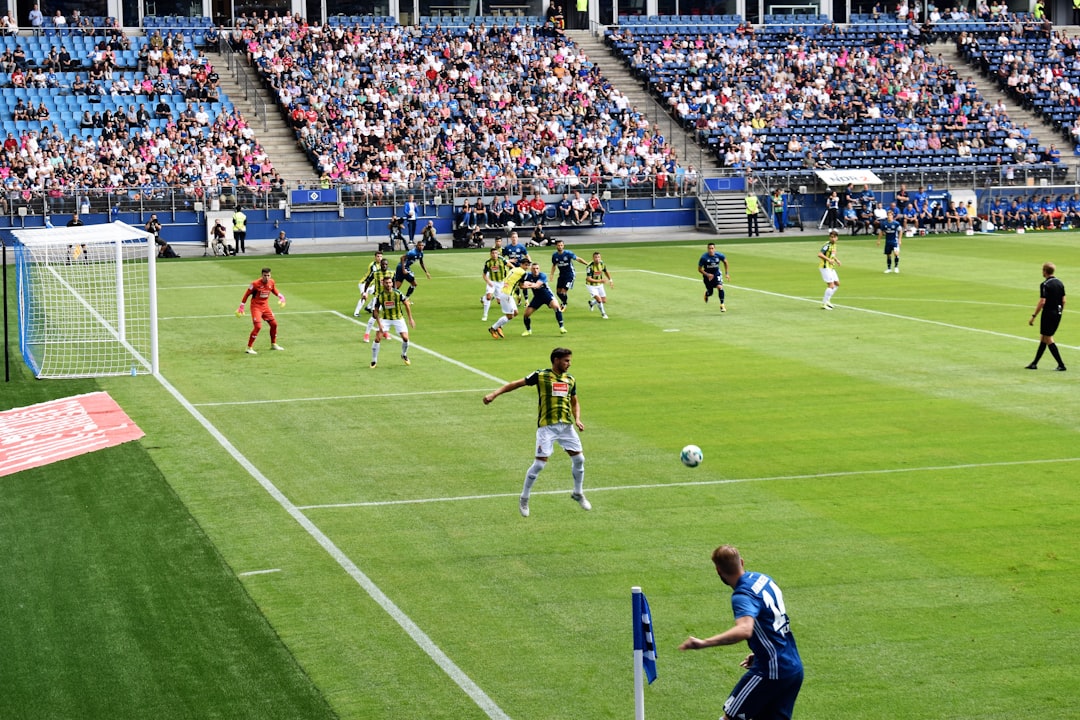
A left-footed player collects the ball near the right touchline, level with the top of the penalty area. The stand wants the cross. He takes three touches inward instead, and by the time he strikes it he has travelled about ten metres across the pitch and none at all toward the goal.
By distance he has gained nothing. He is no nearer than when he received it. By the measurement that governs a shot he has roughly doubled the amount of goal in front of him, and the gap between those two readings is the whole reason the run exists.
The arithmetic is ordinary trigonometry with two fixed lengths in it: a goal 7.32 metres wide, and a penalty area 16.5 metres deep. Everything else follows from where the ball sits when the foot arrives.
The short version
- The unit of measurement. Not distance to goal, but the angle the goal mouth subtends at the ball. Two shots from 20 metres can differ by a factor of three on that number.
- On the touchline. From the right flank at the depth of the penalty-area line, the goal covers about six degrees. That is what a striker sees from seventy metres straight in front of it.
- The metres worth paying for. The steepest gain sits roughly eight to twenty metres off centre. Inside that corridor each metre travelled inward is worth close to a full degree.
- Where the run stops. The final four metres to the middle add barely a degree, while the number of bodies in the way climbs. That is why the shot goes from the corner of the box and not the centre spot.
- Two windows. A narrow angle offers a small gap inside the near post or the whole width of the far corner. The curl on a left foot from the right channel is built for the second one.
- The defensive answer. Forcing the carrier eight metres wider costs him about as much angle as pushing him twenty metres further out through the middle.
Why the inverted winger exists at all
Putting a left-footed player on the right is not a modern invention, but the reason it became standard is narrow and mostly geometric. A wide player who runs to the byline with his strong foot delivers the ball. A wide player whose strong foot is on the inside converts the same starting position into a shot, and he does it by moving toward the goal rather than away from it.
That changes what the defender is defending. Against an orthodox winger the full-back protects the outside and accepts the cut inside, because the cut inside ends in a weak-foot shot from a poor angle. Against an inverted winger the same choice hands over the most valuable ten metres on that side of the pitch.
None of this makes the pattern efficient by itself. The shot at the end of it is still taken from outside the box more often than not. What it does is convert a wide position, worth almost nothing to a shooter, into a central one without the passing sequence that would normally be needed to get there.
Six degrees on the touchline, twenty-five in the middle
The honest way to describe a shooting position is the angle between the two posts as seen from the ball. It sounds abstract until you convert it into something familiar: the distance at which a player standing directly in front of goal would see exactly the same angle.
All the positions below sit on one line across the pitch, 16.5 metres from the goal line, which is the depth of the penalty-area line. Only the sideways position changes.
| Position across the pitch | Distance to goal | Angle between the posts | Same angle as a central shot from | Goal presented |
|---|---|---|---|---|
| Right touchline | 34 m | About 6 degrees | About 70 m | 3.6 m |
| Penalty-area line | 26 m | About 10 degrees | About 41 m | 4.7 m |
| Half-space, 12 m off centre | 20 m | About 17 degrees | About 25 m | 6.0 m |
| Inside the arc, 8 m off centre | 18 m | About 20 degrees | About 20 m | 6.6 m |
| Central | 16.5 m | About 25 degrees | 16.5 m | 7.3 m |
The last column is the width of goal the striker is aiming at once the mouth is seen at an angle rather than square on. From the touchline it is 3.6 metres, less than half the goal, and the keeper has to cover only that. From the middle of the same line it is the full 7.3.
The fourth column is the one worth memorising. A shot from the right touchline at that depth is geometrically a shot from seventy metres. On a pitch of normal length that is deep inside the other half.
The metre that buys the most
The gain is not spread evenly across the carry, which is the part most descriptions of the pattern miss. Moving in from the touchline to the penalty-area line, a distance of roughly ten metres, adds about four and a half degrees. Moving from the penalty-area line to eight metres off centre, a distance of twelve metres, adds more than ten.
Per metre, the exchange rate peaks somewhere between eight and twelve metres off centre, where each stride inward is worth close to a full degree. Outside twenty metres the ball is in the flat part of the curve, and a player carrying it sideways out there is paying in time and in defenders for very little angle.
This is why the good version of the run is diagonal rather than lateral. Every touch that goes inward and forward collects the angle and the distance at once. The player who drifts square across the pitch is buying the same degrees at a worse price, and giving the covering defenders the time to arrive while he does it.
Why the run stops at the corner of the box
If more central is better, the obvious question is why the carry ends where it does instead of continuing to the middle. The numbers answer it. From eight metres off centre to dead centre, at the same depth, the goal opens by about four and a half degrees. The final four metres of that are worth roughly one degree between them.
Meanwhile the cost of those metres rises sharply. The middle in front of the box is where the screening midfielder sits and where two defenders converge from opposite sides. The carrier is buying one degree in a room that is filling up.
So the shot leaves from the top corner of the penalty area, which is the point where the marginal angle and the marginal risk cross. Watch enough of these and you will notice how consistent that release point is across players who otherwise have nothing in common.
Two windows, not one
A narrow angle does not present one target, it presents two, and they demand opposite things. There is the strip inside the near post, which is small, close, and requires the ball to beat the keeper’s front foot before he can transfer weight. And there is the far corner, which is the widest part of the available mouth but sits at the end of a much longer flight.
The near-post window rewards speed and disguise, because it is only open while the keeper is still setting. It closes the moment he is square and low, and it is the one most often chosen when the shot arrives early, before the defence has settled.
The far-post window is the opposite trade. The ball travels further and the keeper has more time, but the target is wider and a goalkeeper who has shifted toward the near post has to cover ground rather than just reach. Every attacker in that channel is choosing between those two windows, and the choice is usually made before the last touch.
What the curl is for
Struck with the inside of the left foot, a ball bends toward the striker’s right. For a left-footed player carrying into the right channel, facing the goal from the outside, right is the direction of the far post. The curl and the run point at the same window.
That is not decoration. A ball hit straight at the far corner from a narrow angle crosses the keeper’s whole body and gives him the full width of his dive. A ball that starts toward the middle of the mouth and bends late gives him a wrong first read: he sets for one path and has to reverse.
The other function is clearance. A curled shot can leave the foot on a line that passes outside the nearest defender’s leg and still finish inside the post, which a straight strike from the same position cannot. In a channel crowded with bodies, the ability to bend the ball around one of them is often what makes the shot possible at all.
The keeper’s share of the mouth
Goalkeeping positioning on these shots is usually explained as narrowing the angle, which is accurate but incomplete. What actually happens is a change in proportion. A keeper’s reach and dive cover a roughly fixed span. When the target is 7.3 metres wide, that span is a fraction of the goal. When the target is 3.6 metres wide, the same span is most of it.
So the keeper’s job from a wide shot is not really a saving job, it is a positioning job. He takes the near-post side, stands a step off his line to shrink the far side by geometry rather than by movement, and accepts that a perfect strike into the far corner beats him. That is a considered concession, not an error, and it is worth remembering before a replay is used to blame someone.
It also explains a goal that always looks worse than it is: the one that goes in at the near post from a tight angle. Sometimes that is a keeper beaten at his own post. Often it is a keeper who had shifted to protect a far corner that was, on the numbers in front of him, the larger part of the target.
Show him outside, and what that is worth
The full-back’s instruction against an inverted winger is usually described as showing him outside, and it is treated as a stylistic preference. It is a measurable one. Pushing a carrier from the penalty-area line out to eight metres from the touchline drops the angle from about ten degrees to under seven. In central terms, that is the difference between a shot from forty metres and one from sixty-three.
The body shape that produces it is specific. The defender leads with the foot nearer the touchline, turns the near shoulder to close the inside lane, and stays slightly deeper than the attacker rather than pressing square. He is not trying to win the ball at that moment. He is trying to make the inside route slower than the outside one, because he has help outside and no help inside.
The failure mode is well known: a defender who dives in with the wrong foot forward opens the inside step and hands over the expensive metres in one movement. Most of the coaching on the point is about footwork rather than aggression, which is a theme that runs through structured defensive coaching generally.
The second defender decides it
No full-back closes this alone. The angle he concedes on the inside is meant to be covered by somebody else, and which somebody depends on the shape behind him.
In a back four the near-side centre-back steps out to occupy the shooting line while the rest of the line slides across. This kills the shot and creates the pass, because the space the centre-back vacated becomes the run for a striker in behind. In a back five the wing-back can hold the touchline while a wide centre-back handles the inside step, which is the tidiest answer to this problem and the main reason the shape is used against sides with two of these players.
The screening midfielder has a narrower job: stand in the shooting line, not near the shooter. A body that is a metre off the line does nothing at all, while a body on the line forces either a chip, a curl the attacker may not have, or another touch that gives the defence a second to arrive. Small distinctions like this decide more possessions than tackles do, and the same principle shows up wherever movement patterns are drilled deliberately rather than left to instinct.
Watching it live from the stand
Television flattens all of this, because a long lens from the side compresses depth and makes every position look more central than it is. From a seat in the ground you get the angle for free, and there are three things worth doing with it.
First, look at the defender’s feet as the ball travels, not at the ball. The lead foot tells you which route is being conceded before the carrier has decided anything. Second, find the covering player at the moment the winger takes his first touch inside: whether he has already started stepping across is the single best predictor of whether the shot happens. Third, note where the ball is when the foot goes back, and estimate how far off centre it is. With the table above in your head you will know roughly what the shooter was looking at.
The pattern reads most clearly before either side adjusts. A fixture with one of these players on each flank gives you two experiments at once, which is worth checking for before kick-off.
Frequently Asked Questions
Is the angle the only thing that decides a shooting position?
No. Distance, the number of bodies in the flight path, whether the ball is moving and whether the shooter is balanced all matter, and finishing models weigh several of them. The angle is simply the input that changes fastest during the carry, which is why the carry exists.
Does the same geometry apply to a right-footer on the left?
It is the mirror image, degree for degree. The only asymmetry is in the curl: a right foot bends the ball toward the striker’s left, which from the left channel again points at the far post. The pattern is symmetric because the physics is.
Why not just get to the byline and cross instead?
Sometimes that is the better option, and the best wide players keep both. A cut-back from the byline creates a shot for somebody else from a good angle, while the cut inside creates a worse shot for yourself. Which is preferable depends on who is in the box and how the defence has set.
Does the crossbar limit the target from wide positions?
Barely. The goal is 2.44 metres high and from a tight angle the ball has to be kept low anyway to fit under a keeper’s hands rather than over them. The horizontal target is what shrinks; the vertical one is not the constraint.
Where does an inverted winger receive the ball if he wants this shot?
Slightly deeper and slightly wider than the finishing position, because he needs room to travel. Receiving too high and too narrow removes the run, which is why defences try to press these players into a corner where the carry has nowhere to go.
Next time one of these players takes the ball on the right, ignore the goal and watch the defender’s lead foot for two seconds. Everything else in the sequence is decided by which way that foot is pointing.