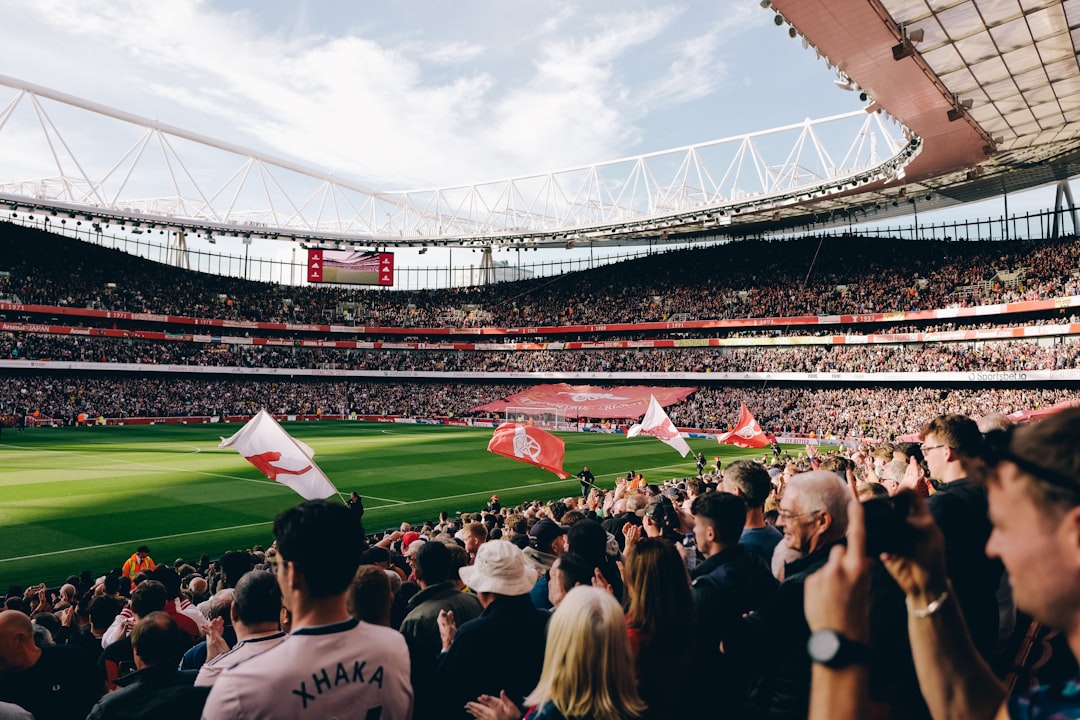

A challenge in the penalty area gets shown four times in ninety seconds and produces four different reactions in the same room. From the main camera it looks like a fair contest for the ball. From the reverse angle it looks like a trip. From behind the goal the two players appear to be nowhere near each other, and from the handheld at pitch level there is contact you could not see in any of the other three.
Nobody is being deceived. Each of those images is an honest record of what a lens at a particular height, distance and angle was able to sample. What changes between them is not the incident but the geometry, and geometry is the part of a replay that almost never gets discussed while an argument is going on.
The camera plan of a live broadcast is a fixed thing, agreed before the teams arrive and largely unchanged from one week to the next. Learning it takes about ten minutes and it permanently changes how a replay reads, because you stop asking what the camera showed and start asking what that position was ever capable of showing.
The camera plan in six lines
- Height answers shape. Spacing, defensive line and off-ball movement are only readable from above. No low camera recovers them.
- Distance answers detail. Contact, hand position and technique need a long lens, which flattens everything behind the subject.
- Alignment answers position. Whether two players are level can only be judged from a camera in line with the plane you are judging.
- Bodies hide things. The most common reason a replay settles nothing is that somebody was standing in the way.
- Frames are samples. A standard camera does not record time continuously, and the instant you want may not exist on it.
- The best angle may never air. Not every position is recorded in isolation, and what the director did not cut to often no longer exists.
Why one incident produces two honest versions
Three optical facts explain almost every replay disagreement, and none of them involves anybody trying to mislead anyone. The first is parallax. Two objects at different distances line up differently depending on where you stand, which is why a defender and an attacker can appear level from one side of the pitch and clearly separated from the other.
The second is focal length. A long lens compresses depth, pulling background toward foreground and making a two-metre gap look like contact. A wide lens does the reverse and makes players look further apart than they are. The tight follow camera and the high wide camera are therefore not two views of the same scene; they are two different accounts of the distances in it.
The third is occlusion, the least interesting and the most decisive. If a body is between the lens and the incident, the information is not in the recording. No amount of zooming, sharpening or slowing recovers a foot that was behind somebody’s leg, and a large share of the replays called inconclusive are inconclusive for exactly this reason.
The standard sports broadcast camera positions, numbered
Football coverage is built around a spine of fixed positions on the main stand side, numbered in a convention that varies slightly between production companies but rarely in substance. Camera one is the high wide on the halfway line. Camera two sits beside or just below it with a long lens as the tight follow. A third position covers the near touchline at a lower height.
Then come the elevated positions in line with the edges of each penalty area, commonly called the eighteen-yard cameras, and low positions behind or beside each goal at around six yards. Opposite the main stand sit the reverse angle cameras, usually two of them, mirroring the eighteen-yard positions from the far side. Handhelds and a steadicam work at pitch level along the touchlines and behind the goals.
Beyond that spine are the specialist positions: a high tactical camera behind one goal, an aerial cable camera, robotic cameras in the goal frame and, in competitions that use them, banks of dedicated cameras aimed at each goal mouth or mounted under the roof for tracking. Those last ones are not broadcast cameras in the ordinary sense. They exist to feed a decision system, and much of what they capture is never shown at all.
Camera one: the high wide, and the shape it protects

The main camera sits high on the halfway line because that is the only position from which the whole structure of a team is legible at once. Distance between the lines, the height of the defensive line, whether a full-back has tucked in, where the free player is: all of it is a function of relative position on the ground, and relative position on the ground needs elevation to read.
What the high wide gives up is everything small. Faces are unusable, hand and arm detail is gone, and the difference between contact and near-contact is below the resolution of the shot. It is the camera that tells you what the team was doing and almost nothing about what any individual did.
There is a second, less obvious property. Because it is roughly on the halfway line, the high wide is badly aligned for any judgement about players being level with each other near a goal. It is looking down the pitch at a shallow angle, which is the worst possible geometry for that particular question and the reason a main-camera view of an offside call is close to worthless.
The tight follow, and what a long lens does to distance
The tight camera lives beside the high wide and does the opposite job. It carries the face, the technique, the ball on the foot and the reaction afterwards, and it is the shot that most highlight packages are built from because it is the one that reads well on a small screen.
Its optical cost is compression. A long focal length makes objects at different depths appear to occupy similar distances, so a defender trailing by two metres can look like he is on the attacker’s shoulder and a challenge that missed by a foot can look like a collision. Viewers absorb this without noticing, and it is one of the largest single sources of disagreement about physical contact.
The rule of thumb is that a long lens is trustworthy about what a body did and untrustworthy about how far that body was from another one. When the question is whether a foot was raised or an arm extended, compression does no harm and the detail is available nowhere else.
The eighteen-yard and six-yard positions
The elevated cameras level with the edges of the penalty area exist to solve the geometry problem of the halfway line. Because they sit roughly in line with the eighteen-yard line, they look across the pitch rather than down it, which makes them much better placed to judge whether two players are level and much better placed to see into the box.
They are still not perfect for it. Being level with the eighteen-yard line does not make a camera level with a defender standing eleven yards out, and that residual angle is why review systems calibrate their images rather than trusting the picture. What these positions reliably give is a clear line of sight into crowded areas from a height where bodies do not stack up as badly.
The low positions near the six-yard box do a different job again. They sit at or near ball height, which is the correct height for judging whether a ball has crossed a line, whether a foot was on the ground and whether a shot was rising or dipping. They are the worst cameras in the ground for context and among the best for a single specific question.
The reverse angle exists because bodies hide things
Every camera on the main side shares one blind spot: the far side of every player. A defender’s trailing arm, an attacker’s inside foot and a hand on a shirt are all on the wrong side of the body from the main stand, and no amount of resolution helps.
The reverse positions exist for that reason alone. They are usually fewer, sometimes lower, and often shot with less expensive equipment, which is why the reverse angle can look noticeably softer on screen. Producers tend to avoid cutting to it during live play because switching sides breaks the viewer’s sense of which way each team is attacking, so it appears almost exclusively in replays.
This produces a pattern worth watching for. A replay sequence that goes to the reverse angle early almost certainly involves something hidden from the main side. A broadcast that shows the same main-side angle three times and never crosses over is telling you the reverse camera was blocked, pointed elsewhere, or never recorded in isolation.
Behind the goal, and the problem it cannot solve
The high camera behind a goal is the tactical view. It shows depth better than any other position, which makes it the best available angle for defensive line height, for the space between midfield and defence, and for how a press is arranged. Coaching staffs request it as a matter of routine and it is the view most analysis clips are drawn from.
It is also poor at the question people most expect it to answer. Looking straight down the pitch, it has almost no ability to judge whether two players are level, because both are moving along its axis of view rather than across it. Depth is what a lens measures worst.
That is the underlying reason automated and semi-automated positional systems exist at all. Rather than choosing one camera and trusting the image, they combine calibrated inputs from several positions and reconstruct where bodies were in three dimensions. The graphic that appears on screen afterwards is a rendering of that reconstruction, not a photograph, which is why it looks so much more precise than any single frame ever does.
Basketball: the same logic, different geometry

| Position | Height | What only it shows | What it cannot settle | Typical replay use |
|---|---|---|---|---|
| Main high wide, centre court | High | Spacing, off-ball movement, defensive rotation | Contact, foot on line | Almost never used for review |
| Low corner slash | Low | Drives to the rim from a shallow angle | Anything on the far side of the key | First replay of a finish at the basket |
| Baseline handheld | Ground | Hand and body contact in traffic | Where anyone was on the floor | Foul calls under the basket |
| Overhead and rim | Above | Ball above the cylinder, feet relative to a line | Who initiated contact | Goaltending and shot-clock questions |
| Stanchion | Backboard | The moment of release, straight on | Everything outside the paint | Buzzer and continuation reviews |
The court is small enough that one high camera can hold the whole play, which is why basketball coverage looks simpler. The questions are just as geometric. Whether a foot touched the three-point line is an alignment problem only an overhead or baseline position can answer.
Handhelds, aerials and the shots that cost the most
Pitch-level handhelds and steadicams deliver the images that travel furthest afterwards: the tunnel, the substitution, the reaction on the touchline, the celebration. They are also the least useful cameras for judging anything, because they are at the height of the players themselves and therefore see the same obstructed world the players see.
Aerial cable cameras occupy the opposite extreme. They can be placed anywhere over the pitch, which sounds like it should solve everything, but their position is never certain enough for a measurement and their movement adds its own distortions. They are a storytelling tool, not an evidential one.
Cost shapes the plan as much as usefulness does. High-frame-rate cameras, robotic mounts and aerial rigs are expensive enough that only a subset of matches in any competition gets the full complement, which is why a knockout tie and a routine league fixture can produce very different replay coverage of identical incidents. What looks like inconsistency in officiating is sometimes just a difference in how much equipment was in the building.
What a replay cannot recover
A broadcast camera does not record time continuously. It samples it, at a rate set by the system the market is built on: European coverage descends from a fifty-hertz standard and North American coverage from sixty, which is one reason the same replay feels slightly different in each. Super slow motion cameras sample at a multiple of that base rate, commonly three or six times, and ultra-motion positions higher still.
The consequence is blunt. Between two consecutive frames of a standard camera, a struck ball travels a real and measurable distance, and if the moment you care about fell between them it was never recorded. Slowing the footage down does not create the missing instant; it only shows you the two frames either side of it for longer. This is the root of the frame-selection problem in any positional review, and it is a property of sampling rather than a failure of anybody’s equipment.
Two more losses are worth knowing about. Motion blur means a fast-moving foot or ball occupies a smear rather than a point, so the apparent position depends on where in the smear you decide to look. And every stage of distribution re-encodes the picture, so the version on a phone has been through more compression than the version in the production truck. When an argument comes down to a few centimetres, the file people are arguing over is rarely the best one that exists. That gap between what was captured and what the public sees is a large part of why disputed incidents spread the way they do, and it is why the technical side of broadcasting has been standardised for decades by bodies such as the European Broadcasting Union. The same standards underpin the tracking feeds behind most performance analytics work.
Frequently Asked Questions
Why does a replay sometimes look like a completely different incident?
Because a change of camera is a change of geometry. Moving the lens alters which objects line up with which, how compressed the depth appears and what is hidden behind whom. Both views are accurate records of what those positions could sample, and they can support opposite conclusions without either being wrong.
Which angle should be trusted for a tight positional call?
The one aligned with the plane being judged, which is rarely the one that looks most dramatic. For a line, that means a camera in line with the line. For anything else it means an image that has been calibrated rather than simply chosen, which is what positional review systems do and what the eye cannot.
Why is the reverse angle usually lower quality?
Less a lower-quality camera than a less-resourced position: fewer of them, sometimes shorter lenses, occasionally robotic mounts rather than operators. It is also lit from a different direction, which changes how the picture reads even when the equipment matches.
Do the cameras used for automated decisions ever appear on television?
Rarely, and usually only as the source of a rendered graphic. They are aimed and calibrated for measurement rather than framed for viewing, so their raw output is close to unwatchable as coverage even though it is the most useful record in the stadium.
Can a broadcast recover an angle it did not cut to live?
Only if that camera was recorded in isolation. Positions recorded separately can be pulled up minutes or years later; positions that exist only inside the program feed survive as whatever the director happened to select. That single production decision determines whether a disputed incident has a second witness.
Next time a replay settles nothing, stop watching the players and identify the camera. Ask what that height, that distance and that angle were physically able to record, and the argument usually resolves itself into a question about geometry rather than about honesty.