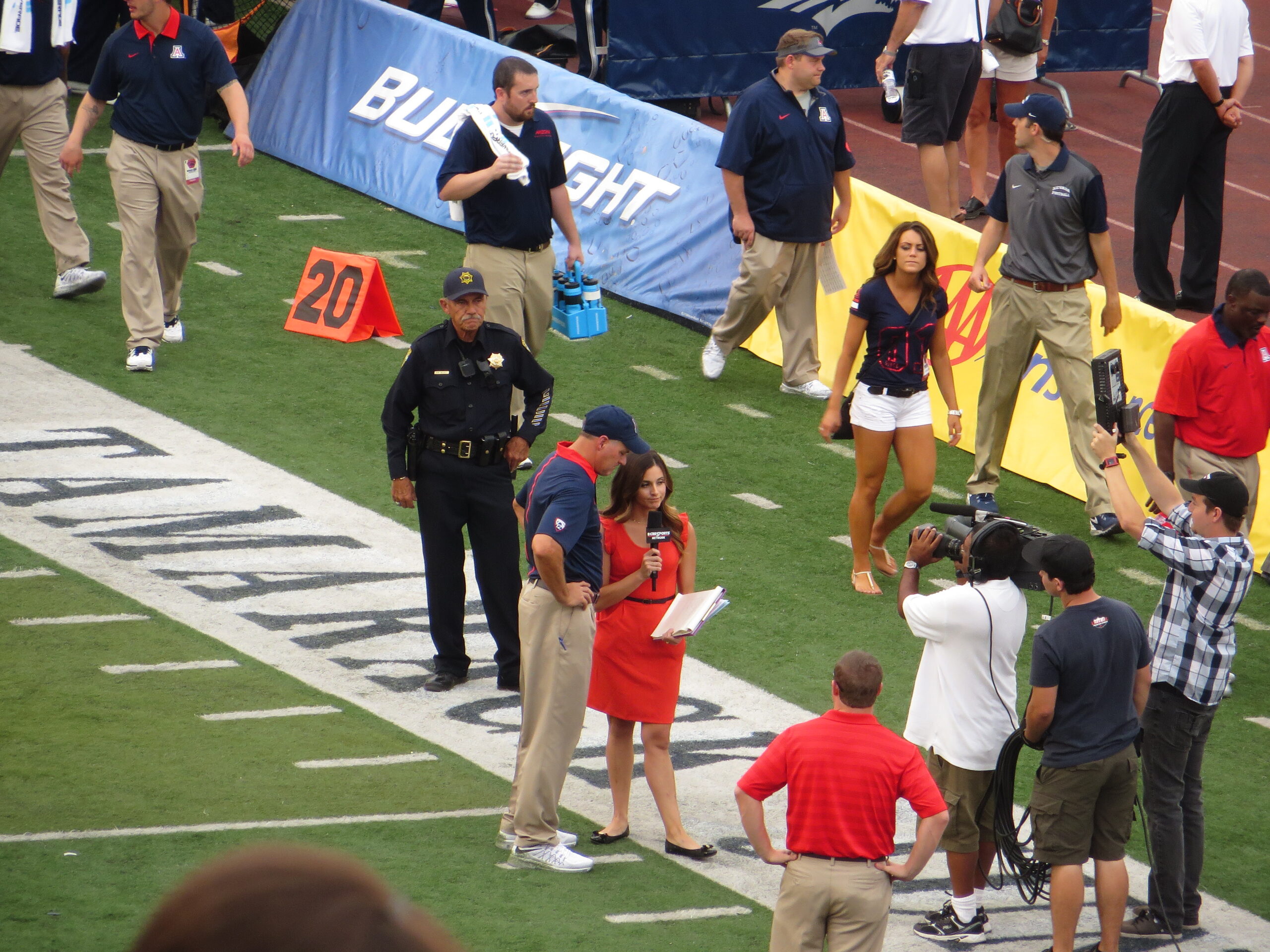
The camera finds an athlete seconds after he has stopped running, breathing hard, sweat still forming, a microphone arriving in front of his face before his heart rate has come down from whatever it reached in the final sequence of play. He is asked three questions. He gives three answers. Almost none of it is usable a week later, and almost none of it was ever going to be.
This is not a failure of any single interviewer. It is the predictable output of a format built around a set of constraints that make good answers structurally unlikely: physical adrenaline, ambient noise, a contractual obligation the athlete did not choose, and a producer counting down in someone’s ear the entire time.
Understanding those constraints does not fix the format, because most of them are not fixable within the time available. What it does is explain why the sideline interview format so reliably underperforms its own premise, and what a better two-question structure can pull out of the same forty seconds.
The format in six lines
- The window. Roughly thirty to forty-five seconds, dictated by the broadcast clock, not the conversation.
- The state. The athlete is interviewed at or near peak physical adrenaline, seconds after finishing.
- The obligation. Participation is usually contractual, not voluntary, which shapes tone before a word is spoken.
- The environment. Crowd noise and ongoing action compete directly with the exchange.
- The default output. Three short, low-information questions producing three short, low-information answers.
- What actually helps. Fewer questions, asked with more room, rather than more questions asked faster.
What a sideline interview is actually built for
The sideline slot exists primarily to serve the broadcast’s need for a live, in-the-moment element between segments of play, not to produce the most informative possible exchange with the athlete involved. That distinction explains almost everything else about how the format behaves.
A producer needs a fixed, predictable block of time that fits neatly around commercial breaks and studio segments, and the interview has to fill that block reliably whether the athlete has anything substantive to say or not. The format is optimized for timing and presence, not for depth, and every other feature of it follows from that priority.
The four constraints working against the interviewer
Physical adrenaline is the first and least discussed. An athlete interviewed within a minute of finishing a competitive effort is often still processing basic physiological arousal, which measurably narrows the kind of reflective, nuanced answer a calmer conversation could produce.
Ambient noise is the second, and it does two things at once: it forces both parties to raise their voices and simplify their phrasing, and it frequently drowns out the more interesting, quieter parts of an answer that a controlled setting would capture cleanly. Contractual obligation is the third. Many athletes participate because a league or broadcast agreement requires it, not because they chose to, which produces answers calibrated for minimal risk rather than maximum insight.
The producer’s countdown is the fourth, and it operates on the interviewer rather than the athlete, cutting a promising follow-up short not because the answer was finished but because the clock has run out.
The sideline interview format, second by second
A typical exchange breaks down roughly as follows: five seconds of introduction and setup, ten to fifteen seconds for the first question and answer, a similar block for the second, and whatever remains, often under ten seconds, for a third question that rarely receives a complete answer before the broadcast cuts away.
Within that structure the interviewer has almost no room to follow up on anything unexpected. A genuinely interesting first answer, one that opens a thread worth pulling, is nearly always left unpulled, because the format has already allocated the remaining time to a second and third question written in advance and unlikely to change regardless of what the first answer contained.
Why the standard three questions rarely produce anything
Three separate questions in forty seconds means each one gets, at best, ten to fifteen seconds of total exchange, which is barely enough time for a simple factual answer and nowhere near enough for anything requiring genuine reflection. The format rewards athletes who have pre-prepared short, safe answers and punishes anyone attempting something more considered, since a considered answer that runs long gets cut off mid-thought.
The three-question habit also spreads the athlete’s attention across three unrelated prompts rather than allowing depth on one, which means the interview typically produces three shallow data points instead of one that might have actually revealed something, a trade that almost never favors the viewer.
Adrenaline as an information problem, not just a nerves problem
The physiological state immediately after competition affects more than composure. Elevated arousal narrows attention and favors well-rehearsed, low-effort responses over the kind of specific, situational recall a good answer about a particular play or decision would require.
Some of the broader mental mechanics behind that state are covered in general work on the mental strategies elite athletes rely on, most of which assumes a calmer setting than a sideline microphone ever provides. This is why athletes so reliably reach for stock phrases like giving it everything or taking it one game at a time in these settings specifically, more than in a calmer post-match press conference held twenty or thirty minutes later. The physical state is doing real work in producing the cliche, not just habit or media training alone.
The producer’s countdown and what it cuts
Every sideline interview is conducted with an earpiece relaying a live countdown from a producer managing the broadcast’s overall timing, and that countdown takes priority over the content of the conversation whenever the two conflict. An interviewer hearing wrap it up has no real choice but to comply, regardless of whether the athlete was mid-sentence on something worth finishing.
This constraint is invisible to the viewer but shapes nearly every exchange that runs long. The most common casualty is the follow-up question that would have turned a generic first answer into something specific, cut not because it was a bad question but because the clock reached zero before it could be asked.
A two-question structure that does more
The most effective sideline interviewers working within this format have largely converged on a similar solution: ask fewer questions and let each one run longer, rather than trying to cover more ground in the same total window. Two questions, each given roughly double the time a three-question structure would allow, produce noticeably more usable material.
The first question in this structure is typically broad and low-pressure, giving the athlete room to settle into the exchange rather than being asked immediately for analysis. The second is where the actual work happens, usually a specific, concrete question about one moment rather than the match as a whole, since specificity is what survives the adrenaline and the noise better than a general prompt does.
How the format differs across sports and settings
The specific pressures of a sideline interview are not identical across every sport that uses the format, even though the underlying constraints are the same in kind. A basketball sideline exchange during a timeout carries an especially tight window, often under twenty seconds, because the broadcast clock is tied directly to a fixed break in play rather than a more flexible stoppage.
Readers following weekly matchday insight coverage will recognize how often the halftime clip ends up carrying more substance than the full-time one. A pitch-side football interview conducted at halftime typically allows a slightly longer exchange than an in-play equivalent, since the athlete has a few extra minutes to recover physically before the microphone arrives, though the same contractual and noise pressures still apply in reduced form. Motorsport post-session interviews sit at the other end of the spectrum, often conducted with the athlete still seated in the vehicle, cooling down from far higher physical exertion than a viewer typically appreciates, which layers an additional physiological constraint on top of the four described earlier.
What stays constant across all of these variations is the underlying trade the format makes: speed and reliable timing in exchange for depth. No sport has found a way around that trade within the live broadcast window itself, which is part of why the supplementary formats described elsewhere in this piece have grown rather than the live slot itself changing shape.
What a good sideline answer actually sounds like
The answers that end up quoted and replayed later are almost never the ones responding to open, general prompts like how does it feel. They are responses to specific, concrete questions, about one decision, one moment, one exchange with an opponent, that the athlete can answer from direct memory rather than having to construct a reflective summary on the spot.
This is consistent with the physiological limits described earlier. Specific recall of a recent, vivid event is easier to produce under adrenaline than abstract reflection is, which means the format’s own constraints point toward concrete questions as the better tool, even before considering time pressure at all.
When the format works despite itself
The sideline interview occasionally produces something genuinely valuable, usually in moments of high emotion immediately following an unexpected result, where the athlete’s guard is down precisely because the outcome overrode the usual instinct toward a safe, rehearsed answer.
These moments are not reproducible by technique alone. They happen because the emotional stakes of the specific situation temporarily override the format’s usual constraints, which is why the most memorable sideline exchanges tend to cluster around upsets, eliminations and record-breaking performances rather than routine wins.
How broadcasters have started adjusting around the format
A number of broadcasters have responded to these limits not by abandoning the sideline slot, which still serves its original production purpose, but by building supplementary formats around it that carry less of the time pressure. This mirrors a wider pattern in how fan engagement has evolved in the digital age, where a second, less constrained format often does the real work a live broadcast slot cannot. Extended, digital-only interviews recorded minutes later, after the immediate adrenaline has settled slightly, increasingly run as separate online content rather than being squeezed into the live broadcast window.
Mic’d-up access during the event itself, capturing an athlete’s real-time reactions without the structure of direct questions at all, has become a parallel approach for some leagues precisely because it sidesteps several of the four constraints simultaneously. There is no interviewer competing against a countdown, and the athlete is not required to construct an answer on demand, which tends to produce more natural material even though it sacrifices the specific, guided quality a well-run question-and-answer exchange can offer.
Neither adjustment replaces the live sideline slot, which still delivers exactly what the broadcast needs in the moment: a recognizable, in-the-moment human element between segments of play. What both adjustments suggest is a growing recognition, inside production teams themselves, that the live sideline window was never going to be the place where the most substantive material actually got captured, and that building a second, less constrained format around the same access point captures more of it without requiring the live format to change.
Frequently Asked Questions
Why do athletes give such similar, generic answers in sideline interviews?
A combination of physical adrenaline, time pressure and contractual obligation pushes toward short, low-risk, well-rehearsed phrasing rather than reflective analysis, regardless of the individual athlete’s usual communication style.
Would giving athletes more time produce better answers?
Likely yes for depth, though the broadcast’s timing constraints make this impractical within the current format. It is part of why longer post-match press conferences tend to produce more substantive material.
Is the countdown pressure visible to viewers watching at home?
Rarely directly, though its effects are visible indirectly whenever an interview cuts away mid-answer or a follow-up question that seemed obvious is never asked.
Why do the best sideline interviewers ask fewer questions rather than more?
Because splitting limited time across three questions produces three shallow answers, while concentrating it on two allows enough room for at least one specific, usable exchange.
Do athletes have any real choice about participating in sideline interviews?
Often not. Many leagues and broadcast agreements require participation as a condition of the athlete’s contract, which shapes the tone of the exchange before either party speaks.
The sideline interview is not badly executed. It is a format asked to do something its own constraints make difficult, and the best it can usually offer is one specific, honest sentence squeezed out of forty seconds that were never built to hold much more than that.