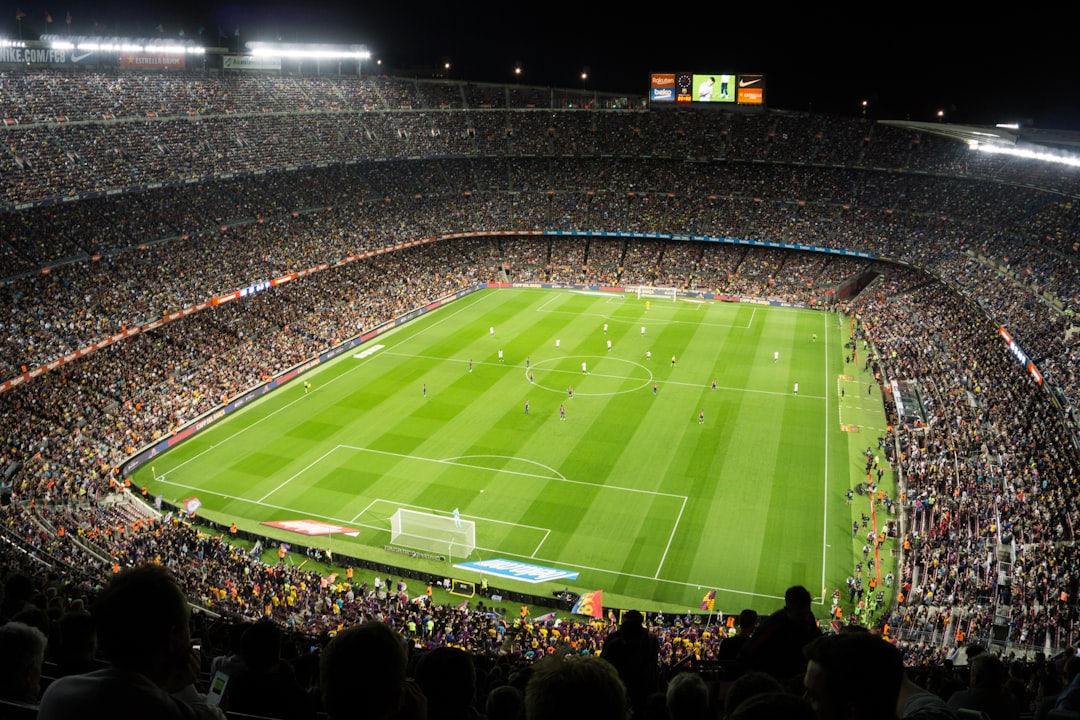

A corner is the only moment in a football match when twenty-two players stop moving, look at each other and wait. The ball is stationary inside a marked quarter-circle. The referee has halted play. Both benches have had somewhere between fifteen and forty seconds to shout instructions at people who can actually hear them. Nothing else in open play hands a coach that.
So almost every senior side turns up with set pieces drilled to the step. Most of them fail, because most corners are cleared, and that failure rate is what makes the successful ones look like accidents. They are not. They were drawn on a board, walked through at half pace on a Friday, and are now being run in front of you with the timing of a fire drill.
The useful part is that the design gives itself away before contact. A rehearsed routine needs specific runners in specific places on a specific beat, and getting them there takes two or three seconds of visible arrangement. Learn what the arrangement is for and you can name the routine while the taker is still walking back to the flag.
What to watch, before the ball moves
- The taker’s approach angle. A right-footed player taking from the left side, running in from wide, is almost always sending it toward goal. The reverse angle sends it away.
- Where the deepest attacker stands. Anyone starting outside the penalty area is a runner, not a target. He is there because he needs a run-up.
- Bodies that are not attacking the ball. Two players standing still in traffic are usually screens, and the runner leaving from behind them is the target.
- The stack. Four attackers queued in single file are hiding assignments from defenders who have to pick up men.
- The number at the flag. A second player jogging toward the corner arc changes the whole geometry, and the defence has to answer it before the ball is struck.
- The beat. Everything above happens in the last two seconds. Watch the arrangement, not the kick.
Why a corner is the one moment a coach fully controls
Open play resists instruction. By the time a coach has identified a pattern, shouted it and been heard, the situation has moved on. A corner freezes the game long enough for a plan to be communicated and executed, which is why set pieces are now a specialist discipline with their own staff.
Two rules make the area behave unlike anywhere else on the pitch. There is no offside offence from a corner kick, so attackers may start and finish as deep as they like, including inside the six-yard box. And opponents must stand at least nine and a bit metres from the corner arc until the ball is in play, which is what makes a short corner a genuine threat rather than a novelty.
Remove offside and you remove the reason attackers normally time their arrival from outside. What replaces it is congestion. Ten or eleven bodies in an area roughly forty metres by sixteen, most of them stationary, all of them capable of getting in each other’s way. Every routine in the sport tries to solve that congestion in favour of one runner.
Four corner kick routines, and what each one buys
The designs below cover the overwhelming majority of what a senior side will run. They are not exclusive; a stack can end in a near-post flick, and a short corner can be the first move of a screen. But the starting arrangements are distinct enough to be named from the stand.
| Routine | What starts it | Where separation appears | Tell before the kick | Usual answer |
|---|---|---|---|---|
| Near-post flick | A flat, fast inswinging delivery | At the flick specialist’s first stride, not at contact | One attacker starting well outside the box on a diagonal | A defender posted on the near post zone |
| Screen and release | Two static attackers in a marker’s path | The instant the runner clears the screen | Players who are looking at the ball but not moving toward it | Switching the marking scheme to zonal |
| The stack | Four or five players queued single file | At the break, one beat before contact | A queue that forms late and holds | Zonal blocks that do not have to follow anyone |
| Short corner | A second and sometimes third player at the flag | When a defender leaves the box to close it | Somebody jogging toward the corner arc | Sending exactly one defender, and no more |
The column that repays attention is the third. In every case the separation is created before the ball arrives, and often before it is struck. By the time the delivery is in the air the routine has already succeeded or failed.
The near-post flick, and the beat that decides it
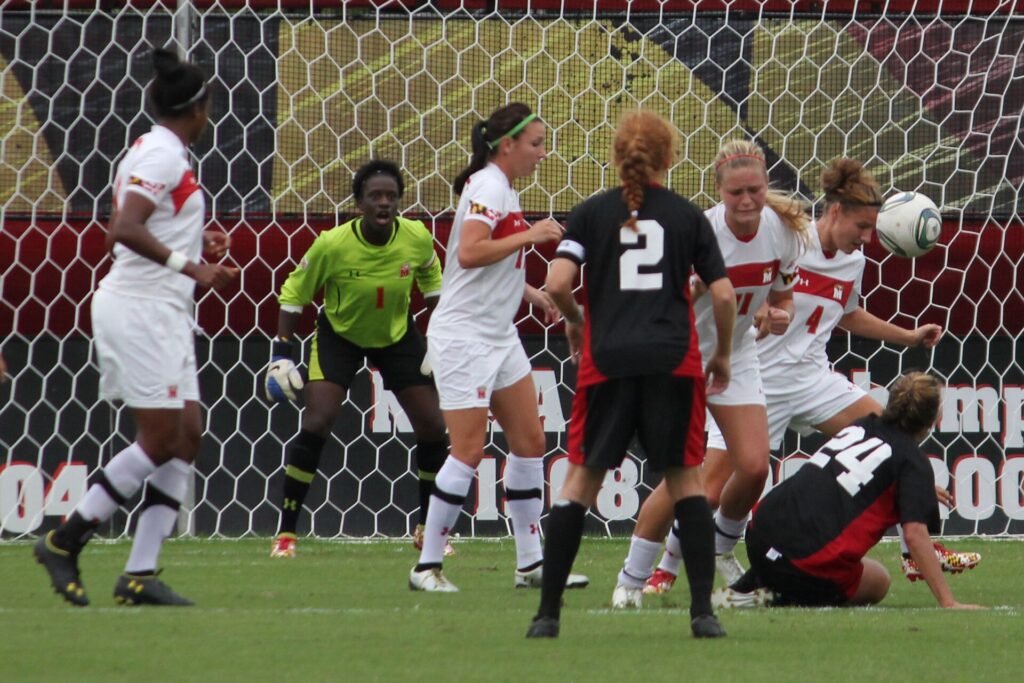
The delivery is inswinging, driven flat and hard, and aimed at a band of air roughly level with the near post and above head height for most of the players under it. It is not a cross to a striker. It is a pass to a redirection.
The specialist attacking that ball almost never starts inside the box. He begins eight or ten metres outside, on a diagonal, because he needs to be moving faster than the man marking him at the moment they meet the flight of the ball. That head start is the entire routine. A flick-on works when the attacker arrives with momentum against a defender who has to turn and jump from standing.
What happens behind him is the point. Two or three runners are attacking the far post and the space between the six-yard line and the penalty spot, and they are running onto a ball that has changed direction once and is now travelling away from a goalkeeper who has already committed his weight toward the near side. The tell is simple: if one attacker is standing conspicuously far from goal as the taker settles the ball, watch him, not the crowd in the middle.
The screen, the release, and where blocking stops being legal
Screening is the most misunderstood part of attacking set pieces, because the border between the legal and illegal versions is narrow and depends on movement rather than contact.
The design is simple. One or two attackers occupy the ground a key defender has to travel through: the route from a marker to the target zone, or the path a goalkeeper would take to claim. The runner starts behind them and leaves across their backs. The defender is now a body-length behind and has to go around rather than through.
The laws draw the line at impeding. Standing still in a position an opponent wants is not an offence, and an opponent who runs into a stationary player has generally created his own problem. Moving into an opponent’s path to block him, holding, pushing or leaning is an offence, and doing it in the penalty area is a penalty rather than a free kick. The Laws of the Game also treat the goalkeeper’s freedom of movement inside the goal area as specifically protected, which is why attacking sides put screens on outfield markers and are far more careful in front of the keeper.
The stack, and why it forms late
A stack is four or five attackers standing in single file, usually somewhere between the penalty spot and the near edge of the six-yard box, facing the corner taker. On a signal they break in different directions: one to the near post, one to the far, one dropping to the penalty spot, one holding.
Against man marking this is an assignment problem. Five defenders have to find five attackers who are all occupying the same two square metres, and they have to do it while the ball is arriving. Contact and confusion in that queue are not accidents; they are the product being sold.
The reason it forms late is that a stack held for ten seconds gives the defence time to line up alongside it and turn the problem into a simple footrace. Formed in the last two seconds, it does not. Watch for a group that drifts together without apparent purpose as the taker places the ball, then locks into a line. That is the moment to stop watching the ball entirely.
The short corner is a spacing problem, not a trick
Short corners get treated as a sign that a team has run out of ideas. They are usually the opposite: the most direct attack on the congestion that makes the other three routines difficult.
The nine-metre exclusion forces a decision. Send nobody and the two attackers get a free pass and an unpressured cross from a better angle. Send one and the box is a defender short. Send two and it is two short, which is what the attacking side wanted, and the ball goes back into a penalty area that has just been emptied.
The angle matters as much as the numbers. A ball delivered from the corner arc travels almost along the goal line, which is hard to attack and hard to defend. Move the delivery point ten metres up the touchline and the same flight crosses the six-yard box rather than skimming it, which turns glancing headers into shots. Sides with real aerial threats often go short purely to reposition the delivery.
Reading the run-up: three tells before contact
The taker’s approach carries more information than anything else on the pitch, and it is visible from any seat.
Foot and side decide swing. A right-footed player taking from the left touchline naturally curls the ball toward goal; the same player on the right curls it away. Teams that want an inswinger from both sides put a left-footer on one flag and a right-footer on the other, and a taker crossing to the far corner tells you the shape of the delivery before he has taken a step.
The approach angle refines it. A run-up starting wide, almost from the touchline, opens the body and produces the driven flat ball a near-post flick needs. A tighter, straighter approach from behind the ball produces the hanging, floated delivery aimed at the far post. And the raised arm is not decoration: most sides signal, and the signal is usually visible one beat before the runners move.
Where the screens stand tells you the target
If you can only watch one thing, watch the players who are not moving. In a rehearsed corner there are almost always two of them, and their positions are a map of where the ball is going.
Screens set near the penalty spot protect a runner heading to the far post. Screens set on the edge of the six-yard box, facing outward, protect a near-post attacker. A single body standing directly in front of the goalkeeper, doing nothing at all, is the most obvious signal in the sport: the delivery is coming to the six-yard box and somebody wants the keeper to arrive late.
The counter-tell belongs to the defence. Two defenders posted on the goal line, one at each post, is a side that expects a delivery to hang. A defender standing alone at the near post while everybody else marks a man is a side that has watched video and expects the flick. That kind of preparation is one of the least glamorous parts of how modern squads structure their training week, and it shows up almost entirely in moments like these.
What the defence is telling you back
Defensive set-ups come in three families, and each is an admission about what the coach fears.
Pure man marking says the side is worried about specific players and will accept traffic and screens in order to follow them. Pure zonal says the opposite: it fears the design more than any individual, so it posts bodies in fixed spaces. Screens do not work against a defender who has no man to be screened from.
Almost nobody plays either in pure form. The common arrangement is a zonal spine of three or four across the six-yard box, man markers on the genuine aerial threats, one player on each post and one outside the area for the clearance. Counting those roles takes four seconds and tells you which routine the attacking side has probably prepared, because staffs scout defensive schemes the way they scout everything else in a build-up to a significant fixture.
Practising the read across one half
Pick a side and watch only their corners, and only the four seconds before contact. Say out loud which of the four designs it is before the taker strikes the ball. Being wrong is fine and quick to check.
Two habits speed this up. First, find the deepest attacker as soon as the corner is awarded, because he is the runner in three of the four designs. Second, count the players inside the six-yard box, because a routine that puts four bodies in there is asking for a scramble and a routine that leaves it empty is aiming for the penalty spot.
The replay will not help you here. Broadcast cuts to a tight shot as the taker approaches and the arrangement leaves the frame, which is why corners look improvised on television and drilled in the stadium. On a wide angle, the two seconds before the run-up are worth more than the rest of the clip, and they are the part almost every highlight package removes. A coaching staff builds these patterns over months, and none of that work survives in a six-second video of the header.
Frequently Asked Questions
Can a player be offside from a corner?
No. The Laws specify that there is no offside offence directly from a corner kick, which is why attackers can start inside the six-yard box and stand behind every defender without consequence. The exception is what happens afterwards: once the ball has been played on again in open play, the ordinary offside law applies from that moment.
Is blocking a defender at a corner actually allowed?
Standing in a position an opponent wants is allowed. Moving into his path to obstruct him, holding him, pushing him or leaning on him is not, and inside the penalty area those offences are punishable by a penalty kick. The practical distinction officials apply is whether the attacker was static and legally placed or whether he moved to create contact.
Why do teams put a player in front of the goalkeeper?
To delay the moment the keeper can leave his line and claim the ball. It is legal as long as the player does not move into the keeper’s path or make contact, and the goalkeeper’s freedom of movement inside the goal area is protected more strictly than an outfield defender’s. Referees watch this specific interaction closely.
Are inswinging corners better than outswinging ones?
They solve different problems. An inswinger travels toward goal, so any touch tends to help it and a goalkeeper who misjudges it is in serious trouble, but it also invites him to come and claim. An outswinger moves away from the keeper and toward attackers arriving with momentum, which suits sides who want to meet the ball running rather than jumping from standing.
Why do so few corners produce goals?
The defending side has more bodies in the area, the ball spends most of its flight above head height where contact is unreliable, and any deflection ends the sequence. The value of a rehearsed routine is not that it converts often; it is that it converts more often than an aimless delivery into a crowd.
Next corner your side wins, ignore the ball for four seconds and find the two players standing still. They are the design, and they will tell you where it is going long before the crowd works it out.