
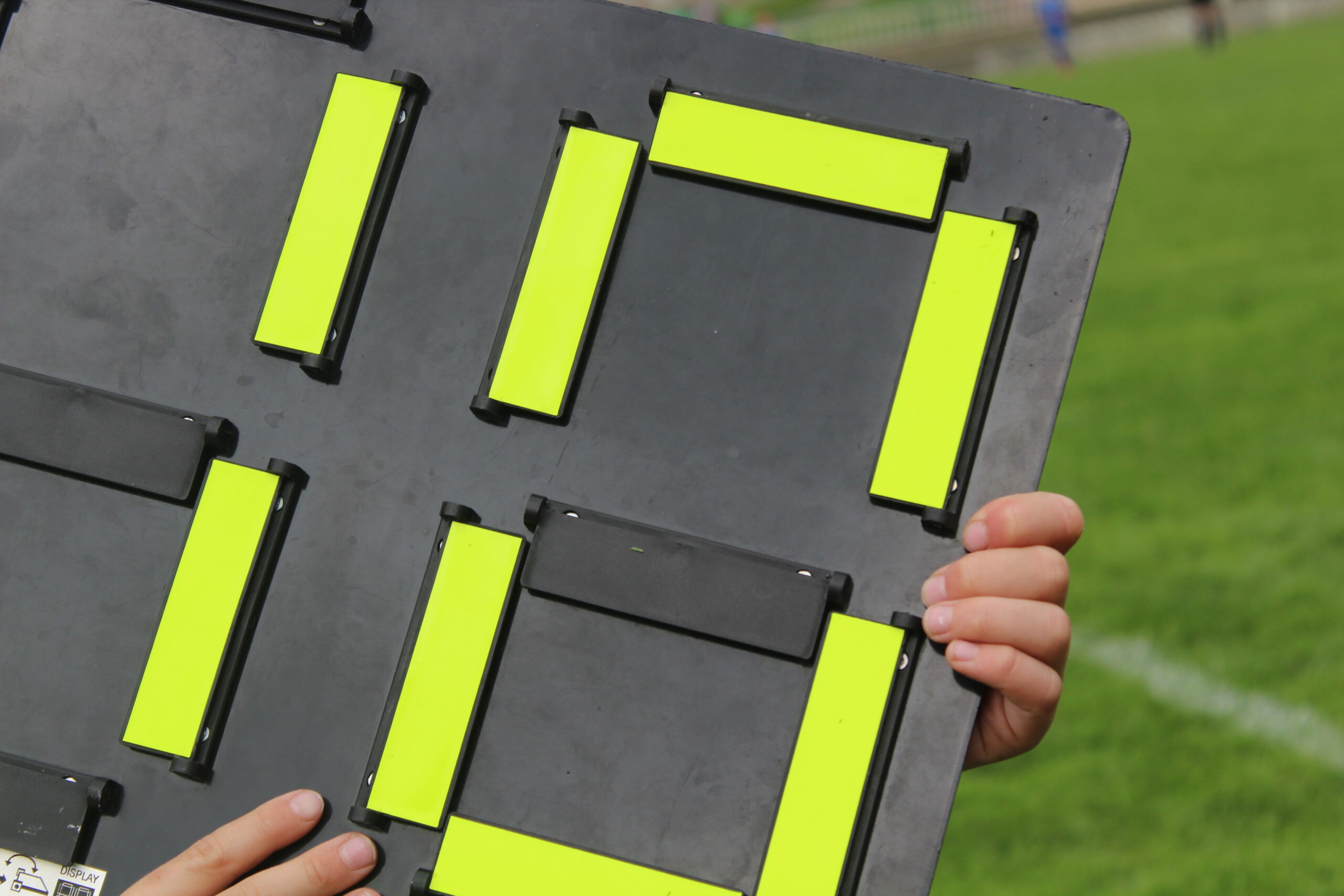
A team a goal down brings on three attackers in a single stoppage, the opposition responds by bringing on a fresh back line, and four minutes later the shape of the match has nothing in common with the one that existed before either bench moved. None of that was possible with three changes. All of it is routine with five.
The jump from three substitutes to five is usually described as a workload concession, and it was one. It is also, with far less discussion, a rewrite of how the last ten minutes of a close match are actually played, because five changes concentrated into three windows do something that three changes spread more thinly never did.
What follows sets out what the rule actually allows, what sits outside it, and what five changes does to fatigue, tempo and time-wasting once a match enters its final quarter of an hour.
Five numbers, and what each one changed
- Five. The substitute limit per team, up from three in most senior competitions.
- Three. The number of stoppages allowed to use them, plus half-time.
- One. The additional concussion substitute, which does not count against the five.
- Zero. The net cost of a like-for-like swap under a permanent concussion substitute.
- Variable. How much time gets added back, which depends on the competition and the referee.
- The trap. Treating a late substitution as automatically defensive, when the numbers say otherwise as often as not.
What a substitution window is actually for
Before the window rule, five substitutes without a limit on stoppages meant five separate interruptions, each with its own walk to the touchline, its own board held up, its own restart. Matches with two heavily rotated benches could lose several minutes to nothing but this.
The window solves a different problem than the substitute count solves. The count is about player welfare across a congested calendar. The window is about protecting the product: a match can still absorb five changes without turning into a procession of stoppages, provided the changes are bunched into three moments plus the half-time interval.
A coach who wants all five changes therefore has to plan them in batches, which is itself a tactical decision. Bringing on two at once uses a window efficiently; saving one substitute for a ninetieth-minute switch and using the other four earlier in two windows is a different plan entirely, and the choice says something about what the coach expects to need late.
The five-substitute rule, and why three stoppages replaced five

The rule itself is simple to state and easy to misapply. A team may make up to five substitutions, but only within three stoppages in normal time, with the half-time interval free of charge and not counted against that total.
The consequence that trips people up is what happens when a fourth window would be needed. If a team has used three stoppages and still has a substitute available, that player cannot enter unless one of the remaining windows in extra time, where competitions allow it, provides another chance. In practice this pushes coaches to use multiple substitutes per window rather than save them individually, which is precisely the behaviour the rule was designed to produce.
The rule also interacts with law on player welfare in a way that is easy to miss: a team is never forced to use all five, and a team that makes only two or three changes across the match has simply managed its windows differently, not broken any part of the rule.
The concussion substitute sits outside the count
Permanent concussion substitutes were introduced separately from the five-substitute change, and the two are frequently confused because they arrived within a few years of each other in most major competitions.
A concussion substitution does not use one of the five permitted changes, and the team conceding the player does not lose a like-for-like swap from its normal allowance. Some competitions allow the opposing team an additional substitute of its own at the same stoppage, specifically so that a concussion assessment does not hand a tactical advantage to whichever side happens to make the change.
The distinction matters for reading a match honestly. A side that makes what looks like six substitutions has not been given an extra allowance by accident; one of those changes was a mandatory response to a head injury assessment, and it should be read that way rather than folded into the count of tactical decisions the coach made.
What five changes does to the last ten minutes
Three substitutes, used carefully, could refresh a forward line or shore up a defence. Five substitutes, used in the same closing period, can functionally rebuild a team: a new front three, a new double pivot, a full change of full-backs, all inside one stoppage in front of a tiring opponent that has already used its own allowance.
This is the part of the rule that changed the shape of matches rather than just the fitness of squads. A team leading by one goal with fifteen minutes to go faces an opponent that can field what amounts to a different eleven for the closing stretch, at a moment when the leading side’s legs are at their heaviest.
The asymmetry runs the other way too. A side that has already used its five changes by the seventieth minute has nothing left to answer with, and every subsequent injury or tactical problem has to be solved with the players already on the pitch. Five substitutes is not simply more of the old resource; it changes when a coach is willing to spend the resource at all.
Fresh legs against tired legs, priced in seconds
The physical case for the rule was built on sprint data: distance covered and high-intensity efforts both fall sharply in the last fifteen minutes of a match played at full substitute limits of three, and they fall further in a compressed fixture schedule.
Two fresh legs entering at the seventy-fifth minute do not simply replace tired legs on a like-for-like basis. A substitute at full sprint speed against a starter who has covered ten kilometres creates a gap that shows up specifically in the actions that decide matches: the recovery run, the closing-down sprint, the last stretch of a counter-attack.
| Situation | Typical effect of a late change | What it does not guarantee |
|---|---|---|
| Attacking substitute, team chasing | Raises tempo and direct running at the back line | Does not create chances by itself without service |
| Defensive substitute, team leading | Restores concentration and closing speed late | Can concede the aerial or physical advantage it replaces |
| Like-for-like at the same position | Maintains structure while restoring sprint capacity | Rarely changes the pattern of the match on its own |
| Concussion substitute | Removes a player regardless of the scoreline | Should not be read as a tactical decision |
None of this is a guarantee of a better result. It is a redistribution of physical capacity to the minutes that decide matches most often, which is the reason the rule is discussed in terms of safety even though its clearest visible effect is tactical.
The double substitution as a stalling tool
A single substitute takes time to reach the touchline, receive instructions and walk on. A double or triple substitution multiplies that time, and coaches leading a match late have noticed.
Bringing on two or three players at once inside the same window is defensible purely on tactical grounds, and it also reliably eats forty to ninety seconds of match time in a period where every second matters to the side that is behind. Officials are aware of the pattern, which is one of the reasons added time has grown rather than shrunk since the rule changed.
The overlap between a genuine tactical substitution and a stalling substitution is difficult to separate from the stands, and it is one reason the added-time totals discussed elsewhere on this site under how competitions have evolved their late-game rules keep climbing even as the underlying law stays the same.
Time wasted, and what the fourth official adds back
Recent instructions to referees specifically flag substitutions as one of the categories of time that must be estimated and returned, alongside goal celebrations, injury treatment and video reviews.
The addition is not a fixed number per substitution. Officials are trained to note the actual duration of the stoppage, including the walk off and the walk on, and to add that time rather than a standard allowance. A stoppage padded by a slow substitution should, in principle, be recovered in full at the end of the half, which removes some of the incentive for using the change purely to run down the clock.
In practice the recovery is imperfect. A team that gains a tactical rest during the stoppage keeps that benefit even if every second is added back, because the benefit was never really about the clock. It was about giving eleven tired players forty extra seconds to stand still.
Reading a late substitution as a signal, not a guess
A substitution in the final fifteen minutes carries more information than the position of the player coming on. The timing, the window used and what remains in the coach’s allowance all narrow the possible explanations.
A substitute introduced with two windows still unused suggests the change is planned rather than reactive. The same substitute introduced in a team’s third and final window, with nothing left in reserve, suggests either an injury the coach was forced to address or a decision made under real pressure with no fallback available. Reading the remaining allowance is a habit that pairs well with the broader discipline covered in how tracked data is changing what counts as evidence in a match, because both depend on watching what a decision costs rather than only what it produces.
Where the rule still differs by competition
Not every competition adopted five substitutes at the same pace or with the same conditions, and the differences are a regular source of confusion for viewers moving between leagues.
Some domestic leagues delayed adoption by a season or more after it became available, citing competitive balance concerns for smaller squads. Extra-time allowances also vary: several competitions grant a sixth substitute specifically for periods of extra time, on top of the five available in normal time, while others do not. The number of permitted stoppages can differ too, with some competitions folding the additional window into existing breaks rather than adding a new one.
The practical advice for a viewer is to check the specific competition’s regulations rather than assume the version seen most often applies everywhere, because the gap between rule sets is exactly where confident-sounding claims about a coach breaking the rules tend to be wrong.
Frequently Asked Questions
Does a concussion substitute count toward the five-substitute limit?
No. It is a separate allowance introduced for player welfare, and the team conceding the substitution does not lose one of its five changes as a result.
Can a team use a fourth substitution window?
Not in normal time under the standard version of the rule. Three stoppages plus half-time is the limit, so a coach with substitutes still available after the third window cannot use them until any extra-time windows, where a competition provides them.
Why do double substitutions happen so often late in matches?
Partly tactical efficiency, since one stoppage covers two changes, and partly a practical way to use match time while a team is protecting a lead. Officials are instructed to add the actual duration back at the end of the half.
Do all competitions allow five substitutes?
Most senior competitions have adopted it, but adoption dates and the exact number of permitted stoppages vary. Some competitions add a sixth substitute for extra time; others do not.
Does more substitutes favour the team that is losing or the team that is winning?
Neither by design. In practice it gives the trailing team more ways to change the pattern of a match late, while giving the leading team a way to reinforce tired legs at exactly the moment an opponent is refreshing its own.
Five changes did not just add capacity to a squad. It moved the decisive substitutions of a match later, concentrated them into fewer stoppages, and made the state of a coach’s remaining allowance as worth reading as the scoreline itself.