
Third and six. The ball comes out roughly a second and a half after the snap, the receiver catches it four yards downfield running inside, and he falls forward past the marker. On the broadcast it is a routine completion, filed under short passing game and forgotten by the next commercial break.
Inside that second and a half, a quarterback has taken a pre-snap reading of one defender’s alignment, confirmed or discarded it after the snap, and chosen between two receivers running in opposite directions. Neither receiver was the primary target in any absolute sense. Which one was correct was decided by a defender who touched neither of them.
That structure is what makes this the most-called two-man combination in the sport at every level from high school upward. It does not need a great receiver, it does not need protection to hold, and it converts against most of what a defence can show, provided the man throwing it reads the right person.
The concept in six lines
- The shape. One receiver breaks inside at a shallow angle, another runs to the sideline underneath him. Two routes, opposite directions, same throwing window in time.
- The target. Not a receiver. A defender, usually the one responsible for the flat, who cannot cover both.
- The clock. Three steps from under centre, one from the shotgun. If the ball is still in the quarterback’s hand on the fourth step, the concept has already failed.
- The pre-snap read. Leverage and cushion on the outside receiver. It tells you what is likely, not what is true.
- The post-snap read. The flat defender’s first two steps. Widens, throw inside. Squats, throw outside.
- The separation required. Coaches usually work to about three yards of horizontal daylight at the catch point. Less than that and the throw belongs somewhere else.
What third down actually asks for
A third down with five to eight yards to gain is a narrow problem. The offence needs a completion that reaches the marker, delivered before pressure arrives, without exposing the ball to a defender who can turn it around.
That rules out most of the passing game. Deep concepts take too long. Crossing routes take too long. Anything requiring a receiver to win a contested catch introduces a failure mode that ends the drive rather than merely stalling it. What is left is a small family of quick-game concepts that get the ball out before the rush matters.
The horizontal stretch is the most efficient member of that family because it does not require anyone to beat anybody. It requires one defender to be wrong, and it is constructed so that he is wrong whichever choice he makes. The offence is not attacking a player, it is attacking an assignment.
The slant flat concept, snap by snap
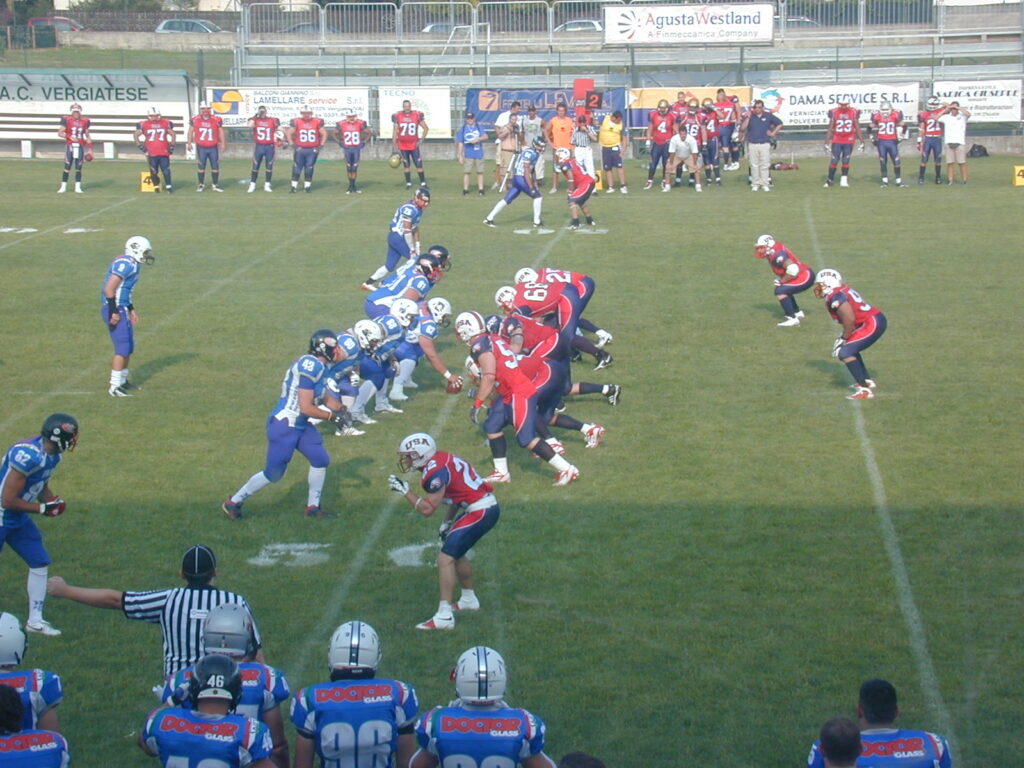
Two receivers to one side. The inside one, usually a slot or a tight end, releases immediately toward the sideline and settles at two to four yards deep, facing back to the ball. The outside one takes three steps upfield, plants on the outside foot and breaks inside at roughly forty-five degrees, climbing as he goes.
Between them sits the defender responsible for the flat area. In some coverages that is a cornerback, in others an outside linebacker or a nickel back. Whoever he is, he has one body and two receivers entering his zone at almost the same moment, going opposite ways.
The quarterback’s job is not to find an open man. It is to watch that one defender and throw away from him. If the defender chases the flat route toward the sideline, he has vacated the space the slant is climbing into. If he holds his ground or squeezes inside to wall off the slant, the flat route is uncovered with a lot of grass in front of it. There is no third option available to him, which is the entire design.
The pre-snap read: leverage and cushion
Before the snap, the quarterback is looking at one thing on the outside receiver: where the defender’s body is relative to the route the receiver is about to run.
Outside leverage with five or six yards of cushion is the friendliest picture there is. The defender is aligned to the field side and is backing off, so the inside break happens away from him and into space he cannot reach quickly. Inside leverage is the opposite: the defender is already standing where the receiver wants to go, and the slant becomes a route that has to be won rather than a route that is simply run.
Press alignment changes the problem again. A defender lined up on the receiver’s face is trying to disrupt the release, and the timing that makes this concept work is the first thing a jam destroys. Against press, the receiver has to win the first step inside, and if he cannot, the ball goes to the flat by default. None of this is a decision yet. It is a prediction, and the snap will either confirm it or not.
The break: depth, angle and the beat it happens on
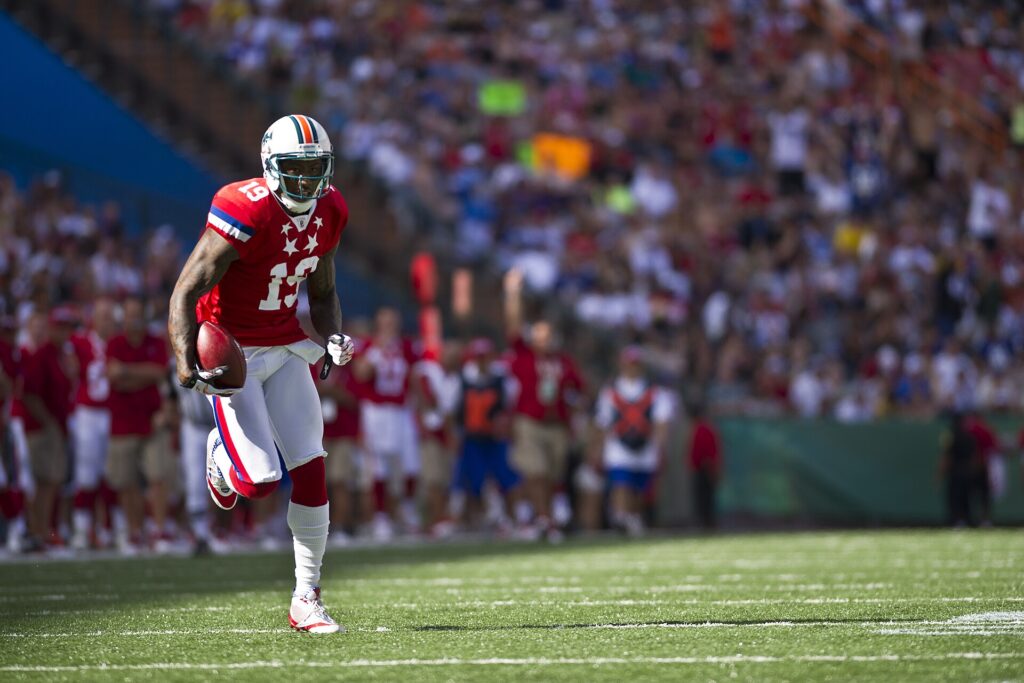
The slant is a timing route, which means its depth is defined by steps rather than yards. Three steps for most receivers, planted hard on the outside foot, with the break happening at somewhere around five to six yards depending on stride length.
The angle matters more than the depth. A break that is too flat, close to horizontal, runs the receiver across the face of underneath defenders and into traffic, and it also fails to gain the yardage the down requires. A break that is too steep, closer to a post, takes too long to create horizontal separation and arrives after the throwing window has closed. The working angle climbs while it crosses.
The beat is fixed on both ends. The quarterback’s third step and the receiver’s third step have to happen at the same time, which is why this concept is drilled to exhaustion and why an unfamiliar pairing runs it badly. The familiarity between two players who have repeated something thousands of times is not a sentimental idea here. It is the difference between the ball arriving at the break point and arriving a half-step late, which is the half-step a safety needs.
The flat route is not a checkdown
The most common misreading of this concept treats the flat route as a safety valve, something thrown when the real play is covered. It is not. It is one of two primaries, and against several coverages it is the better one.
Its job before the ball is thrown is to force a decision. A receiver releasing hard to the sideline forces the flat defender to honour him, and that honouring is what opens the slant. A flat route run lazily, or run at the wrong depth, lets the defender split the difference and cover neither properly, which is the most common way this concept dies without anybody noticing.
Its job when the ball comes its way is different again. A completed flat route on third down starts behind the marker, so the play only works if the receiver can get north quickly against a defender who is arriving from the inside. That is why the route is usually given to whichever of the two is better in space, and why some coaching staffs will run it from a tight end rather than a slot when the tight end is the more reliable runner after contact.
Against a squatting corner: the vacated hole
In a two-deep zone, the cornerback’s job is to sink and take away the flat while a safety plays over the top. He is not chasing anybody deep, so he can squat aggressively and arrive on the flat route almost immediately.
That aggression is what the slant is built for. When the corner drives on the flat, the area behind him and in front of the safety is unoccupied, and the receiver breaking inside is climbing directly into it. The throw is the same throw, delivered a hair later and with more air under it, aimed at the window between the underneath defender and the safety.
The constraint is the linebacker to that side. If he has depth in his drop and is sitting in the throwing lane rather than chasing the run fake, the window narrows fast. A quarterback who has confirmed the corner is squatting still has to see that linebacker, and this is the single most common source of the interception this concept produces.
Against a bailing corner: the flat and the yards after
In a three-deep zone, the corner turns and runs to protect his third of the field. He is gone. The flat becomes the responsibility of an outside linebacker or a nickel back who starts inside and has to run outward to get there.
That defender is arriving late by design, which means the flat route is open at the catch and the question is what happens next. The receiver catches it at two or three yards with a defender closing from his inside shoulder, and the conversion depends entirely on whether he can turn upfield before contact.
The slant is still there behind the underneath drop, but it is a tighter throw, because the defender who vacated for the flat did not vacate very far and there is a hook defender inside. Most quarterbacks take the free completion here and let the receiver make the down. Against a soft three-deep look on third and four, that is the correct and unspectacular answer.
Man coverage, traffic and the legal edge of a rub
Man coverage removes the conflicted defender entirely. Nobody is reading anybody; two defenders are following two receivers, and the concept becomes a pair of one-on-one races.
It also creates traffic. The two routes cross paths, and a defender chasing the flat route from the inside has to get through or around a receiver breaking the other way. When that contact is incidental to two players running their routes, it is legal and it is the reason this concept is popular against man. When a receiver deliberately blocks a defender before the pass is thrown, it is offensive pass interference, and the distinction is not about how hard the contact was but about whether the receiver was running a route or setting a pick. Officiating that boundary is one of the recurring sources of the arguments that follow a decisive call, because the two situations look almost identical at full speed.
The reading against man is done at the line. Inside leverage on the slant receiver means the flat route is the answer, because his defender is trailing through traffic. Outside leverage means the slant is the answer, because the defender has to cross the receiver’s face to get there.
Coverage by coverage, who the correct target is
| Coverage | Flat responsibility | Correct target | Why | Tell |
|---|---|---|---|---|
| Two-deep zone | Cornerback, squatting | Slant | The corner drives forward and empties the space behind him | The corner’s shoulders staying square as he steps up |
| Three-deep zone | Outside linebacker or nickel | Flat, usually | The defender starts inside and arrives late | The corner opening his hips and running at the snap |
| Single-high man | Nobody, it is a matchup | Whichever route has leverage | Traffic decides it, not zone conflict | Defenders turning to face receivers rather than the ball |
| Quarters with a pattern read | Corner reads the inside receiver | Neither, often | The corner is free to jump the slant when the flat declares | The corner’s eyes on the slot rather than the outside man |
| Fire zone pressure | A dropping lineman or vacated zone | Slant, thrown hot | The underneath area is short a body | An unblocked rusher and a lineman dropping out |
The fourth row is the one that matters. A pattern-reading quarters coverage, where the cornerback keys the inside receiver rather than the man in front of him, is specifically constructed to defeat this concept. If the inside receiver goes flat and shallow, the corner is released from his deep responsibility and can drive on the slant with a safety over the top. That is a defence answering the design rather than reacting to it, and it is the reason offences pair this concept with a vertical route on the backside.
Calling the read before the throw arrives
From the stand or the sofa, this is one of the easiest reads in the sport to call early, because everything you need is visible before the ball moves.
Find the two receivers to one side. Find the defender between them and slightly outside, the one nobody will block. When the ball is snapped, watch only him. His first two steps decide the play, and they happen before the quarterback has finished his drop. Widening toward the sideline means the throw is going inside. Stepping up or squeezing inside means it is going outside.
Two habits make this quicker. Check the outside cornerback’s leverage before the snap and predict out loud, then see whether the snap confirms it. And watch the receiver’s third step rather than the ball, because that is the moment the concept either happens on time or does not. The drilling behind all of it belongs to the least visible part of a week’s work, which is where most modern preparation actually happens, and the standard coverage families involved are catalogued in any reference on zone defensive structures.
Frequently Asked Questions
Why is this concept so common on third and short?
Because it gets the ball out before pressure matters, it converts against most coverages, and it does not require anybody to win a contested catch. On a down where a sack or a turnover is far worse than an incompletion, a concept with a low ceiling and a very low floor is exactly what the situation asks for.
Can it be run from either side of the formation?
Yes, and it usually is, with the slant assigned to whichever receiver has the better leverage. Some staffs mirror it on both sides so the quarterback reads whichever flat defender is more clearly in conflict, which turns a two-man concept into a full-field read without adding any complexity for the receivers.
What makes the throw dangerous?
Ball placement and the underneath linebacker. A slant thrown behind the receiver, on his back shoulder, arrives in the exact area a dropping defender occupies, and because everyone is facing the same direction it is the throw most likely to be returned a long way. The ball has to lead the receiver away from the trailing defender.
How do defences take it away without changing coverage?
By jamming the release. Disrupting either receiver at the line breaks the timing, and a timing concept that is a half-step late is no longer the same play. That is why press alignment against the quick game is common on third down even from defences that play off coverage everywhere else.
Does it work at every level?
It is one of the few concepts that genuinely does, because the underlying conflict exists wherever zones are played. What changes with level is the speed of the flat defender’s reaction and the size of the window, which is why the same play looks comfortable at one level and marginal at the next.
Next third down you watch, ignore the quarterback and the ball entirely. Find the defender nobody is blocking on the two-receiver side, watch his first two steps, and say where the throw is going. You will be right more often than the commentary.