Most corners look identical for the first two seconds: a cluster of players drifting into rough zones, a delivery, a scramble. This one looked the same way until frame four, when a single blocking run that had nothing to do with the eventual goal scorer quietly decided the entire sequence. Taken apart frame by frame, the routine reveals itself as something closer to an engineering drawing than an improvised scramble, with every non-scoring run built specifically to clear space for the one that mattered.
Reconstructing a single dead-ball sequence this closely is less about the specific goal than about the method it demonstrates, since the same logic, design the routine backwards from the target zone rather than forward from the delivery, applies to nearly every rehearsed corner worth studying.
What follows walks the routine forward in the order it actually happened, then reads the whole sequence backward to show how it was actually built.
The routine in five lines
- The target zone. The six-yard area just off the near post, decided before any run was planned.
- The decoy runs. Two attackers occupy the two defenders who would otherwise cover that zone.
- The block. A third attacker creates a legal pick that delays the nearest defender by roughly a second.
- The delayed run. The actual scorer starts moving late, timed to arrive after the block, not before it.
- The delivery. Placed to the space the block created, not to the player’s run in isolation.
Setting the scene: the situation that produced this corner
The corner arrived midway through a match the attacking side had struggled to break down through open play, facing a deep, well-organized defensive block that had conceded very little space all half. Set pieces in exactly this kind of match carry disproportionate value, since they are one of the few moments where an attacking side can manufacture an advantage a compact defense would never concede through normal buildup.
The specific corner examined here was the team’s fourth of the match, and its design reflected information gathered from the earlier three: the near-post defender’s marking had shown a slight, repeatable delay in reacting to blocking runs, a detail the coaching staff had clearly built this specific routine to exploit directly.
Frame one: starting positions before the corner is taken
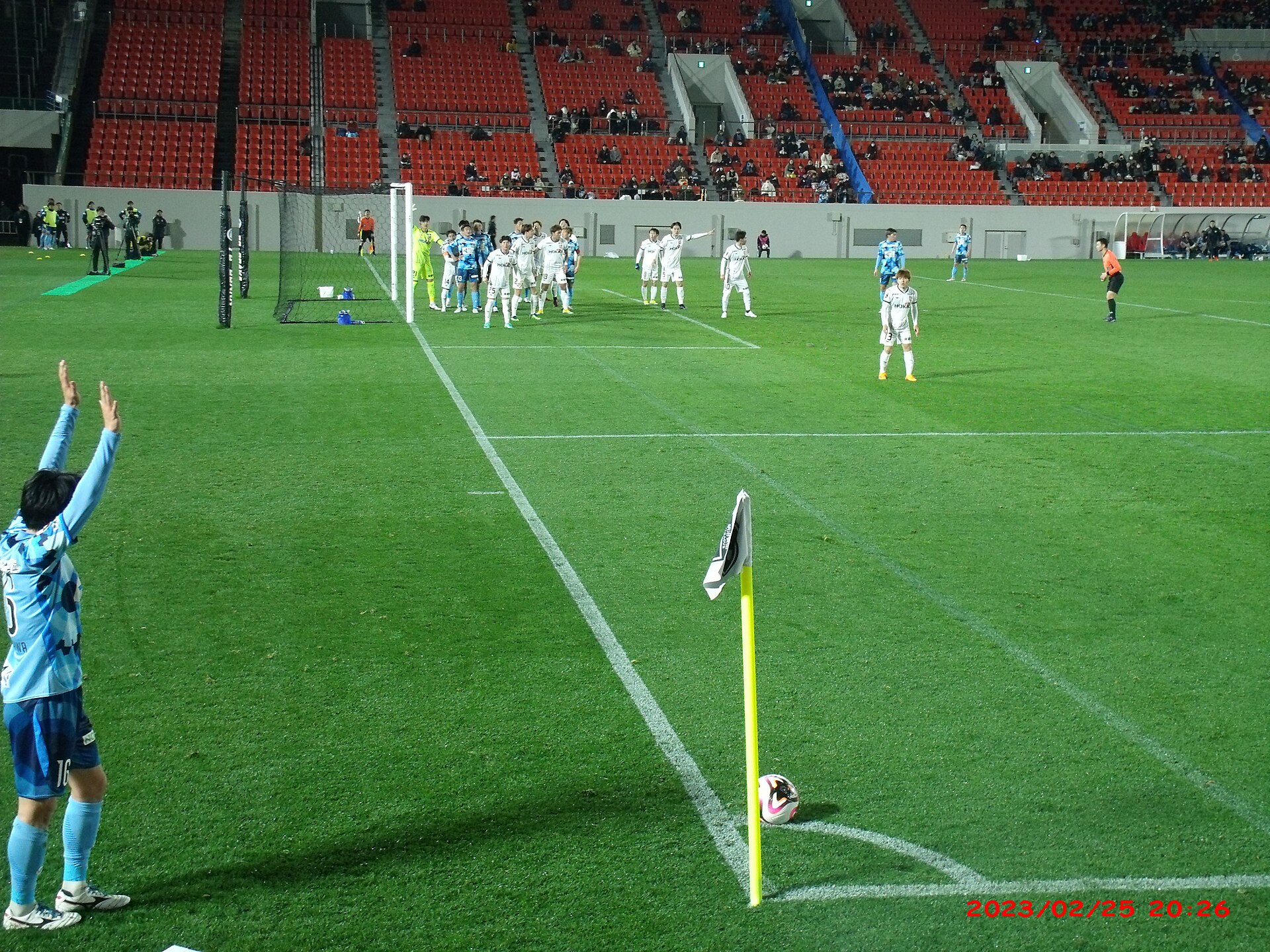
Six attacking players are visible in and around the box as the corner taker sets the ball, arranged in a loose cluster near the penalty spot rather than spread evenly across the width of the area. This clustering is itself a design choice, since spreading attackers evenly makes every individual run easier for a compact defense to track, while clustering forces defenders to briefly commit to zones rather than specific runners.
Two defenders are positioned at the near post, the specific pairing the routine is built to disrupt, while the remaining defenders hold a roughly zonal shape further from goal, a common setup against a cluster start precisely because it delays committing individual markers until the runs actually begin.
Frames two and three: the decoy runs begin
As the corner taker begins his run-up, two attackers peel away from the cluster toward the far post, a run with no realistic chance of receiving the actual delivery but every intention of pulling at least one covering defender away from the near-post zone the routine is actually targeting.
Both decoy runners commit fully and convincingly, at genuine pace, since a half-hearted decoy run is easily read and ignored by an organized defense. The value of a decoy run is measured entirely by whether a defender treats it as a real threat, and a defender who does not respect the run’s pace and conviction will simply stay in the near-post zone the routine needs vacated.
Frames four and five: the block at the near post
A third attacker moves directly across the path of the nearest near-post defender at almost exactly the moment the decoy runs draw the second defender’s attention away, creating a legal, stationary screen that the marking defender has to navigate around rather than run straight through. This block is the single most important action in the entire routine and the one a casual viewer is least likely to notice, since it produces no shot and touches no ball.
The block’s legality depends on timing and movement, not positioning alone: a stationary attacker in a defender’s path who has genuinely stopped moving toward the ball is within the rules, while the same positioning combined with an active push or extension toward the defender crosses into an offense. This routine’s block was built specifically to sit on the legal side of that line, costing the defender roughly a full second of delay rather than a whistle.
Frames six and seven: the delayed run and the delivery
The eventual scorer does not begin his run toward the target zone until after the block has already engaged the defender, a deliberate delay rather than a mistimed start. Arriving too early would have meant reaching the space before the defender was actually obstructed, allowing a recovery the routine is specifically built to prevent.
The delivery itself, struck at the exact moment the runner crosses into the vacated zone, is placed to the space the block created rather than simply toward the runner’s general position, a distinction that matters because a delivery aimed at a player rather than a zone fails the moment that player’s run is even slightly early or late relative to the ball’s flight.
Frames eight and nine: the finish and why the marking failed
The header itself, in isolation, looks like an unremarkable, unmarked finish from close range, exactly the kind of moment broadcast commentary describes as a simple defensive lapse. It was not a lapse. It was the final, visible step of a sequence in which every preceding action existed specifically to produce that one second of complete separation.
The defender’s failure to recover in time is frequently, and unfairly, treated as an individual error, when the frame-by-frame sequence shows a defender delayed by a legal block he had no realistic way to anticipate or avoid, given how convincingly the decoy runs had already drawn his teammates’ attention elsewhere.
Set piece routine breakdown: designing backwards from the target zone
The method this routine demonstrates works in the opposite order from how it is watched: a coaching staff first identifies the specific zone a defense is weakest in defending, based on scouting or, as in this case, patterns observed earlier in the same match, and only then designs the decoy runs and the block backward from that target, rather than starting with a generic routine and hoping it produces an opening somewhere.
Every non-scoring action in the sequence, both decoy runs and the block itself, exists purely to serve that single target zone. A routine designed forward from a generic starting shape, rather than backward from a specific target, tends to produce a plausible-looking sequence that nonetheless fails to create genuine separation anywhere specific, which is the difference between a rehearsed routine and a routine that merely looks rehearsed.
Why the same routine rarely works twice against the same opponent
A defense that concedes from a specific blocking pattern generally identifies and corrects it before the same fixture’s return leg or before facing that opponent again, assigning a specific defender to track through blocks more aggressively or adjusting marking assignments to reduce the exposure the routine exploited. This is why set piece coaches maintain a rotating library of routines targeting the same general zone through different specific mechanisms, rather than relying on one successful design indefinitely.
The nine-frame sequence examined here is best understood as a snapshot of one specific exploit rather than a permanent blueprint, valuable for what it teaches about method, target the weakness, build backward from it, disguise the mechanism, rather than as a routine to copy directly against a defense that has already seen it succeed once.
What the corner taker’s role reveals about the design
The delivery itself, examined on its own, looks unremarkable: a flat, driven ball rather than a looping, high cross, struck with pace toward the near-post area rather than floated for a contest. That choice of delivery type is itself part of the routine’s design rather than a separate decision made independently by the corner taker.
A driven, low delivery arrives too quickly for a recovering defender to adjust once the block has already cost him a step, while a slower, looping cross would give even a delayed defender enough time to recover position and re-establish his marking before the ball actually arrives at the target zone. The corner taker’s choice of pace and trajectory is therefore inseparable from the blocking action described earlier, both are solving the same specific problem, the recovering defender’s available time, from two different points in the sequence.
How this routine would have looked from the broadcast angle alone
A viewer watching only the standard broadcast angle, which typically follows the ball rather than tracking off-ball positioning, would have seen almost none of the mechanism described throughout this piece. The decoy runs occur outside the frame most broadcasts use for a corner kick, and the block itself happens in a crowd of players that a single wide camera rarely resolves clearly enough to show which specific contact actually caused the defender’s delay.
This is precisely why set piece analysis benefits from a dedicated tactical camera angle, positioned high and wide enough to capture the full width of the box before the delivery arrives, rather than the standard broadcast angle built to follow the ball and capture the eventual finish. Coaching staffs reviewing their own routines almost always use this wider, static angle rather than the broadcast feed, for exactly the reason this reconstruction demonstrates: the goal is the least informative part of the sequence to actually study.
Fans trying to study set pieces seriously from home footage face the same limitation without the same access to a corrected angle, which is one reason detailed frame-by-frame breakdowns like this one tend to circulate specifically among tactically minded viewers rather than casual highlight audiences. Reconstructing the sequence from still frames pulled at each key moment, rather than relying on the flowing broadcast footage alone, is the closest a viewer without access to the tactical camera can get to seeing what the coaching staff actually designed.
Frequently Asked Questions
What makes a blocking run at a corner legal rather than an offensive foul?
A stationary attacker who has genuinely stopped moving toward the ball, without pushing or extending toward the defender, is generally within the rules, while active contact or continued movement into the defender crosses into an offense.
Why do decoy runs matter if they never receive the ball?
A convincing decoy run forces a defender to commit attention and positioning to a threat that never materializes, which is precisely what creates the space the actual target run depends on.
Is timing or positioning more important for the runner who actually scores?
Timing, in most well-designed routines. Arriving in the right space too early or too late relative to the block and the delivery undoes the advantage the rest of the sequence worked to create.
Do professional teams design corner routines around a specific opponent’s weakness?
Yes, frequently, using scouting information or patterns observed earlier in the same match, rather than relying on one generic routine applied identically against every opponent.
Why do successful set piece routines usually stop working after one or two uses?
Opposing coaching staffs typically identify and correct the specific exploit once it succeeds, which is why attacking sides maintain several variations targeting the same general zone through different mechanisms.
Nine frames turned one ordinary-looking header into a case study in how little of a good set piece actually involves the ball. Almost everything that decided it happened before the delivery ever left the corner taker’s foot, in decisions made by players who never touched it at all.