The most useful sentence an athlete says all evening is usually spoken standing up, in a concrete corridor, with a bag over one shoulder and somebody’s recorder held over a barrier. It is rarely the sentence that leads the coverage, because the coverage was built around the podium, and the podium happened forty minutes later in a room with a backdrop.
Three separate settings produce quotes after a major fixture, and they are not variations of the same thing. They have different rules, different participants, different time limits and different levels of preparation, and each one systematically produces a different kind of answer.
Knowing which room a quote came from tells you a great deal about how much weight it can carry. It is also, for anybody working in the corridor, the difference between coming away with something and coming away with a transcript everybody else already has.
Three rooms, one athlete
- The flash. Seconds after the finish, on camera, to the broadcaster that paid for the event. Emotional, short, rarely informative.
- The corridor. A barriered walkway between the changing area and the exit. Standing, unstructured, and the most productive of the three.
- The podium. A seated conference with a moderator, a backdrop and a running order. The most quoted and the most managed.
- The order is fixed. Rights holders first, then the corridor, then the formal room, and the sequence itself shapes the answers.
- Obligation varies. Passing through is often required. Stopping to speak usually is not.
- The reason it works. Standing, unrehearsed, with an exit in sight, people answer the question they were asked.
What the corridor actually is
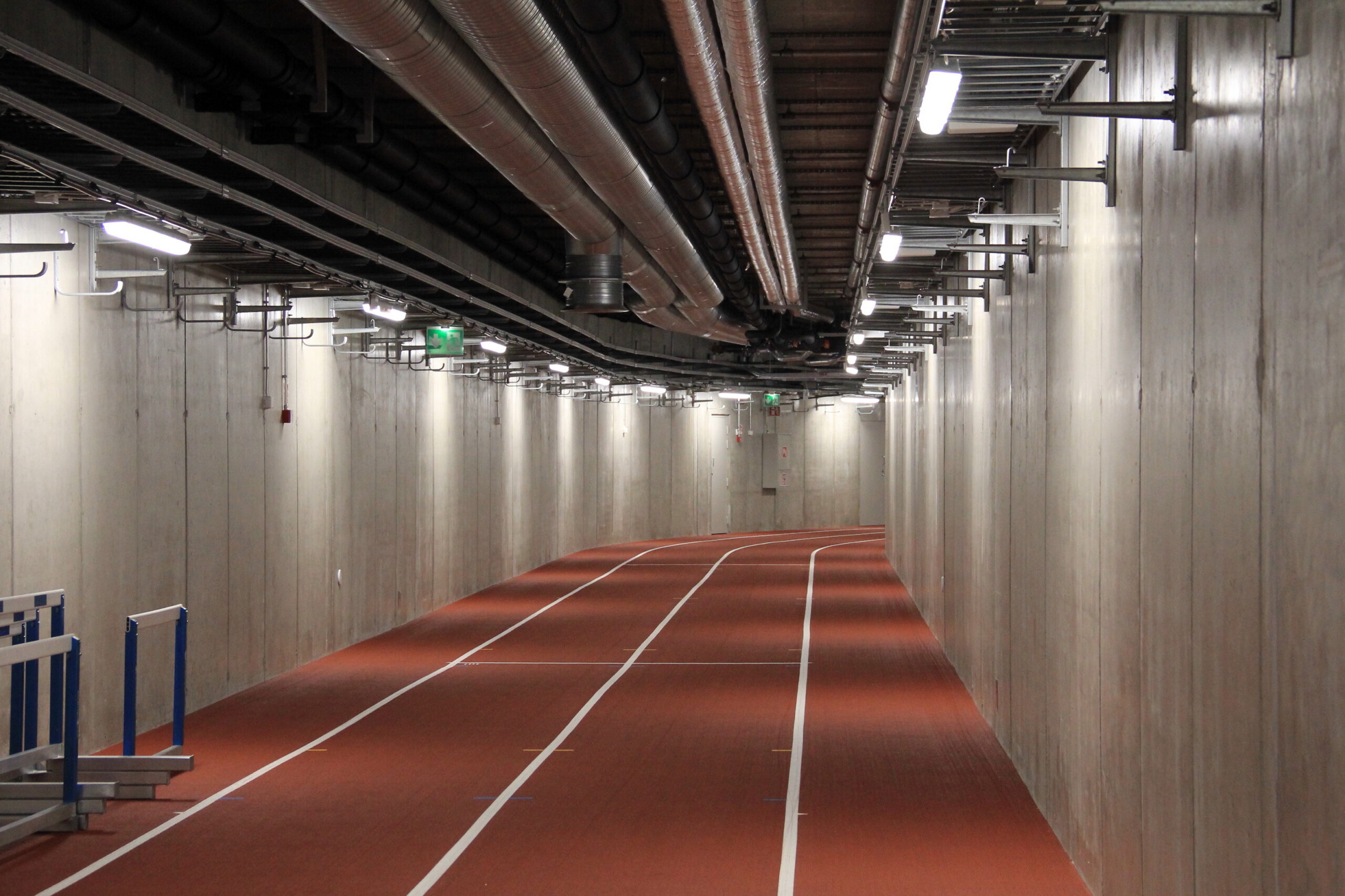
Physically it is unglamorous: a stretch of service passage between the dressing rooms and the team coach, divided by barriers, with reporters on one side and athletes walking down the other. Larger events run it in segments, with television positions first, then radio, then written press at the far end.
Its purpose is to guarantee access without requiring a formal session for everybody. Rather than obliging every athlete to sit at a table, the competition obliges them to pass through a space where accredited media are standing, and leaves the rest to negotiation. That is a lighter obligation on the athlete and a much broader one in terms of who gets a chance to ask.
The format is standard at major international competitions and it exists in some form almost everywhere the schedule is tight enough that formal sessions cannot cover the field. In events with dozens of competitors finishing within an hour, it is the only arrangement that works at all, which is why it is so closely associated with multi-sport competitions and major tournaments.
Who has to walk through it, and who does not
The rules differ by competition and they matter more than any technique. In many events, athletes are required to pass through the zone; in a smaller number they are required to stop for rights-holding broadcasters specifically. Almost nowhere are they required to answer a written-press question, and that gap is the entire craft.
Team sports and individual sports diverge sharply here. In team competitions the club often controls who is made available, and a press officer will walk a player through, sometimes steering them past particular positions. In individual sports the athlete decides alone, immediately after competing, with nobody managing the decision.
There are also legitimate reasons an athlete walks straight through, and they are worth stating because they are so often read as arrogance. Doping control has its own schedule and it is not negotiable. Medical attention takes priority. Some athletes have contractual obligations to appear elsewhere first, and some have simply been told by their federation to say nothing until a result is confirmed.
The mixed zone, position by position
Where you stand determines what you get, and experienced operators choose deliberately rather than taking whatever space is left.
The first positions belong to rights-holding broadcasters, and they are non-negotiable. Standing near them means competing with a camera, a light and a producer counting down, and an athlete in that section is performing rather than talking. The middle sections, usually radio and agency, are faster and more transactional: short questions, short answers, a lot of movement.
The written-press section at the far end is where the useful work happens. By the time an athlete reaches it, the camera is off, the adrenaline has dropped a little, and the questions can be longer than one clause. It is also the section most likely to be skipped, which is the trade: better conditions, lower probability of anybody stopping.
The flash interview, and why the rights holder goes first
The interview conducted within seconds of the finish exists because a broadcaster paid for it. Access rights are part of what a rights package buys, and immediacy is the product: the audience is still watching, and the value of the answer decays quickly.
That produces a predictable kind of exchange. The athlete is out of breath, has not seen a replay, and does not yet know the result of anything happening elsewhere. Questions are short and largely emotional because nothing else is answerable in that state, and the answers reflect it.
Reading these as evidence of anything is a mistake reporters make less often than audiences do. An athlete who says something ungenerous ninety seconds after losing has said something ungenerous ninety seconds after losing, and treating it as a considered position ignores the conditions under which it was produced. The commercial logic behind the arrangement is the same one that governs most of what a rights package is actually buying.
The formal conference, and what a podium changes
By the time a formal session begins, several things have happened. The athlete has showered, spoken to at least one broadcaster, probably seen a replay, and in team sport has usually spoken to a press officer about what is and is not being discussed.
The room itself changes the answers. Sitting down lengthens them. A moderator choosing who speaks removes the follow-up, because the next question typically goes to a different person on a different subject. A microphone and a backdrop signal that this is a record rather than a conversation, and people speak differently when they know it is.
None of that makes the format useless. It is the right setting for questions that need a considered answer, for anything that requires precision, and for subjects where an off-the-cuff response would be unfair to the person answering. It is simply the wrong setting to expect candour from.
Why the least formal setting produces the best quotes
Four mechanical reasons, none of them about personality.
The first is the absence of a moderator. In a corridor, whoever asks can ask again, and the follow-up is where an interview actually happens. The second is standing. Standing conversations are shorter, less rehearsed and less structured than seated ones, and they do not invite a prepared paragraph.
The third is that the audience is small and visible. An athlete talking to four people leaning over a barrier is talking to four people. On a podium, the room is a proxy for an audience of millions, and the answer is calibrated for the larger one. The fourth is timing. Between the flash interview and the formal room, an athlete has had enough distance to think and not yet enough time to be briefed, and that window is narrow and productive.
There is a fifth reason that is easy to miss because it looks like a disadvantage. The corridor has no agenda. Nobody has decided in advance what the session is about, so the subject is whatever the first question raises, and an athlete who has spent the previous ten minutes anticipating questions about one thing will frequently answer a question about something else without any of the preparation attached.
The limit on all of this is that none of it is guaranteed. An athlete can walk the whole length of the corridor without breaking stride, and on any given evening most of them do. The format trades reliability for quality, which is exactly the opposite trade from the podium, and a newsroom that plans around only one of the two will regularly come away with nothing.
Time limits, and how they shape a question
Everything in the corridor is governed by the fact that the person you are speaking to is walking. There is no allotted slot; there is however long they choose to stand there, which is frequently under a minute.
That has direct consequences for how questions have to be built. Long preambles consume the entire interaction. Multi-part questions get one part answered, usually the easiest. Questions that require the athlete to remember a statistic produce a hedge, because they have not seen a stat sheet.
The questions that work are short, specific and about something the athlete definitely knows: a decision they made, a moment they were involved in, a change they noticed. Anything requiring an overview belongs in the formal room, where there is time for it and where the person answering has had a chance to form one.
Three settings on five criteria
| Criterion | Flash interview | Mixed zone | Formal conference |
|---|---|---|---|
| Timing | Seconds after finishing | Fifteen to forty minutes after | Thirty minutes to over an hour |
| Who gets access | Rights holders only | All accredited media | All accredited media |
| Follow-up possible | Rarely | Yes, and it is the point | Almost never |
| Preparation by the athlete | None | Little | Substantial |
| Best used for | Immediate reaction | Detail and process | Considered positions and sensitive subjects |
| Main risk | Overreading an emotional answer | Getting nothing at all | Receiving a prepared line |
The bottom row is the one worth memorising. Each setting fails in its own characteristic way, and knowing which failure you are exposed to changes how much confidence a quote deserves.
Working the corridor without becoming a nuisance
The professional standards here are informal and enforced socially, which means they are learned by watching. A few hold everywhere.
Ask by name, and ask one question. Do not block a colleague’s recorder or talk across an answer that is already in progress. Do not chase somebody who has declined, and do not treat a decline as material. If an athlete has just lost something significant, the question that acknowledges it is more likely to get an answer than the question that ignores it.
Two things are genuinely off-limits rather than merely impolite. Questions about a medical condition an athlete has not disclosed put the person in an impossible position, and questions designed to produce a reaction to something they have not been told about are a form of ambush. The ethical guidance published by organisations such as the Poynter Institute is written for a wider profession, and it applies here without much translation.
What a reader should know about where a quote came from
Very little coverage attributes a quote to its setting, and it would be better if more did. A line from a corridor and a line from a podium carry different weight, and the reader has no way of knowing which they are looking at.
Some conventions help. Reporting that an athlete spoke after the match, as distinct from spoke at a press conference, signals the difference to anybody who knows the formats. Where an answer came from a broadcast interview, saying so is both accurate and fair to the broadcaster who arranged it.
The reason this matters is that the same words mean different things in different rooms. An unguarded sentence in a corridor is a person thinking out loud; the same sentence delivered from a podium is a position. Careers have been reshaped by the second kind, and the archive of how great players are remembered is built partly out of quotes whose original setting nobody records.
Frequently Asked Questions
Are athletes obliged to answer questions in the corridor?
Usually they are obliged to pass through it, and usually they are not obliged to stop, except sometimes for rights-holding broadcasters. The precise requirement is set by the competition and it varies widely, which is why the same athlete appears cooperative at one event and unavailable at another.
Why do broadcasters get access first?
Because immediacy is part of what a rights agreement buys, and the value of an immediate reaction falls quickly. The order is contractual rather than a judgement about which outlet matters more, and it is one of the few things in the corridor that is genuinely fixed.
Is the corridor recorded?
By everyone standing in it, and that is understood by all parties. What is not always understood is that a comment made to one reporter in a shared space is available to all of them, which is why the phrase off the record has very little meaning in a barriered walkway.
Does the format work for every sport?
It works best where many athletes finish in a short window and formal sessions are impossible. In sports with one fixture and two teams, the formal conference does more of the work and the corridor is supplementary. Neither format is a substitute for a scheduled sit-down interview arranged separately.
What is the most common mistake made there?
Asking a question that has already been answered on camera. An athlete who has just given the same reaction to a broadcaster will repeat it, and the interaction is spent. Listening to the flash interview before the athlete arrives is the cheapest possible preparation and it is skipped constantly.
The next time a quote reads as unusually direct, look for where it was taken. If the athlete was standing, holding a bag, forty minutes after finishing, that is the reason, and it is worth more than anything said into a microphone on a table.